Email Automation Tools: The Ultimate Guide to Choosing and Implementing the Best Email Automation Tools for Small Businesses
Email Automation Tools: The Ultimate Guide to Choosing and Implementing the Best Email Automation Tools for Small Businesses
Estimated reading time: 9 minutes
Key Takeaways
- Time Savings: Automate routine tasks like welcome emails, follow-ups, and promotional sequences
- Improved Engagement: Deliver perfectly timed, personalized content based on user behavior
- Better ROI: Increase conversion rates through targeted messaging and optimal send times
- Scalability: Grow your email marketing efforts without proportionally increasing workload
Studies show that automated emails generate 320% more revenue than non-automated emails, making them invaluable for small businesses looking to grow efficiently. 320% more revenue from automated emails can be achieved with the right tools.
Related reading: Automate small business processes
Table of contents
Why Email Automation is Essential for Small Businesses
Email automation transforms how small businesses approach marketing by eliminating repetitive tasks and ensuring consistent communication with audiences. Here’s why it’s crucial:
- Time Savings: Automate routine tasks like welcome emails, follow-ups, and promotional sequences
- Improved Engagement: Deliver perfectly timed, personalized content based on user behavior
- Better ROI: Increase conversion rates through targeted messaging and optimal send times
- Scalability: Grow your email marketing efforts without proportionally increasing workload
Studies and industry data support the ROI benefits of automation. For example, see the ROI findings here: ROI findings.
Related reading: Automate small business processes
Best Email Automation Tools (2025 Landscape)
Let’s explore the top email automation tools available today:
MailerLite
- MailerLite — Perfect for beginners and small businesses
- User-friendly drag-and-drop builder
- Strong free plan with basic automation features
- Excellent value for growing businesses
Related reading: No-Code/Low-Code Automation Tools – No-Code/Low-Code Automation Tools
ActiveCampaign
- ActiveCampaign — Advanced automation capabilities
- Robust CRM integration
- Detailed behavior tracking
- Ideal for businesses needing sophisticated workflows
Agency automation focus: GoHighLevel features and benefits – GoHighLevel
Selzy
- Selzy — Competitive pricing
- Intuitive user interface
- AI-powered content assistance
- Strong personalization features
No-code/Low-code workflows: No-Code/Low-Code Automation Tools
Moosend
- Moosend — User-friendly automation builder
- Advanced segmentation capabilities
- Auto-resend functionality
- Solid ecommerce integrations
No-code/Low-code workflows: No-Code/Low-Code Automation Tools
ConvertKit
- ConvertKit — Ideal for content creators and bloggers
- Clean, minimalist email templates
- Intuitive automation workflows
- Strong focus on subscriber engagement
Mailchimp — Versatile platform for various business types
Additional reading: Introduction to Business Automation – Introduction to Business Automation
[CONTINUED IN NEXT PART DUE TO LENGTH RESTRICTIONS]
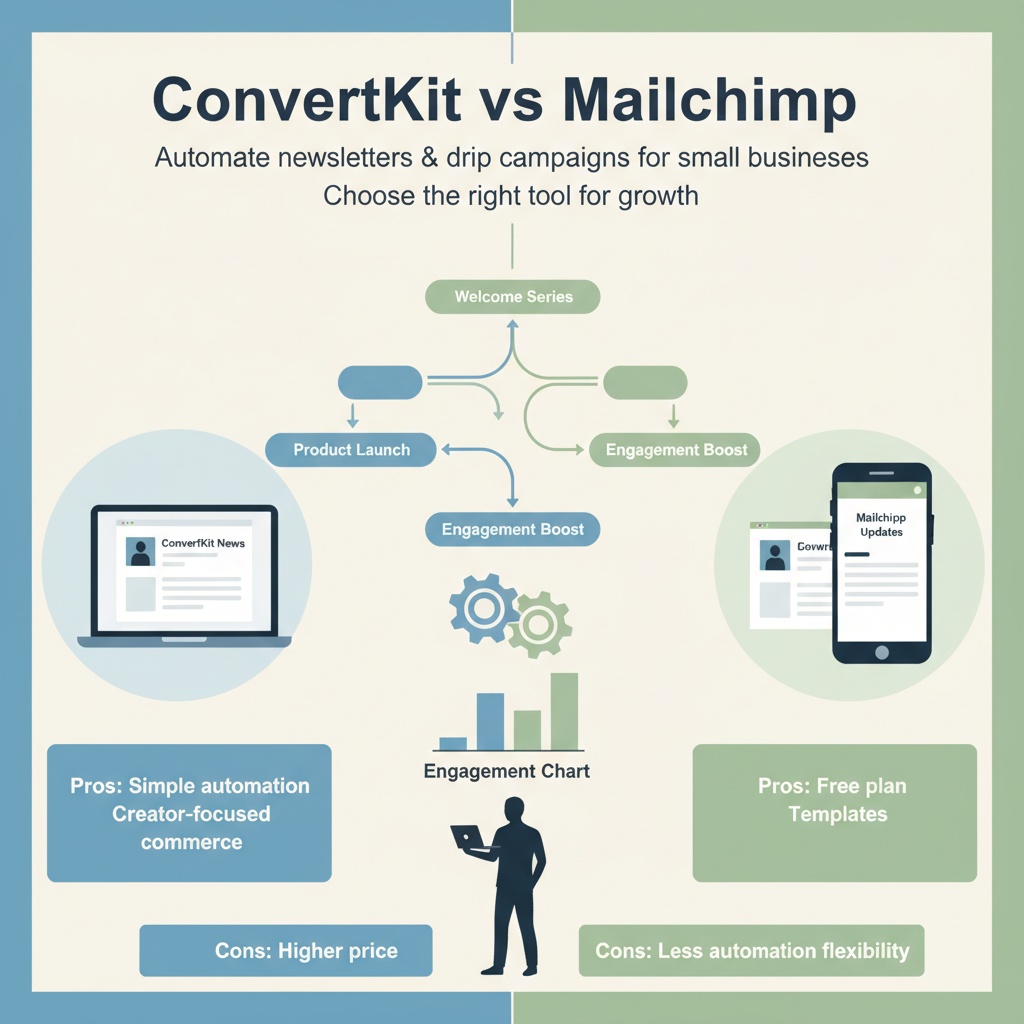
ConvertKit vs Mailchimp for Small Businesses
When comparing these popular platforms, consider the following points:
- ConvertKit — Ideal for content creators and bloggers with clean templates and intuitive automation.
- Mailchimp — Versatile platform with an extensive template library and broad analytics.
Comparison Table:
| Feature | ConvertKit | Mailchimp |
|---|---|---|
| Ease of Use | Very High | High |
| Automation Depth | Medium | High |
| Template Variety | Limited | Extensive |
| Pricing Structure | List-based | Contact-based |
| Best For | Content Creators | Small Businesses |
Additional reading: Introduction to Business Automation – Introduction to Business Automation
[CONTINUED IN NEXT PART DUE TO LENGTH RESTRICTIONS]
Additional reading
For more on automation in business processes, see the primer here: Introduction to Business Automation.
Frequently Asked Questions
Is email automation worth the investment for small businesses?
Yes. When implemented with clear goals, segmentation, and a well-designed onboarding sequence, email automation can deliver strong ROI and measurable growth. Start small with a welcome series and nurture campaigns, then expand based on results.
How do I choose an email automation tool?
Consider ease of use, automation depth, CRM integrations, deliverability, reporting, and price. Try free plans or trials, and evaluate how well the tool fits your current tech stack.
Can I integrate email automation with my CRM?
Most tools offer CRM integrations or native CRMs. Ensure data synchronization, lead scoring alignment, and a smooth workflow between marketing and sales teams.
What is a good onboarding sequence?
Begin with a welcome email, followed by product onboarding steps, value-driven content, and a check-in after a few days. Tailor the timing based on engagement data.
What about pricing?
Pricing varies by contact count and features. Look for transparent tiering and potential add-ons; many tools offer scalable plans suitable for small businesses and growing teams.
How do ConvertKit and Mailchimp compare?
ConvertKit shines for creators with clean templates and simple automation; Mailchimp offers a broader feature set, templates, and analytics, suitable for a wider range of business types. Evaluate based on your use case and team capabilities.