How to Scale Your Business Using Automation
How to Scale Your Business Using Automation
Estimated reading time: 8 minutes
Key Takeaways
- Automation frees up human resources for strategic work and enables faster scaling with reduced costs.
- Understand the core categories of automation to target high-impact areas in your business.
- Start small with basic automation and progressively expand to workflows and end-to-end processes.
- Leverage time-saving hacks to realize quick wins across CRM, marketing, and operations.
- Scale a service-based business, such as an agency, by automating lead gen, onboarding, project management, and reporting.
Table of contents
In today’s fast-paced business landscape, automation is a strategic lever for sustainable growth. Scale your operations by using technology to handle repetitive tasks, freeing resources for strategic initiatives and faster execution. This guide breaks down what automation is, how complex it can be, and how to apply it across your organization.
Understanding Automation
Business automation encompasses technologies and strategies designed to execute recurring tasks and processes with minimal human intervention to improve efficiency, reduce errors, and scale operations. To effectively leverage automation for growth, it’s essential to understand its various categories and complexity levels.
Core Categories of Business Automation:
- Operational Automation
Handles day-to-day activities like inventory control and order fulfillment
Ensures smooth workflow in supply chain logistics
Reduces manual effort in routine operations - Financial Automation
Streamlines invoicing and payroll processes
Automates budgeting and compliance tasks
Minimizes errors in financial operations - Customer Service Automation
Implements chatbots and automated ticketing systems
Utilizes AI-powered virtual assistants
Improves response times and customer satisfaction - Human Resources Automation
Streamlines recruitment and onboarding processes
Automates performance tracking
Enables HR teams to focus on strategic initiatives
Automation Complexity Levels:
- Basic Automation
Simple, repetitive tasks requiring minimal coding
Uses basic BPM tools
Perfect starting point for automation beginners - Task Automation
Eliminates manual actions like email sending
Automates document generation
Focuses on individual task improvement - Workflow Automation
Connects multiple tasks in a sequence
Combines automated and manual processes
Creates efficient process flows - Process Automation
Implements end-to-end automation
Connects multiple workflows
Provides comprehensive business solutions - Robotic Process Automation (RPA)
Utilizes software bots for structured tasks
Handles data retrieval and transfer
Perfect for repetitive, rule-based processes - Intelligent Automation
Combines AI, machine learning, and RPA
Handles complex decision-making
Adapts to changing conditions
Benefits of Automation for Business Growth
Automation plays a crucial role in enhancing productivity by eliminating repetitive manual tasks and reducing errors. This freedom allows employees to focus on strategic initiatives that drive business growth.
Key Benefits:
- Lower Operational Costs
– Reduced manual labor requirements
– Fewer errors requiring correction
– Improved resource allocation - Enhanced Efficiency
– Faster task completion
– Consistent process execution
– Reduced bottlenecks - Revenue Growth Through:
– Accelerated order fulfillment
– Improved customer service
– Better client retention
– More accurate decision-making
– Enhanced profit margins
Time-Saving Automation Hacks for Businesses
Quick-win automation strategies can provide immediate benefits with minimal technical expertise. Here are practical automation hacks any business can implement:
- Customer Relationship Management
– Implement automated customer tracking
– Set up automated follow-up sequences
– Use tools like HubSpot or Salesforce - Email Marketing Automation
– Schedule campaigns in advance
– Implement customer segmentation
– Use personalization tools
– Recommended tools: Mailchimp, ActiveCampaign - Social Media Management
– Schedule posts in advance
– Automate engagement monitoring
– Use tools like Buffer or Hootsuite - Appointment Management
– Implement automated booking systems
– Set up reminder sequences
– Reduce no-shows through automation
Pro Tip: Start with high-frequency, low-complexity tasks to build confidence in automation systems.
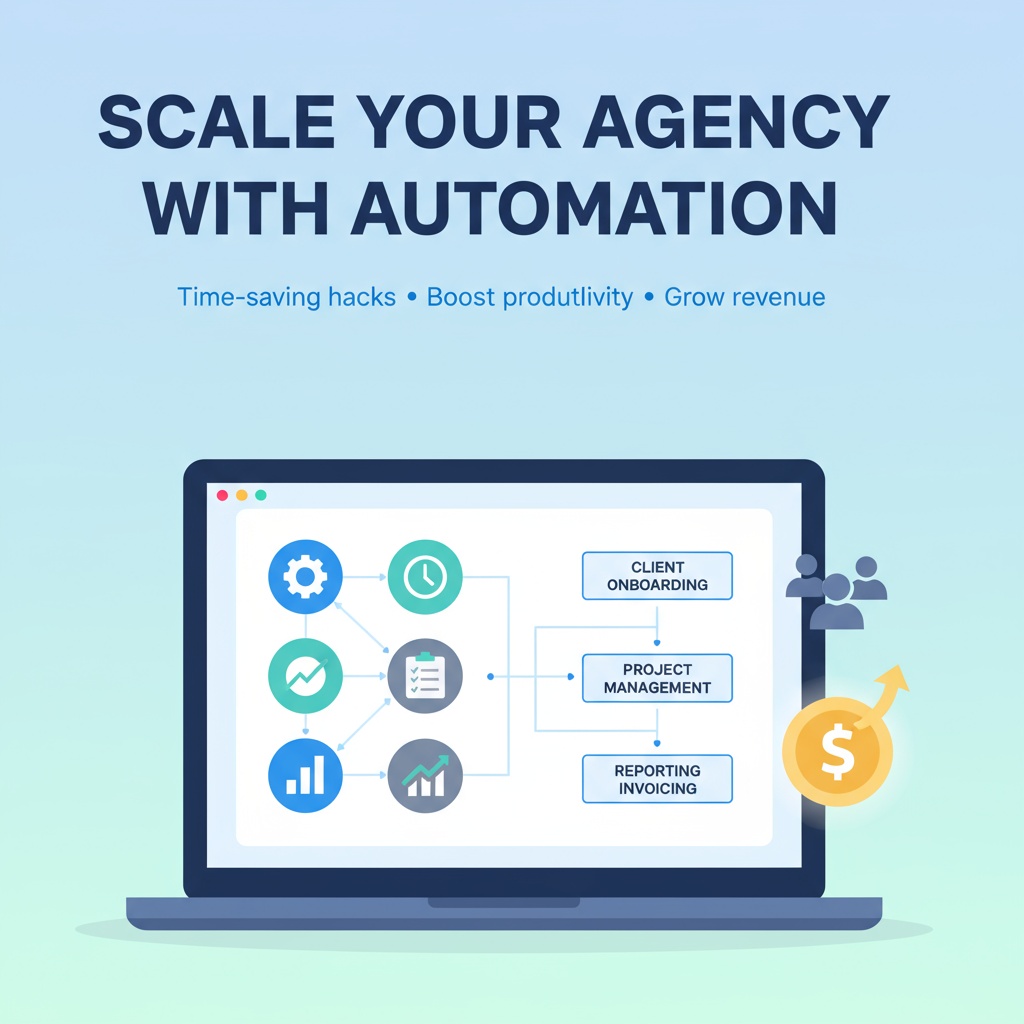
Scaling Your Agency with Automation
Agencies can leverage automation to achieve significant growth without proportional resource increases. Here’s how:
Key Areas for Agency Automation:
- Lead Generation
– Automated lead capture forms
– Lead scoring and qualification
– Follow-up sequences - Client Onboarding
– Automated welcome sequences
– Document collection
– Project setup workflows - Project Management
– Automated task assignment
– Progress tracking
– Client communication
– Tools: Asana, Monday.com - Reporting
– Automated data collection
– Report generation
– Client dashboard updates
Essential Agency Tools:
- Project management platforms with automation
- Proposal automation (PandaDoc, DocuSign)
- Marketing automation tools
- Social media management platforms
Implementing Automation in Your Business Strategy
To successfully integrate automation into your business, follow these strategic steps:
- Process Mapping
– Identify repetitive tasks
– Document current workflows
– Spot automation opportunities - Prioritization
– Focus on high-impact processes
– Consider implementation complexity
– Evaluate potential ROI - Implementation Steps:
a) Start with basic automation
b) Build user confidence
c) Expand to workflow automation
d) Implement process automation
e) Consider intelligent automation - Tool Selection Criteria:
– Compatibility with existing systems
– Scalability potential
– Ease of use
– Support availability
– Cost-effectiveness - Change Management:
– Provide adequate training
– Set clear expectations
– Monitor adoption rates
– Gather feedback
– Make necessary adjustments
Remember: Keep human judgment for tasks requiring creativity or complex decision-making.
Conclusion
Scaling your business using automation is no longer optional in today’s competitive landscape. By implementing automation strategically, businesses can achieve sustainable growth through increased productivity, reduced costs, and enhanced revenue potential. The key is to start small, focus on high-impact areas, and gradually expand automation across the organization. Remember that automation is about enabling humans to focus on strategic, value-adding activities, not replacing them.
Frequently Asked Questions
Is automation only for large enterprises?
Not at all. Start with simple, high-impact tasks and scale as you gain confidence. Many small businesses benefit from even basic automations that streamline repetitive processes.
What is the first step to start automating my business?
Map your existing processes to identify repetitive tasks, then prioritize opportunities based on impact and feasibility. Start with a small pilot to validate the approach.
Which areas should I automate first in an agency?
Lead generation, client onboarding, project management, and reporting are typically high-impact areas that can unlock quick wins and compound returns.
How do I measure the ROI of automation?
Track metrics such as time saved, error reduction, cycle time, and revenue impact. Compare pre- and post-automation performance to quantify value.