What Is West Co? Meet the Founders Reimagining Social Media
You know that feeling when you open Instagram “just for a second” and suddenly it’s been 45 minutes? Yeah. We’ve all been there.
Social media promised to connect us. But here’s the thing — 15 years later, we’re more anxious, more distracted, and honestly more addicted than ever. We’re spending hours scrolling through algorithm-driven feeds that seem designed to keep us hooked, not happy.
The numbers are staggering. Facebook has 2.9 billion users. Instagram and TikTok have become the default way an entire generation communicates. And while 65% of the global population is now on social media, most of us feel… trapped. The platforms prioritize engagement over well-being, rage-baiting over real connection. And the alternatives? BeReal had its moment. Mastodon tried. But sustainable traction has been elusive.
Enter West Co — a startup founded by Twitter co-founder Biz Stone and Pinterest co-founder Evan Sharp. They’ve raised $29 million in seed funding. And their new app, Tangle, promises something different: an “intention-first feed” that puts you back in control.
Can they actually pull this off? Let’s dig in.
What Is West Co? Meet the Founders Reimagining Social Media
West Co isn’t just another startup with big promises. Look at who’s behind it.
Biz Stone helped build Twitter from the ground up. He understands how social platforms scale, how communities form, and — crucially — how things can go wrong. Evan Sharp co-founded Pinterest, creating a visual discovery platform that actually felt different from the feed-based chaos everywhere else. These aren’t outsiders throwing darts at a problem. They’ve lived inside the machine.
Their mission statement is refreshingly blunt. Stone has talked about addressing the “terrible devastation of the human mind and heart” caused by current social media. Not the most uplifting tagline, but it’s honest. And honestly? That candor matters.
West Co is the parent company. Tangle is their flagship product — a social app launching in late 2025 with invite-only access initially. The approach mirrors how Twitter and Pinterest both started: small, controlled, focused on getting the core experience right before opening the floodgates.
I’ve seen this pattern before. The best social platforms don’t try to be everything to everyone on day one. They nail one thing, build a devoted early community, then expand. Stone and Sharp know this playbook intimately.
What’s different this time? They’re explicitly designing against the addictive patterns they helped create. That’s either the most credible pivot in tech or the most ironic. Probably both.
The $29 Million Bet: Why Investors Are Backing West Co
Twenty-nine million dollars for a seed round. That’s not normal.
Most seed funding rounds hover in the low single-digit millions, according to PitchBook data. West Co raised nearly 10x that amount. Spark Capital led the round — a firm with a solid track record in social and consumer tech. So what do they see?
The market opportunity is massive. Social media has 65% global penetration, but user satisfaction is at an all-time low. There’s a genuine hunger for alternatives. The problem is that building alternatives is brutally hard. Network effects are real. Switching costs are high. And users have tried “better” platforms before, only to drift back to Instagram or TikTok because that’s where everyone else is.
But here’s why the investor thesis makes sense: the founders’ credibility buys them something invaluable — trust. When Biz Stone and Evan Sharp say they’re building humane social media, people actually listen. That’s worth millions in free press and early adopter enthusiasm.
The funding also signals something else. West Co isn’t under pressure to grow at all costs immediately. A $29 million runway means they can experiment, iterate, and prioritize user experience over user acquisition. That’s rare in startup land, where the default mode is “grow or die.”
Compare this to BeReal, which raised significantly less and felt constant pressure to maintain viral growth. Or Mastodon, which operates on donations and volunteer labor. West Co has resources to actually compete — to build robust moderation tools, hire top designers, and weather the inevitable rough patches.
Will it be enough? That depends entirely on execution.
Tangle’s Intention-First Feed: How It Actually Works
Okay, so what does “intention-first” actually mean? Because I’ll be honest — it sounds like marketing speak.
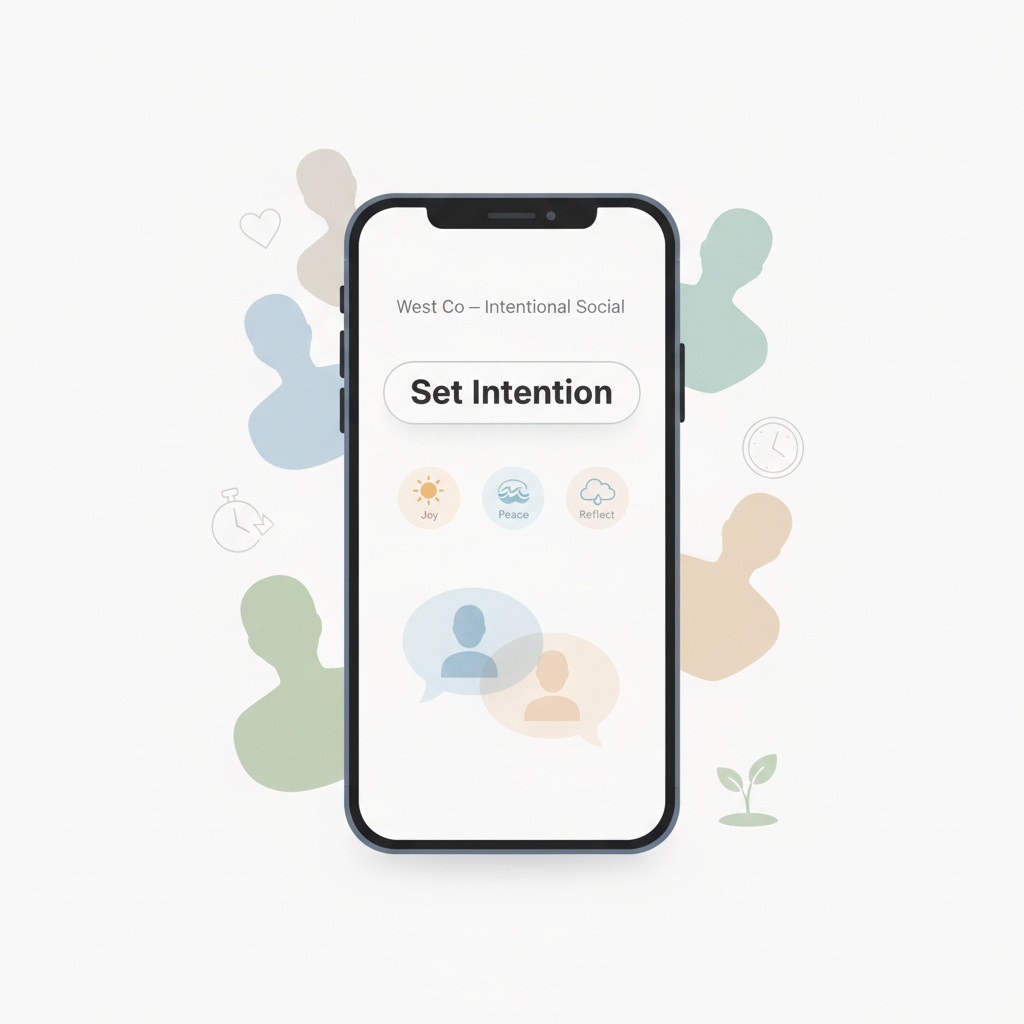
But the concept is simpler than it sounds. Instead of opening an app and getting hit with whatever the algorithm thinks will keep you scrolling, Tangle asks you to set an intention first. What are you here for? Morning motivation? Catching up with close friends? Looking for creative inspiration? Evening relaxation?
Your feed adjusts based on that intention. And here’s the key part — the rankings are explainable. You can see why you’re seeing what you’re seeing. No black box algorithm mystery.
Traditional platforms need you to post constantly. Hootsuite’s 2025 data shows brands need 48-72 posts weekly just to maintain visibility. That’s exhausting. And it creates this content saturation where everything feels like noise. Tangle’s approach is different — it’s designed around private circles by default, with chronological options when you want them.
Let me give you a practical example. Say you open Tangle in the morning and select “Morning motivation.” The app shows you posts from friends who energize you, maybe some inspirational content you’ve saved, perhaps updates from creative projects you’re following. But it limits the session. You’re not falling down an infinite scroll rabbit hole.
Later, you open it again with “Evening relaxation” as your intention. Different content, different vibe, different pace. The feed adapts to what you need, not what maximizes engagement metrics.
The technical approach matters too. Tangle is building in friction — the good kind. Rate limits on posting. Deliberate pauses in scrolling. Features that encourage you to close the app and go live your life. These are anti-patterns in traditional social media design, where every feature is optimized to increase time on site.
Will users actually embrace this? That’s the billion-dollar question. We say we want healthier social media. But our behavior often tells a different story.
Learning from Failure: Why Past Social Media Alternatives Didn’t Stick
Let’s talk about the graveyard of “better” social networks. Because it’s long and instructive.
Path tried privacy-first social media back in 2010. Limited to 150 friends — Dunbar’s number, the theoretical limit of meaningful relationships. Beautiful design. Thoughtful features. It shut down in 2018. Why? Network effects crushed it. Your 150 closest friends weren’t on Path. They were on Facebook.
Ello launched in 2014 as the ad-free alternative. Their manifesto literally said “You are not a product.” Users loved the idea. But here’s the problem — without advertising revenue, how do you sustain operations? Ello pivoted to a niche creator network and faded from mainstream consciousness.
BeReal is the more recent cautionary tale. Remember the hype? Authentic, unfiltered moments. Post once daily when the notification hits. No algorithms, no filters, no BS. It went viral in 2022. And then… engagement plateaued. Turns out, the novelty wore off. Users got notification fatigue. The lack of content discovery made it feel empty.
Mastodon tried decentralization. No single company controls it. Choose your server, set your own rules. It’s technically impressive. But moderation became a nightmare across thousands of independent servers. The user experience felt fragmented. And most people just wanted something that worked simply.
So what’s West Co doing differently?
First, they’re not rejecting algorithms entirely — they’re making them explainable and controllable. Second, they have a clear monetization strategy from the start (more on that next). Third, they’re building moderation and safety in from day one, not bolting it on later. And fourth — this matters — they have founder credibility that opens doors.
But here’s what worries me: every failed alternative also had smart people, good intentions, and initial enthusiasm. Execution is everything.
Safety, Privacy, and Monetization: West Co’s Strategic Approach
You can’t build humane social media without solving three core problems: safety, privacy, and money. Let’s break down how West Co is approaching each.
On safety, they’re implementing what they call “safety-by-design” principles. Proactive content filters, not just reactive reporting. Rate limits that prevent harassment campaigns. Smaller circles by default, which naturally reduce exposure to abuse. The goal is to reduce abuse reports before they even happen — not just respond faster when they do.
Privacy-wise, Tangle is built on data minimization. They’re collecting less information, storing it for shorter periods, and giving users actual control over what’s shared. This isn’t just good ethics — it’s smart business. With the EU Digital Services Act and similar regulations worldwide, privacy-first design is becoming table stakes.
Now for the tricky part: monetization. West Co is betting on subscriptions, not advertising. Here’s why that matters.
Advertising-based social media creates perverse incentives. You need maximum engagement, which means addictive design. You need maximum data collection, which means privacy invasion. You need maximum scale, which means moderation becomes impossible. It’s a race to the bottom.
Subscription models flip the incentives. Your customer is the user, not the advertiser. You succeed by making users happy enough to pay, not by keeping them scrolling endlessly. The challenge? Convincing people to pay for something they’ve gotten “free” for 15 years.
I’ve seen subscription social platforms work in niche contexts — professional networks, creator communities, specialized forums. But at scale? That’s unproven territory. West Co will likely offer a free tier with limitations and paid tiers with advanced features. Maybe custom analytics, enhanced privacy controls, or premium customization options.
The key is making the free tier good enough to attract users but the paid tier compelling enough to convert them. That’s a delicate balance. Too restrictive on free, and you never build critical mass. Too generous, and nobody pays.
Success Metrics That Matter: Measuring Humane Social Media
Here’s where things get really interesting. How do you measure success when you’re explicitly not optimizing for engagement?
Traditional social media metrics are all about more. More daily active users. More time on site. More posts, more likes, more shares. These metrics made sense when the goal was growth at all costs. But they’re terrible proxies for user well-being.
West Co is proposing different KPIs. Shorter session times — not longer. Improved user mood after using the app. Lower abuse reports. Higher quality connections, even if there are fewer total interactions. These are harder to measure, but they’re more honest about what actually matters.
Think about it this way. Would you rather spend 3 hours on a platform feeling anxious and empty? Or 20 minutes feeling connected and energized? Traditional metrics say the first scenario is better. That’s insane.
To make this credible, West Co needs independent audits. Self-reported well-being metrics are nice, but they need third-party verification. Partner with researchers. Publish data openly. Invite scrutiny. That transparency builds trust in a way that marketing claims never can.
I’m also watching retention rates closely. Subscription-based apps typically have better retention than ad-based ones because the relationship is clearer. You’re paying for value, not being farmed for attention. But converting free users to paid subscribers at scale? That’s the ultimate test.
The dashboard showing “time saved” versus “time spent” is brilliant if they execute it well. Imagine opening your weekly summary and seeing: “You spent 2 hours on Tangle this week. The average user spends 14 hours on Instagram. You saved 12 hours.” That’s powerful messaging.
Will Tangle Succeed? Expert Predictions and What to Watch
Let’s be real — predicting the success of social platforms is notoriously difficult. Friendster seemed unstoppable until it wasn’t. Google+ had every advantage and failed spectacularly. Snapchat was written off as a sexting app before it became essential for Gen Z.
But we can identify critical success factors for West Co.
First, the private-by-default approach needs to work from day one. If early users feel isolated or can’t find their friends, they’ll bounce immediately. Network effects work both ways — they can accelerate growth or kill it.
Second, the intention-setting feature needs to feel natural, not like homework. If it’s too many taps, too much friction, too much thinking — users will skip it. And once they’re skipping it, you’ve lost the core differentiator.
Third, content moderation must be excellent. One high-profile harassment case or safety failure, and the “humane social media” brand is toast. The bar is higher precisely because the promises are bigger.
Fourth, monetization timing matters enormously. Launch too early with subscription pressure, and you alienate users. Wait too long, and you burn through that $29 million runway without proving the business model works.
The competitive landscape in 2025 is both challenging and opportune. Facebook’s 2.9 billion users represent an enormous moat. But user satisfaction is low. TikTok faces regulatory uncertainty. Instagram is increasingly seen as inauthentic. There’s an opening — but it’s narrow.
Market timing might actually be perfect. We’re seeing content experimentation trends across platforms. AI-driven efficiency is making it easier to build sophisticated features with smaller teams. And there’s genuine cultural appetite for alternatives.
What would success look like? Honestly, it doesn’t need to be Facebook-scale. If Tangle reaches 50-100 million users who genuinely prefer it and pay for it — that’s a massive win. That’s a sustainable business and proof that humane social media can work.
What would failure look like? Slow user growth leading to a quiet pivot. Or rapid growth followed by the same old problems — harassment, misinformation, addiction — proving that founder intentions don’t overcome structural incentives.
My prediction? Tangle will attract a devoted early community. The challenge will be expanding beyond that core without compromising the principles. That’s where every alternative has struggled. Scale changes everything.
The Verdict: Cautious Optimism
West Co’s Tangle represents the most credible attempt yet to build humane social media at scale. The founders have done this before. The funding provides real runway. And the philosophy — intention over addiction, privacy over exploitation, well-being over engagement — addresses the core problems that have made social media toxic.
But I’ve been covering tech long enough to know that good intentions and smart people aren’t enough. Network effects are brutally powerful. User habits are deeply entrenched. And even well-funded alternatives with celebrity founders have failed before.
The differentiators matter though. Private defaults reduce harassment exposure. Explainable rankings build trust. Subscription monetization aligns incentives. Metrics focused on well-being over engagement create accountability. These aren’t just features — they’re a fundamentally different approach to what social media should be.
Will it work? Ask me in two years. The invite-only launch in late 2025 is just the beginning. The real test comes when Tangle opens up, when the early adopters invite their friends, when the platform faces its first major crisis.
What I know for sure is this: we need companies trying to solve these problems. The current social media landscape isn’t sustainable. The mental health costs are real. The societal damage is measurable. And market concentration means the big platforms have little incentive to change.
Tangle might fail. But the attempt matters. And if it succeeds — even partially — it could force existing platforms to finally prioritize users over metrics.
That alone would be worth celebrating.
Ready to stay updated on the future of social media? Join the T