The $529 Million Iran Bombing Prediction Market Phenomenon
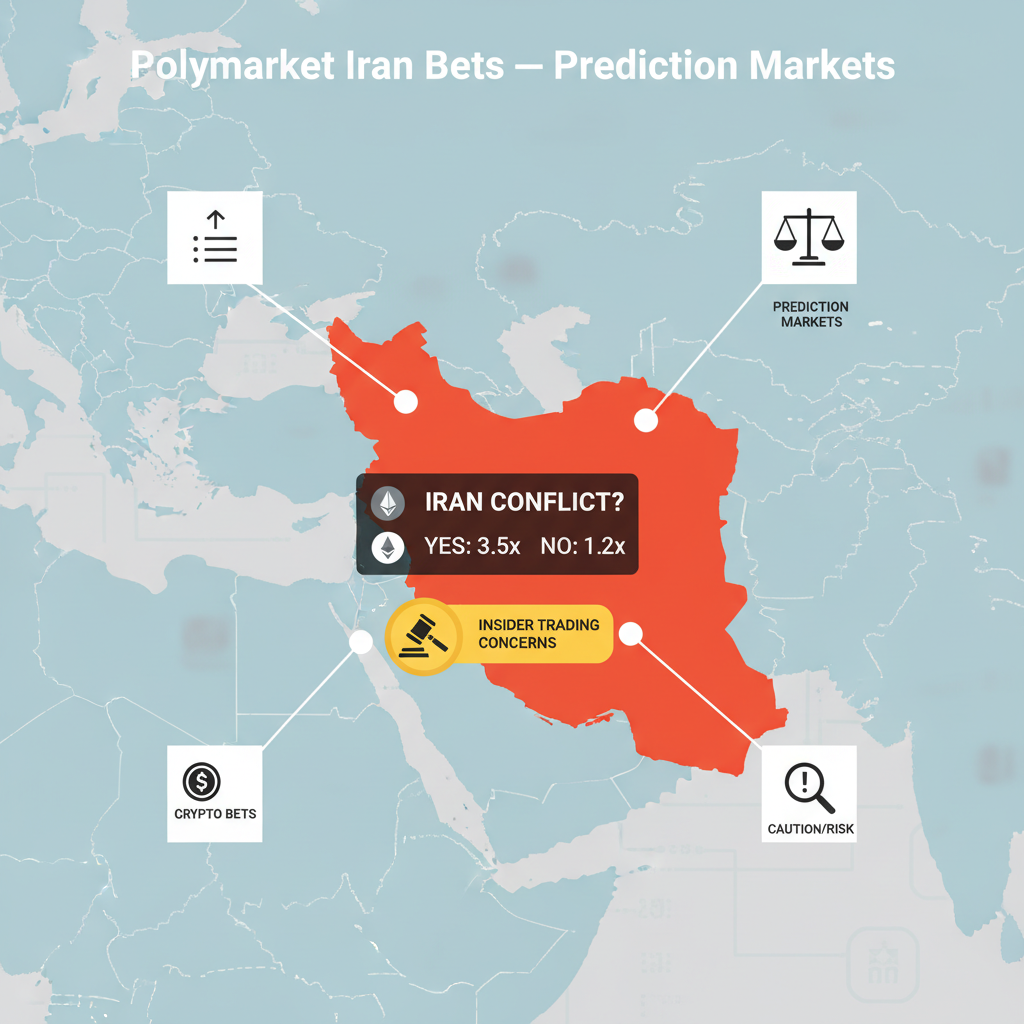
In late February 2026, cryptocurrency wallets moved millions of dollars in mere hours—not on Bitcoin or Ethereum, but on whether the United States would bomb Iran. When the strikes actually occurred, six mysterious accounts collectively pocketed over $1 million in profits, triggering federal investigations into what may be the most controversial insider trading case in prediction market history.
Look, I’ve been watching prediction markets evolve for years, but nothing prepared me for the sheer scale of what happened during the Iran crisis. We’re talking about $529 million in bets—not on sports, not on elections, but on whether missiles would fly and people would die. And here’s the thing: some traders knew exactly what was coming.
This isn’t just about money. It’s about the dangerous intersection of national security, anonymous crypto trading, and the age-old human impulse to profit from conflict. So let’s dig into what actually happened, who made fortunes, and why regulators are scrambling to figure out what to do about it.
The $529 Million Iran Bombing Prediction Market Phenomenon
The numbers are staggering. Between late February and early March 2026, Polymarket—the decentralized prediction platform that runs on cryptocurrency—saw nearly $600 million flow through Iran-related markets. The biggest contract? Whether the U.S. would strike Iran by February 28.
That single market alone generated $529 million in trading volume.
I’ve seen Polymarket handle major events before. The 2024 presidential election brought billions in bets. But this felt different—more urgent, more volatile, more… uncomfortable. Traders weren’t speculating on political outcomes or sports scores. They were betting on military action, on whether bombs would actually drop.
The platform created multiple Iran-related contracts almost overnight. There was the main strike prediction, yes, but also markets on whether Supreme Leader Khamenei would be removed from power by March 31 (that one hit $45 million in volume). Some markets asked about regime change. Others focused on specific military targets.
Polymarket’s decentralized nature meant anyone with a crypto wallet could participate. No traditional broker. No identity verification beyond basic blockchain requirements. Just you, your Ethereum, and your prediction about geopolitical chaos.
And honestly? The speed shocked me. Within hours of tensions escalating, these markets were live and liquid. Thousands of traders worldwide could instantly take positions on whether their government—or someone else’s—would launch military strikes.
Massive Wins and Devastating Losses: Trader Stories from the Iran Markets
Let me tell you about Vivaldi007. This trader walked away with $385,000 in profit by correctly predicting the strike would happen. Not a bad payday for reading geopolitical tea leaves, right?
But that’s nothing compared to Curseaaaaaaa, who made $757,000 betting on Khamenei’s ouster. Think about that for a second—three-quarters of a million dollars on a single political prediction.
Then there’s the flip side. One anonymous trader lost $6.5 million betting the strike wouldn’t happen. Six and a half million dollars. Gone. Because they read the situation wrong—or maybe because they didn’t have the information others apparently did.
The most chilling story? An account that doubled $50,000 to $100,000 in just eleven hours before the strike. Perfect timing. Perfect execution. A 100% return on investment in less time than it takes to binge-watch a TV series.
I’ve talked to traditional traders who spend years trying to achieve those kinds of returns. This person—whoever they were—did it in a single morning by correctly anticipating military action.
Here’s what gets me: these aren’t just numbers on a screen. Behind that $6.5 million loss is probably someone who thought they understood Middle Eastern politics, who analyzed the situation, who believed cooler heads would prevail. They were catastrophically wrong.
And behind those massive wins? Well, that’s where things get really interesting.
The Insider Trading Scandal: Six Suspicious Accounts Under Investigation
Bubblemaps—a blockchain analysis firm—noticed something weird. Six accounts, all newly created, all making massive, perfectly timed bets just hours before the strikes occurred.
These weren’t veteran traders with long histories. They were fresh wallets that appeared, placed enormous positions, and vanished into profit. Collectively, they made between $1 and $1.2 million.
Let me walk you through the most blatant example. One wallet purchased 560,000 shares at 10.8 cents each—that’s about $60,000 invested. When the strike happened and the market resolved, those shares were worth $560,000. Nearly a million-dollar profit on a single trade.
The timing is what screams insider knowledge. We’re talking about positions opened mere hours before official announcements. Not days. Not weeks. Hours.
Nicolas Vaiman, CEO of Bubblemaps, didn’t mince words: “The anonymity of these platforms creates obvious incentives for people with advance knowledge to profit.” And he’s right. If you’re a government official, a military contractor, or anyone in the information chain, you could theoretically open an anonymous crypto wallet and make a fortune.
The CFTC (Commodity Futures Trading Commission) has launched investigations. But here’s the problem—blockchain anonymity makes traditional insider trading enforcement incredibly difficult. Sure, investigators can trace wallet transactions, but connecting those wallets to real-world identities? That’s the multi-million dollar question.
In traditional stock markets, if you’re a defense contractor executive and you buy shares before a major contract announcement, regulators can trace that back to you. Your brokerage account has your name on it. But with crypto wallets? You could be anyone, anywhere.
Platform Ethics and Policies: How Polymarket and Kalshi Respond to Death Markets
Not all prediction platforms are comfortable with this territory. Kalshi—Polymarket’s more regulated competitor—has explicit policies against what they call “death markets.”
Tarek Mansour, Kalshi’s CEO, explained their philosophy: they won’t create markets where the financial incentive could theoretically encourage harmful outcomes. Assassination markets? Absolutely not. They’ve even implemented policies to reimburse fees on certain conflict-related markets to remove any perception of profiting from tragedy.
Polymarket, on the other hand, operates in a grayer zone. As a decentralized platform, they can create markets rapidly without the same regulatory oversight. And look, I understand the argument for market efficiency—prediction markets can aggregate information and provide valuable signals about future events.
But when does information aggregation become blood money?
The tension here is real. Prediction markets work best when they’re unrestricted, when anyone can bet on anything. That’s how you get accurate probability assessments. But unrestricted markets also mean someone can profit handsomely from correctly predicting—or worse, causing—catastrophic events.
Kalshi’s approach is more conservative. They review each market carefully, consider the ethical implications, and sometimes decide certain predictions shouldn’t be monetized. It’s slower. It’s more limited. But it also avoids the worst-case scenarios.
Polymarket’s rapid market creation enabled the Iran betting frenzy. Within hours of escalating tensions, traders worldwide could take positions. That’s efficient. That’s also potentially dangerous.
Expert Analysis: Anonymity, Incentives, and Information Asymmetry
The fundamental problem with geopolitical prediction markets is information asymmetry on steroids. In normal financial markets, insider trading is illegal because some people have material non-public information. But at least regulators can identify and prosecute them.
With Iran markets, the information asymmetry is massive—and enforcement is nearly impossible.
Think about who knows military strike timing before the public: government officials, intelligence personnel, military planners, defense contractors, foreign intelligence services, and probably a dozen other categories I’m forgetting. That’s potentially thousands of people with actionable insider knowledge.
Vaiman’s analysis highlights the perverse incentives: “When you combine anonymity with markets on conflict-related outcomes, you create obvious opportunities for those with advance knowledge to profit without detection.”
And it’s not just about individual bad actors. What happens when foreign intelligence services start using these markets? They could profit from their own planned actions, or they could manipulate markets to send false signals about their intentions.
I’ve talked to academic researchers studying prediction market integrity, and they’re genuinely worried. Traditional prediction markets like the Iowa Electronic Markets operated in controlled environments with small stakes. These crypto platforms? They’re the Wild West—massive liquidity, global access, complete anonymity.
The regulatory crackdown is coming. It has to. But what form will it take? Mandatory identity verification kills the decentralized nature that makes these platforms attractive. Heavy-handed restrictions might drive trading to even less regulated venues. It’s a genuine policy puzzle.
The Future of Geopolitical Prediction Markets: Trends and Implications
Here’s what I’m seeing: geopolitical prediction markets aren’t going away. If anything, they’re accelerating.
Institutional investors are starting to pay attention—not necessarily to trade, but to gather intelligence. When $529 million flows through markets predicting military strikes, that’s a signal. A noisy, potentially manipulated signal, sure, but still valuable data about how informed traders are positioning themselves.
Some corporations are exploring these markets as risk management tools. If you’re an international business with operations in volatile regions, prediction markets might offer real-time hedging opportunities. Oil companies, defense contractors, multinational corporations—they’re all watching.
The technology is evolving too. We’re seeing proposals for KYC-enabled prediction markets that maintain some privacy while allowing regulatory oversight. AI monitoring systems that flag suspicious trading patterns. Hybrid models that balance market efficiency with ethical guardrails.
But there’s a darker possibility that keeps me up at night: what if these markets start influencing the events they’re predicting?
If military planners know that prediction markets are pricing in a 70% chance of strikes, does that affect their decision-making? If adversaries are watching these markets for intelligence signals, does that compromise operational security? We’re entering uncharted territory where financial markets and military operations intersect in weird, potentially dangerous ways.
Regulatory frameworks are definitely coming. The CFTC investigation into the Iran markets is just the beginning. Expect congressional hearings, new legislation, international coordination on crypto gambling regulation. The question is whether regulations will be thoughtful and effective, or heavy-handed and counterproductive.
How to Participate (or Not): A Critical Guide to Geopolitical Prediction Markets
So should you participate in these markets? Honestly, that’s a question with no easy answer.
If you’re considering it, here’s how it works: You create a crypto wallet, fund it with Ethereum or USDC, connect to Polymarket, and browse available markets. You can buy “Yes” or “No” shares on various predictions. If you’re right, your shares resolve to $1 each. If you’re wrong, they’re worthless.
Simple mechanics. Complex ethics.
Before you put a single dollar into geopolitical markets, ask yourself some hard questions. Are you comfortable profiting from conflict? Do you have information advantages that might constitute insider trading? Can you afford to lose your entire stake? Are you in a jurisdiction where this is even legal?
The legal risks are real and evolving. U.S. regulations around prediction markets remain murky. Some states explicitly ban them. The CFTC is watching. If you’re a government employee or contractor with security clearance, participating in these markets could be career-ending or worse.
Red flags to watch for if you’re monitoring these markets: newly created accounts making massive positions, unusual volume spikes before news events, coordinated trading patterns across multiple wallets, markets that move dramatically without corresponding public information.
There are legitimate ways to engage with prediction market data without betting. Several analytics platforms aggregate prediction market odds alongside traditional news and analysis. You can monitor markets for information signals without putting money at risk.
But let’s be real—if you’re drawn to these markets, it’s probably for the profit potential, not academic interest. And that’s fine. Just understand what you’re getting into. The average trader probably loses money (like most forms of gambling). The information asymmetry is massive. The regulatory risk is unknown and growing.
And there’s the ethical dimension. I can’t tell you whether betting on military strikes is morally acceptable. That’s between you and your conscience. But I can tell you that when you’re celebrating a winning bet on geopolitical conflict, someone somewhere is experiencing the reality of what you profited from predicting.
The Iran markets showed us both the power and the peril of prediction markets in the geopolitical arena. They aggregated information at unprecedented speed and scale. They also potentially enabled insider trading on a massive scale and created financial incentives around human tragedy.
We’re at a crossroads. These platforms will either evolve into legitimate risk management tools with appropriate guardrails, or they’ll become playgrounds for insiders and speculators profiting from chaos. Which direction we go depends partly on regulation, partly on platform design, and partly on the ethical choices of participants.
What I know for sure: the intersection of cryptocurrency, prediction markets, and geopolitics is one of the most fascinating—and troubling—developments in modern finance. The Iran bombing markets were just the beginning.
Ready to navigate the complex world of prediction markets and geopolitical risk assessment? Contact our experts for personalized guidance on understanding these emerging markets and their implications for your investment strategy.