The World Has Splintered Into Three Economic Spheres — And VCs Are Paying Attention
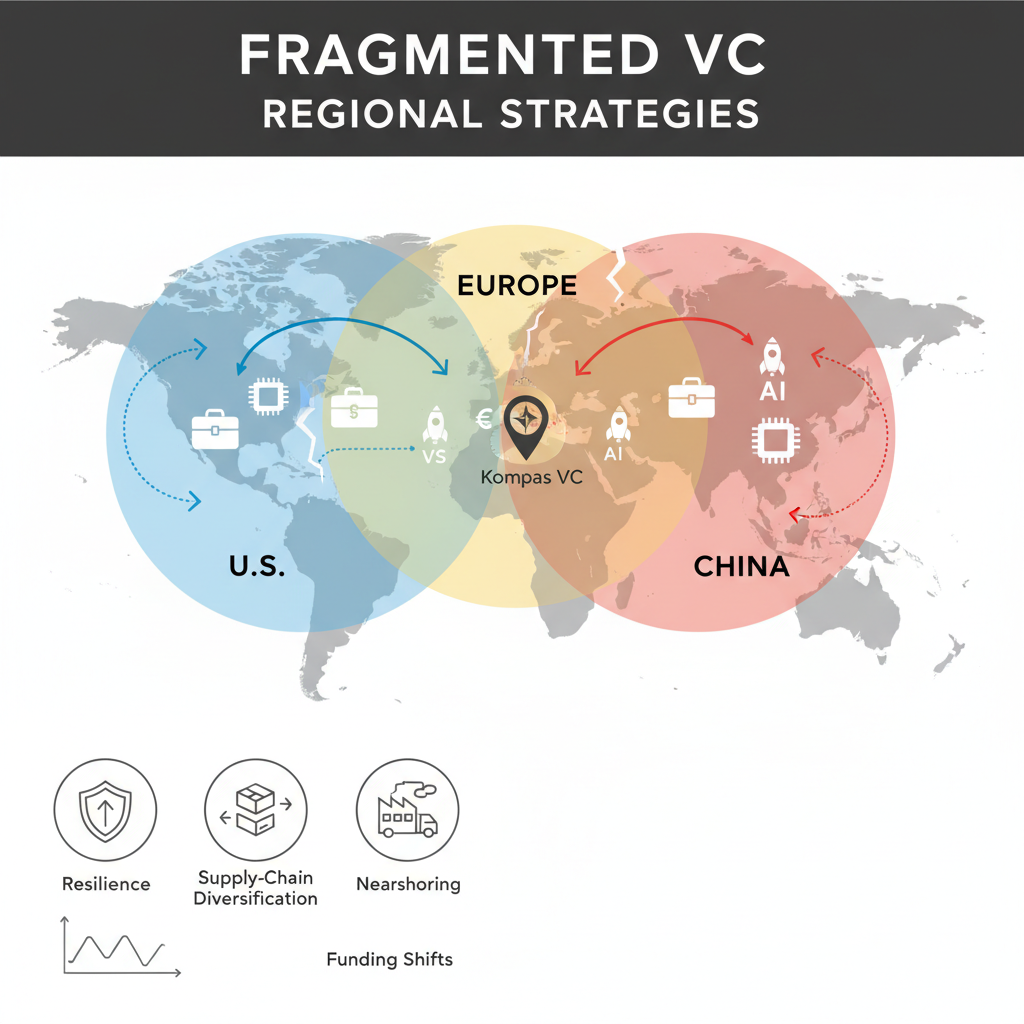
The rules of global venture capital have fundamentally changed. The same interconnected world that made billion-dollar cross-border startups possible is fracturing — and investors who ignore that reality risk being left behind.
I’ve watched this shift happen in real-time over the past few years. What started as trade tensions and political rhetoric has hardened into structural economic divisions that reshape where capital flows, which startups can scale, and honestly, who wins in venture.
As Kompas VC partner Sebastian Peck told TechCrunch, “In 2026, we’re in a very, very different paradigm.” And he’s not wrong. The old playbook of deploying capital globally without regional sensitivity? It doesn’t work anymore.
Here’s what’s actually happening on the ground — and what founders, LPs, and investors need to understand about venture capital in this fragmented world.
The World Has Splintered Into Three Economic Spheres — And VCs Are Paying Attention
Look, we need to talk about the elephant in the room. The global economy has fractured into three dominant blocs: the U.S., Europe, and China. This isn’t speculation or political commentary — it’s the operational reality that every serious VC firm is now building their strategy around.
The post-2008 era of frictionless global capital deployment? That’s over. Done. What replaced it is a world where geopolitical disputes and cultural differences directly impact your Total Addressable Market calculations in ways that would’ve seemed paranoid five years ago.
Think about what this means practically. A startup that can scale beautifully in one sphere may be structurally blocked from the others. Not because the product isn’t good enough, but because the geopolitical fragmentation venture capital landscape has changed the rules of the game entirely.
Kompas VC gets this. They just raised a €160 million ($187.5 million) fund explicitly designed around this fragmented-world thesis [Source #1]. That’s not a small bet — that’s a firm putting serious money behind the idea that regional positioning matters more than ever.
And they’re not alone. The World Economic Forum observed that “businesses around the world have prioritized resilience by moving supply chains closer to home or to geopolitically aligned countries” [Source #3]. When you see that kind of restructuring at the corporate level, it cascades down to venture-backed startups too.
I’ve seen VC firms actively splitting China-based businesses from global entities. It’s messy, it’s expensive, and it’s happening because the cross-border startup investment risks have become too significant to ignore.
Why European Venture Capital Is Having a Strategic Moment
Here’s something I’ve noticed — Europe isn’t just a secondary market to Silicon Valley anymore. It’s emerging as a distinct economic sphere with its own rules, advantages, and honestly, some pretty compelling investment opportunities.
The advantage of regionally embedded VC firms with local founder relationships is becoming clearer every quarter. You can’t parachute into Berlin for a week and expect to understand the nuances of European B2B SaaS the way a local fund does.
Kompas VC operates across Amsterdam, Copenhagen, Berlin, and Tel Aviv — strategically positioned within the European sphere [Source #2]. That’s not random. Each of those cities represents a different slice of the European startup ecosystem, and having boots on the ground matters.
But here’s where it gets interesting. European regulatory frameworks like GDPR and the AI Act are creating both challenges and defensible moats for EU startups. A Berlin-based deep tech company that’s already navigated these regulations? That’s not a bug — it’s a feature when you’re trying to sell into European enterprises.
As Kompas explicitly frames it: “As a European fund, Kompas has access to a range of founders and startups in the region” [Source #1]. That access translates into deal flow that U.S.-only funds simply can’t match. And SeedScope identified Europe as one of the rising investment hotspots in 2026 [Source #5], which tracks with what I’m seeing in the market.
The talent density across European hubs is real too. You’ve got world-class engineering talent in Berlin, fintech innovation in Amsterdam, design-forward thinking in Copenhagen. It’s not Silicon Valley, but it doesn’t need to be — it’s building something different.
The AI Boom Is Real — But the Winning Strategy Is More Nuanced Than Just “Bet on AI”
Okay, let’s address the AI elephant in every pitch deck. Yes, Q1 2026 shattered venture funding records, driven almost entirely by the AI boom [Source #4]. And yes, in 2025, the U.S. accounted for roughly 85% of global AI investment and over half of all AI deals [Source #5].
But — and this is a big but — that concentration is creating dangerous blind spots.
I’ve reviewed dozens of AI pitches this year, and here’s what I’ve learned: there’s a massive difference between backing “AI companies” and identifying AI companies with defensible moats and proven traction. SeedScope literally warned investors about this [Source #5], and they’re right.
The AI investment intersects with geopolitical fragmentation in fascinating ways. U.S. AI dominance is real, but European and Chinese AI ecosystems are carving out their own territories. European AI startups are finding niches in regulated industries — healthcare, finance, government — where U.S. hyperscalers face barriers.
Think about it. An AI infrastructure company with proprietary data pipelines and proven enterprise customers? That’s interesting. A generic LLM wrapper with no clear differentiation? That’s a commodity waiting to happen.
The numbers tell the story: early-stage funding up over 40%, seed funding up over 30%, late-stage also surging [Source #4]. But volume doesn’t equal quality. The risk of AI hype cycles for early-stage investors is real, and I’ve seen smart firms get burned by chasing the trend without doing the deep technical diligence.
In my experience, the winning AI investments in 2026 are the ones that solve specific problems in specific markets — not the ones promising to revolutionize everything.
Resilience Is the New Growth — How Smart Capital Is Being Deployed
Here’s the paradigm shift that’s actually happening: we’ve moved from “growth at all costs” to “resilience-first” portfolio construction. And honestly? It’s about time.
Supply chain localization and nearshoring aren’t just corporate buzzwords anymore — they’re legitimate VC investment themes. The World Economic Forum noted that “businesses around the world have prioritized resilience by moving supply chains closer to home or to geopolitically aligned countries, and banks have backed these efforts with investment initiatives” [Source #3].
What does this mean practically? It means a European defense-tech startup or energy-security company can benefit from EU sovereignty mandates in ways that weren’t possible three years ago. Government subsidies and industrial policy are reshaping where startups can win.
I’ve watched companies restructure specifically “to take advantage of subsidies and minimize vulnerability to geopolitical turbulence” [Source #3]. That’s not gaming the system — that’s smart strategy in a world where yesterday’s geopolitical risk is today’s operational reality.
A Latin American logistics startup capitalizing on nearshoring trends as U.S. companies reduce Asia-Pacific supply chain exposure? That’s a resilience play with real economics behind it. Banks and institutional capital are backing these efforts because the risk-adjusted returns make sense.
The role of banks in this shift is underappreciated. They’re not just financing deals — they’re actively shaping which business models get funded based on geopolitical risk portfolio management considerations.
Regional Hotspots Beyond Europe — Where Else Smart Capital Is Flowing in 2026
Europe’s not the only game in town. SeedScope identifies Latin America, the Middle East, and Asia-Pacific (excluding China) as rising investment hotspots in 2026 [Source #5]. And the data backs this up.
Geopolitical realignment is creating new investment corridors that didn’t exist before. Gulf sovereign wealth funds are co-investing with European VCs in climate tech. Brazilian fintech startups are benefiting from both explosive local demand and nearshoring-driven U.S. investor interest.
The role of sovereign wealth funds and regional LPs in directing capital can’t be overstated. They’re not just passive check-writers — they’re strategic partners with specific geopolitical and economic objectives.
Here’s what’s interesting about emerging market venture capital in 2026: the risk-adjusted opportunity in markets previously overlooked by global mega-funds is actually pretty compelling. You know why? Because those mega-funds are still trying to deploy billion-dollar funds into a smaller pool of “safe” deals.
Meanwhile, regional funds with $50-200 million can move quickly, build deep local relationships, and capture opportunities that don’t fit the mega-fund model. The reopening IPO markets are providing a liquidity catalyst for these regional funds [Source #5], which changes the math significantly.
After two years of constrained liquidity, 2026 represents a new deployment phase. And regional funds positioned in the right markets are seeing deal flow that would’ve been impossible when global capital could move freely.
What Founders Need to Know When Raising From Regionally Sensitive VCs
If you’re a founder raising capital in 2026, you need to understand that your geographic go-to-market strategy matters more than ever. VCs aren’t just asking “can you scale globally?” — they’re asking “can you scale within specific economic spheres?”
Be explicit about which markets you’re targeting and why. If you’re a European startup, lean into your regulatory compliance and local market knowledge. Don’t apologize for not being a Silicon Valley company — position it as a strategic advantage.
When you’re pitching to firms like Kompas or other regionally focused funds, they want to see that you understand the fragmented landscape. They’re not looking for founders who pretend the old rules still apply.
Here’s what works: Show that you’ve thought through the geopolitical implications of your business model. If you’re building infrastructure, where will your servers be located? If you’re processing data, which regulatory frameworks apply? These aren’t theoretical questions anymore.
And honestly? Founders who can articulate a clear regional strategy are getting funded faster than those pitching generic “global expansion” plans. Because VCs know that generic global expansion in 2026 often means expansion nowhere.
One more thing — if you’re raising from a fund with a specific regional focus, understand their LP base and strategic objectives. A European fund backed by EU-focused LPs has different constraints and opportunities than a U.S. fund trying to deploy capital globally.
The Bottom Line: Adaptation Is the Only Strategy
Look, I get it. The fragmented world is messier and more complicated than the globalized one we got used to. But complexity creates opportunity — if you know where to look.
The VCs winning in 2026 are the ones who’ve adapted their strategies to match reality. They’re building regional expertise, developing defensible AI investment theses, and prioritizing resilience over pure growth metrics.
For founders, the message is clear: understand which economic sphere you’re playing in, and build your strategy accordingly. The days of pitching a generic “global startup” are over.
For LPs, the question is whether your fund managers have actually adapted to this new paradigm or are still operating on outdated assumptions about global capital flows.
And for everyone else watching this space? The venture capital landscape in 2026 is fundamentally different from what came before. The firms that acknowledge that reality — and build their strategies around it — are the ones that’ll deliver returns.
The world has changed. The smart money has noticed. Have you?
Ready to navigate the fragmented venture capital landscape with expert guidance? Contact our team for personalized insights on regional investment strategies and AI-driven opportunities in 2026.