What Is AI Token Pricing? (And Why It Matters More Than Ever)
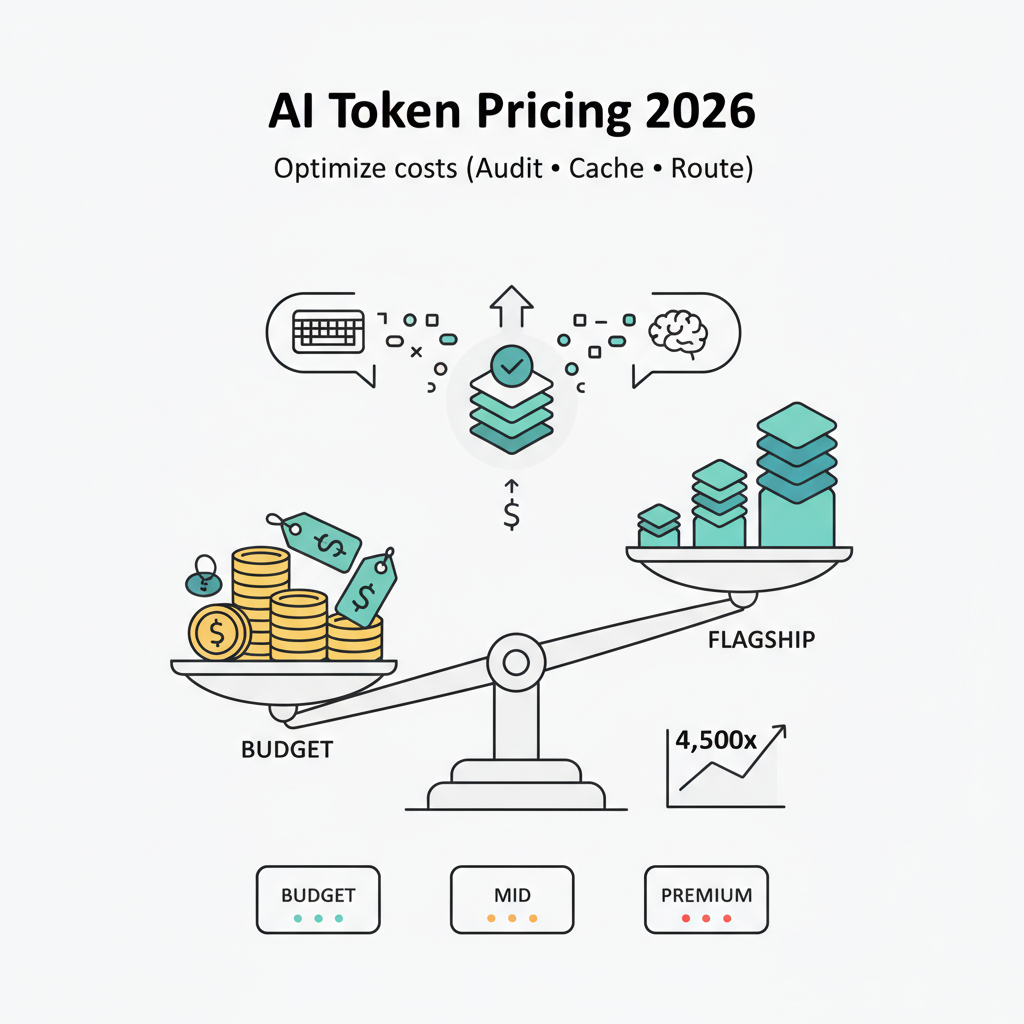
Every dollar you spend on AI tokens is either a competitive advantage or a budget drain — and in 2026, the difference between the cheapest and most expensive model is 4,500x. Yeah, you read that right.
Here’s the thing: with 300+ AI models now available across OpenAI, Anthropic, Google, Mistral, DeepSeek, and dozens of other providers, choosing the wrong model can silently inflate your infrastructure costs by thousands of dollars per month. I’ve seen teams default to flagship models when cheaper alternatives would’ve delivered basically the same results. It’s like buying a Ferrari when you really just need reliable transportation.
This guide breaks down exactly what AI token pricing means, how it’s calculated, which models offer the best value in 2026, and how to build a cost-efficient AI stack — backed by real pricing data tracked across all major providers. No fluff, just the numbers that matter.
What Is AI Token Pricing? (And Why It Matters More Than Ever)
Let’s start with the basics. A “token” is roughly 4 characters or about three-quarters of a word in English. So the phrase “AI token pricing” would be about 3-4 tokens, depending on how the model breaks it down.
But here’s where it gets interesting — not all tokens cost the same. Input tokens (what you send to the model) typically cost less than output tokens (what the model generates back). Makes sense, right? The model does more computational work generating text than processing your prompt.
The standard pricing unit you’ll see everywhere is cost per 1 million tokens (1M tokens). It’s like how gas stations price per gallon — gives you a consistent baseline for comparison.
And there’s this newer thing called prompt caching that’s becoming huge for cost reduction. Basically, if you’re sending the same context over and over (think: system prompts, documentation, knowledge bases), some providers will cache that input and charge you way less for subsequent uses. I’ve seen teams cut their costs by 75% just by implementing caching properly.
Why does any of this matter? Because small per-token differences compound dramatically at production volume. Let me show you what I mean.
If your app processes 100M tokens per month, at $0.04 per 1M tokens (Command R7B’s rate) that’s $4 per month. At $30.00 per 1M tokens (GPT-5.4 Pro’s input rate) that’s $3,000 per month — a 750x cost difference for the exact same volume. And we’re not even talking about output tokens yet, where GPT-5.4 Pro hits $180 per 1M tokens. [Source: aipricing.guru]
The math gets scary fast when you’re at scale.
The 2026 AI Token Pricing Landscape — Key Trends Shaping Costs
Look, there’s an actual “pricing crisis” happening right now in the AI world. Enterprise customers are getting strained by token costs even as AI revenue absolutely soars. OpenAI generated $5.7 billion in Q1 2026 revenue, beating Anthropic by about $1 billion. [Source: investing.com]
But — and this is a big but — Anthropic isn’t exactly hurting. They pulled in $4.8 billion in Q1 2026 and they’re projected to more than double that to $10.9 billion in Q2 2026. They’re also in the middle of a fundraising round seeking $30B–$50B at a valuation up to $950 billion. [Source: investing.com]
So the providers are making bank. Meanwhile, their customers are hemorrhaging money on tokens.
This tension is creating two distinct market dynamics. On one end, you’ve got a race to the bottom — providers like DeepSeek offering incredibly capable models at a fraction of traditional pricing. DeepSeek’s emergence has forced price reductions across the board. Honestly, they’ve been a wake-up call for the entire industry.
On the other end, you’ve got premium model divergence. OpenAI’s GPT-5.4 Pro charges $180 per 1M output tokens because some use cases genuinely need that level of capability and will pay for it. The market is bifurcating into budget-conscious and performance-at-any-cost segments.
Google’s playing an interesting game here. They’re positioning Gemini 3.5 Flash as the cost-cutter’s dream, claiming it could save enterprises more than $1 billion per year in AI costs. [Source: investing.com] That’s not just marketing speak — they’re genuinely undercutting OpenAI and Anthropic on price for comparable performance tiers.
Then you’ve got the IPO pressure factor. Both OpenAI and Anthropic are facing investor expectations that’ll eventually push them toward profitability. Which means? Pricing changes. Probably not in your favor.
Meanwhile, inference providers like Together AI and Groq are offering competitive rates on third-party models, giving you more options than ever. It’s like the difference between buying directly from Apple or getting the same chip through a reseller at a discount.
Here’s a practical example: a mid-size SaaS company running customer support automation at 500M tokens per month would spend roughly $14,000 per month on Claude Sonnet-tier pricing versus about $2,500 per month on a DeepSeek V3-tier alternative. That’s $138,000 in annual savings. You can hire two senior engineers with that difference.
2026 AI Model Pricing Comparison — From Cheapest to Most Expensive
Alright, let’s get into the actual numbers. I’ve organized this into three tiers: Budget, Mid-Range, and Flagship/Premium. Keep in mind that pricing changes frequently — like, sometimes weekly — so treat this as a snapshot of May 2026 data.
One more thing before we dive in: context window sizes matter here. Longer context windows mean you can fit more tokens per request, which affects your total cost. A model with a 200k context window isn’t automatically more expensive, but you can rack up costs faster if you’re not careful about what you’re sending.
Budget Tier — The Cost-Conscious Winners
These are your workhorses for high-volume, straightforward tasks. Classification, simple generation, data extraction — they’ll handle it without breaking your budget.
- Command R7B (Cohere): $0.04 input / 1M tokens — this is literally the cheapest production model I’ve tracked [Source: aipricing.guru]
- Qwen 3.5-9B (Qwen): $0.04 input / $0.15 output per 1M tokens
- Qwen 2.5-7B (Qwen): $0.04 input / $0.10 output per 1M tokens
- Gemma 2 9B (Google): $0.08 input / $0.08 output per 1M tokens
- GPT-4.1 nano (OpenAI): $0.10 input ($0.025 cached) / $0.40 output per 1M tokens
The Qwen models are surprisingly capable for the price. I’ve used them for content moderation and basic summarization with solid results. And GPT-4.1 nano with caching? That’s a steal if you’re sending repetitive prompts.
Mid-Range Tier — The Balanced Performers
This is where most production apps should probably live. You get significantly better reasoning and instruction-following without the premium price tag.
- Mistral Small 4 (Mistral): $0.15 input / $0.60 output per 1M tokens
- DeepSeek V3.1 (Together): $0.60 input / $1.70 output per 1M tokens
- Claude Haiku 4.5 (Anthropic): $1.00 input ($0.10 cached) / $5.00 output per 1M tokens
Claude Haiku is my go-to recommendation for teams that want Anthropic’s quality without Sonnet’s price. The caching discount ($0.10 vs $1.00) is massive if you’re doing RAG or agent workflows.
DeepSeek V3.1 punches way above its weight class. For $0.60 input, you’re getting reasoning capabilities that used to cost $10+ per 1M tokens just a year ago.
Flagship & Premium Tier — When Performance Matters Most
These are for complex reasoning, creative work, or when you absolutely need the best output quality available.
- DeepSeek V4 Pro (Together): $2.10 input ($0.20 cached) / $4.40 output per 1M tokens
- Gemini 2.5 Pro >200k context (Google): $2.50 input ($0.25 cached) / $15.00 output per 1M tokens
- Claude Sonnet 4.0 (Anthropic): $3.00 input ($0.30 cached) / $15.00 output per 1M tokens
- GPT-4.2 Turbo (OpenAI): $5.00 input / $15.00 output per 1M tokens
- Mistral Large 3 (Mistral): $2.00 input / $6.00 output per 1M tokens — cheapest flagship option [Source: aipricing.guru]
- GPT-5.4 Pro (OpenAI): $30.00 input / $180.00 output per 1M tokens — the most expensive tracked model [Source: aipricing.guru]
GPT-5.4 Pro is genuinely wild. At $180 per 1M output tokens, you’re paying 1,800x more than Command R7B’s input rate. Is it worth it? Depends on your use case. For medical diagnosis support or complex legal analysis, maybe. For chatbots? Absolutely not.
Mistral Large 3 deserves more attention. At $2.00 input, it’s offering flagship-tier performance at mid-range pricing. I’ve been impressed with its multilingual capabilities especially.
How to Actually Optimize Your AI Token Costs
Knowing the prices is one thing. Using that knowledge strategically is another.
First — and I can’t stress this enough — implement prompt caching if your provider supports it. Anthropic, OpenAI, and Google all offer it now. If you’re sending the same system prompt or knowledge base with every request, you’re literally throwing money away by not caching.
Second, use the right model for the right job. Don’t default to GPT-4 or Claude Sonnet for everything. I’ve seen production systems where 80% of requests could’ve been handled by a budget-tier model, but they were using flagship pricing across the board. That’s like taking an Uber Black to get groceries.
Third, consider model routing. Start with a cheap model, and only escalate to expensive models when the output quality isn’t sufficient. This cascading approach can cut costs by 60-70% for many applications.
Fourth, monitor your actual token usage. Most developers wildly underestimate how many tokens they’re burning through. Set up billing alerts and track usage by feature. You might discover that one feature is responsible for 90% of your token costs.
And look — sometimes you need to pay for quality. If you’re building a product where output quality directly impacts revenue or user trust, don’t be penny-wise and pound-foolish. But at least know what you’re paying for and why.
The Bottom Line on AI Token Pricing in 2026
The AI pricing landscape is more complex and competitive than ever. You’ve got options ranging from $0.04 to $180 per 1M tokens — a 4,500x spread. That’s unprecedented in any technology market I’ve followed.
The “pricing crisis” is real for enterprises, but it’s also creating opportunities for cost-conscious builders. DeepSeek, Mistral, and Google are all pushing prices down through competition. OpenAI and Anthropic are defending their premium positioning while also introducing budget tiers.
What does this mean for you? You need a strategy. Audit your current usage, identify where you can downgrade models without sacrificing quality, implement caching, and stay informed about pricing changes. The providers update their pricing frequently — sometimes monthly.
I bookmark aipricing.guru and pricepertoken.com and check them quarterly. It’s become part of my infrastructure review process, just like checking cloud compute costs or CDN pricing.
The teams that win in 2026 won’t necessarily be the ones using the most expensive models. They’ll be the ones using the right models for each use case, optimizing aggressively, and staying on top of market changes.
Ready to take your AI infrastructure costs to the next level? Contact our experts for personalized guidance on optimizing your model selection and token usage strategy.