The benchmark wars are a distraction
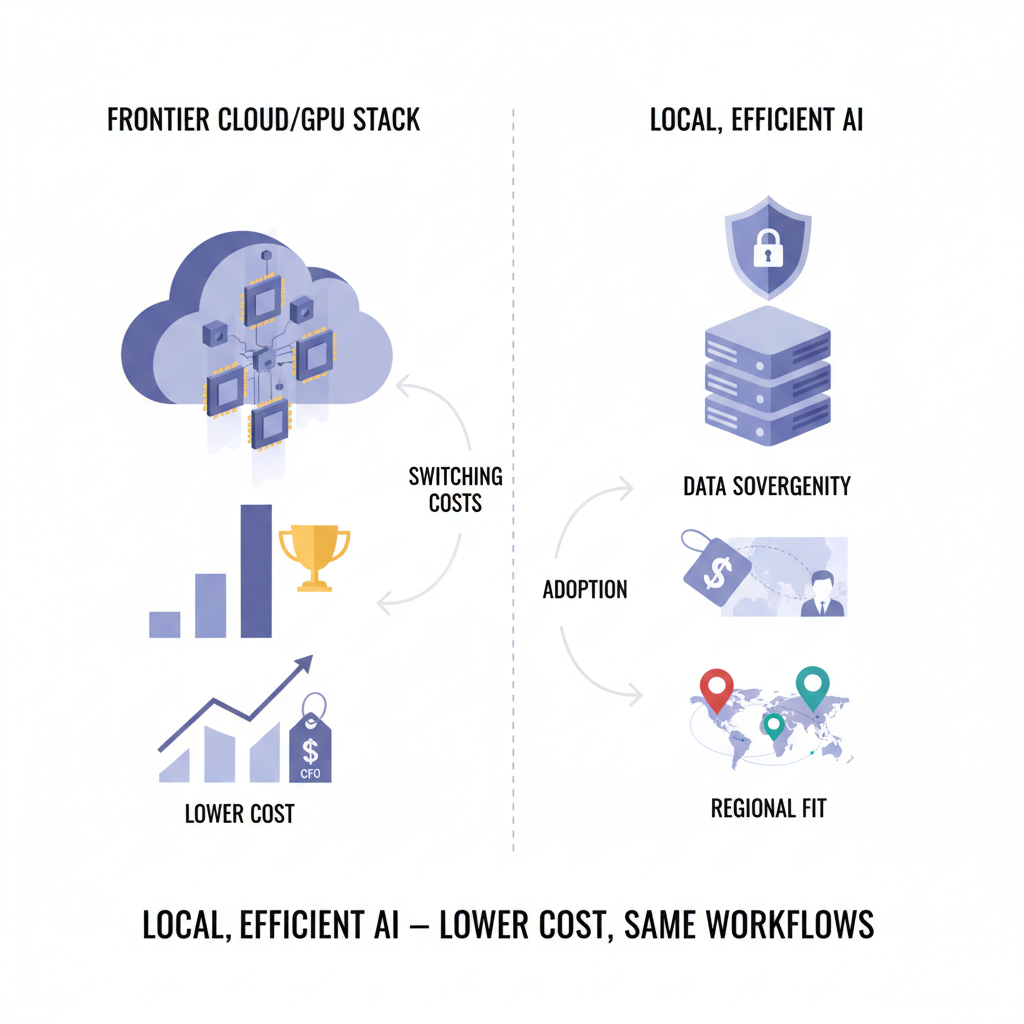
The benchmark wars are a distraction. Every few weeks another Chinese model posts numbers alongside Claude or GPT-4o, the tech press runs the “Silicon Valley is no longer clearly leading” headline, and American AI executives go on background to say benchmarks don’t tell the whole story. They’re right — but not in the way they mean. The real story isn’t whether Kimi K3’s 2.8 trillion parameters beat Anthropic’s latest on some reasoning test. It’s that a growing slice of the enterprise market doesn’t need the frontier. They need something that works, runs on infrastructure they control, and doesn’t cost them a per-token fee that makes the CFO’s eye twitch. China figured that out before most US vendors admitted it was the actual game.
The constraint was forced, not chosen. US export controls on high-end chips — specifically the restrictions on GPUs capable of the kind of compute density that American labs take for granted — created a different optimization problem for Chinese AI labs. They couldn’t compete on scale, so they competed on efficiency. That’s not a consolation prize. It’s a product strategy that happens to align perfectly with what the majority of enterprises actually need.
When you can’t buy the best chips, you learn to build models that don’t require them. Kimi K3, DeepSeek, and others in that tier weren’t built as second-rate alternatives to GPT-4o. They were built to run on the hardware available in the market where they’re being deployed. A mid-market enterprise in Southeast Asia evaluating whether to pay OpenAI API rates — with the per-token metering, the vendor lock-in, the data leaving the country — versus self-hosting an open-weight Chinese model that runs on their existing infrastructure doesn’t see two versions of the same product. They see two different business models. The math on total cost of ownership isn’t close.
This is what Brookings documented in their recent testimony on Chinese AI development: startups in that ecosystem are “more focused on making progress in model efficiency, AI adoption, and the integration of AI into the physical world” precisely because they lack access to the compute scale of American peers. That’s not a limitation they’re working around. It’s the actual competitive advantage. Efficiency compounds. Once your model is running inside an enterprise’s own environment, doesn’t require expensive GPU infrastructure, and produces acceptable results for the workloads that matter most, switching costs accrue rapidly. The enterprise has rewritten their ML pipelines around your model. Their ops team knows how to run it. Their data stays internal. Ripping that out to chase marginal improvements on a benchmark published by your competitor requires board approval and budget reallocation.
The open-weight release of these models isn’t charity.
It’s distribution. And it works.
From a pure capability standpoint, the performance gap has already closed to “months, not years” according to reporting from outlets that have actually tested against production workloads, not just benchmarks. For most enterprise use cases — summarization, code assistance, internal search, document classification, basic question-answering over proprietary data — that gap is functionally zero today. You can run tests all day and find marginal wins for the latest frontier model. None of those wins matter if the model you’re comparing against costs a tenth as much to deploy and run.
The real friction isn’t technical anymore. It’s political tolerance.
US-headquartered firms face board-level pressure to avoid Chinese AI dependencies. That’s a real constraint, and it’s not going away. But that calculus looks radically different in markets where Chinese AI carries no political stigma and the cost savings are meaningful enough to move the needle on operating expenses. A global enterprise with operations in Singapore, Riyadh, Mexico City, or Dubai is making a different procurement call than a firm headquartered in Chicago. The CIO in Singapore evaluates the same model on capability and cost. The CIO in Chicago evaluates it on capability, cost, and geopolitical risk. One of those evaluations has a much tighter margin for the US vendor.
China is explicitly targeting that gap. Not as a future strategy — as a current distribution strategy. The venture capital flowing into Chinese AI companies is increasingly focused on enterprise adoption in non-Western markets, exactly the regions where the US has retreated from multilateral tech engagement and left room for someone else to establish the standard. That’s not speculation. It’s already visible in procurement patterns across Southeast Asia and parts of the Middle East. The question isn’t whether Chinese models are “good enough.” The question is whether they’re good enough for the markets where they’re being deployed. They clearly are.
There’s a difference between frontier and sufficient.
The frontier is where you build the next generation of AI applications. It’s where you solve problems that didn’t have computational solutions before. It’s valuable, it’s where the AI press focuses, and it’s where US labs still hold genuine advantages in research velocity and talent density. But frontier capability is not the same as enterprise capability. Most organizations don’t operate at the frontier. They operate in the middle of the market, where “good enough and cheap” beats “best and expensive” for the majority of actual buyers.
The US AI establishment hasn’t fully internalized this yet, which is why you still see venture capitalists and executives defending the benchmark lead as if it’s the same as market leadership. It isn’t. Market leadership in enterprise software is decided by adoption, cost, switching costs, and regional fit — not by whether your model scored 0.3 percentage points higher on a reasoning test. Chinese vendors understand that. They’re not trying to beat GPT-4o on MMLU. They’re trying to become the default choice for enterprises that can’t or won’t pay US vendor pricing and have no political reason to avoid Chinese infrastructure.
That’s already happening at a pace most IT leaders haven’t acknowledged internally. Enterprise IT leaders who are still framing this as “wait for the US to win the race” are solving the wrong problem. The frontier will keep moving — that’s not the question. The question is what percentage of your actual AI workload genuinely requires the frontier, and what percentage could run on something efficient, open-weight, and dramatically cheaper today. Most organizations haven’t done that audit honestly. When they do, they’ll find the frontier is a smaller slice than vendor conversations suggest. They’ll also find that the middle of the market is already contested terrain, with Chinese models holding more of it than most IT leaders have acknowledged to their boards.