OpenRouter isn’t a product, it’s a position
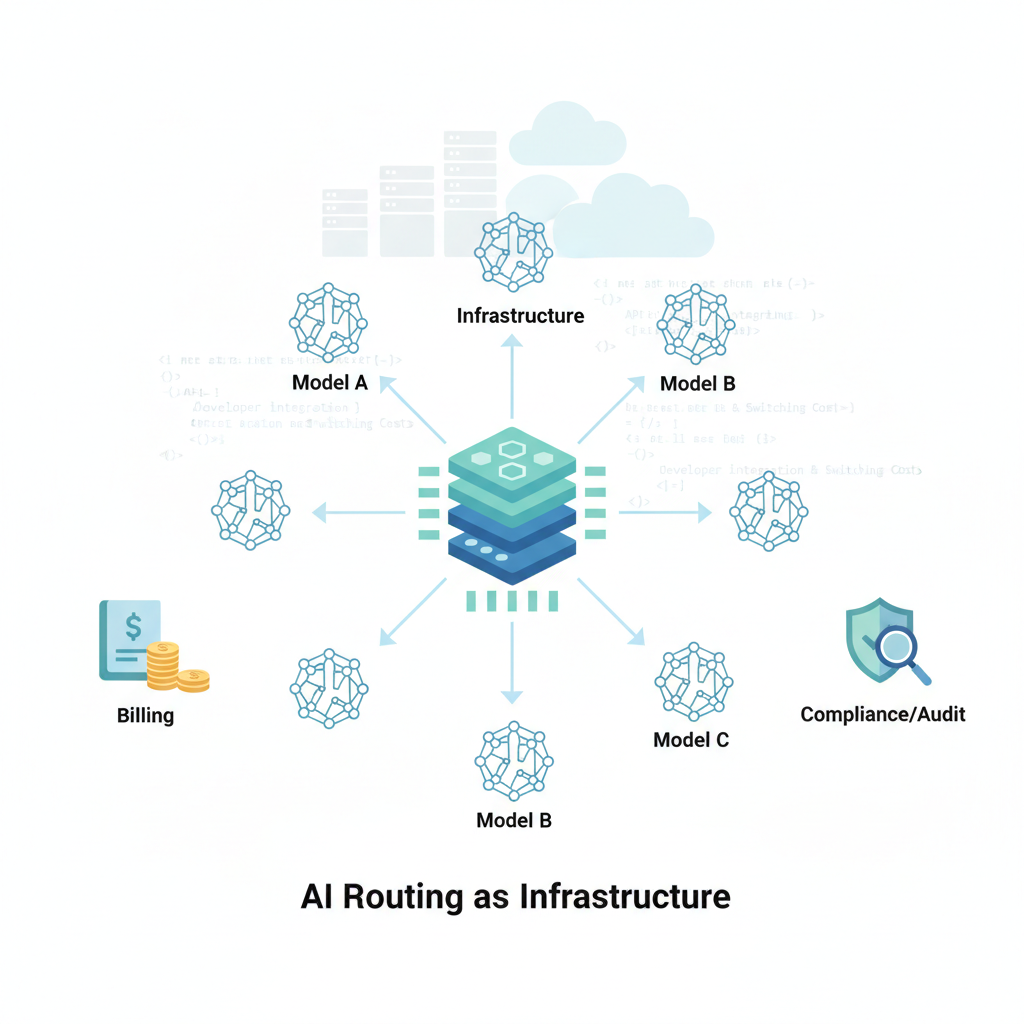
Every major platform shift has produced one company that didn’t build the thing everyone wanted — it built the thing every version of the thing had to pass through. Visa didn’t write banking software. AWS didn’t build your app. The pattern is consistent enough that when Stripe — a company that has spent fifteen years perfecting its position as invisible financial infrastructure — reportedly moves on OpenRouter, the marketplace routing traffic across dozens of AI models, the right question isn’t “why is a payments company buying an AI router?” The right question is: why would a company that understands infrastructure better than almost anyone not buy the switching layer sitting underneath the entire model marketplace before someone else does?
The deal, if confirmed, will probably be announced as a natural extension of Stripe’s existing business. Payments for AI services. Billing for model consumption. Logical adjacency. That framing will be wrong in the way that most strategic framings are wrong — technically accurate about the surface, completely blind to the actual value being acquired.
OpenRouter isn’t a product, it’s a position
OpenRouter’s value proposition is straightforward: developers point their applications at OpenRouter’s API instead of integrating directly with Claude, GPT-4, or whatever else is shipping this month. OpenRouter handles the routing, the failover, the model selection logic. It’s a thin layer between your code and the model providers. The UI is functional. The model catalog is comprehensive. But neither of those things is why it matters.
What matters is that developers have already wired their applications through it.
Switching costs accumulate invisibly. A startup uses OpenRouter for three months because it’s convenient. They write their prompts in a way that assumes OpenRouter’s routing logic. They build monitoring around OpenRouter’s API. They configure their error handling to expect OpenRouter’s response format. By month four, switching to direct integrations isn’t a technical problem anymore — it’s a migration project. By month twelve, it’s a rewrite. This is exactly how Stripe itself became unmoveable. Not because Stripe’s API was technically superior to alternatives, but because by 2014, changing payment processors meant changing code that had been written assuming Stripe’s specific behavior, error handling, and feature set.
The model landscape is accelerating toward a state where no enterprise wants to maintain direct integrations with every frontier lab.
Nvidia’s $5 billion commitment to Safe Superintelligence is just one signal. We’re heading into a world where new model providers launch every quarter, where switching between Claude and GPT-4 and Gemini and whatever else is on the market becomes part of routine optimization, where a company might run different models for different workloads based on cost, latency, or regulatory fit. A neutral router stops looking like a convenience and starts looking like a utility — the same way load balancers did, the same way API gateways did. And once something looks like a utility, the person who owns it has pricing power.
But there’s a second angle that changes the calculus entirely.
The EU AI Act’s General-Purpose AI provisions go into full force in August 2026. What that actually means for enterprises is still unclear, but the pattern is visible: regulators want auditable, documented decisions about which models are running where, how they’re being used, and what safeguards are in place. An enterprise running Claude for one workflow, GPT-4 for another, and Gemini for a third has three separate compliance relationships. A credentialed intermediary that sits in the middle of all three, that keeps logs, that can prove which model was called for which request, that can demonstrate failover behavior — that suddenly has compliance value, not just convenience value.
Consider a mid-size financial services company with a realistic constraint: they need to run language models for customer service, for internal document processing, and for regulatory analysis. Three different risk profiles. Three different compliance requirements. They could integrate directly with three model providers, which means three separate vendor relationships, three separate audit trails, three separate data handling agreements. Or they could run everything through a routing layer that’s owned by a credentialed intermediary, which means one audit trail, one set of logs that regulators can inspect, one vendor relationship to negotiate SLAs with. The routing layer doesn’t just route — it becomes the compliance boundary.
Stripe already knows what it’s like to own a choke point
Stripe’s entire business model is built on a specific insight: if you can position yourself as the unavoidable intermediary between two parties that need to exchange value, you can take a small, defensible cut of a very large, growing flow. That’s the payment processor model. Merchants don’t want to work with Stripe because they love Stripe’s UI. They work with Stripe because their customers expect credit card processing to just work, and Stripe is positioned as the credible way to make that happen.
Now consider what happens when autonomous AI agents become common enough to be operationally significant.
An AI agent running in production will need to call external APIs, spin up compute resources, purchase data, maybe even trade on exchanges. Every one of those actions is a transaction that needs to be authorized, logged, and settled. The agent’s creator needs to control spending. The infrastructure provider needs to know what’s being spent and why. The vendor providing the model needs to know the agent is legitimate and not engaged in fraud or abuse. These are all financial infrastructure problems, and Stripe has been solving financial infrastructure problems for fifteen years.
But here’s where the geometry gets interesting: Stripe Connect, Stripe Billing, Stripe’s settlement infrastructure — all of that only works if Stripe is positioned as a trusted intermediary in the flow.
If Stripe owns the routing layer that every AI agent passes through to select which model to call, then Stripe sees every agent transaction before it happens. Stripe becomes the settlement layer for agent-to-agent commerce. Stripe Billing becomes the way agents pay for model calls. Stripe Connect becomes the way different autonomous systems exchange value. The routing layer isn’t a separate product — it’s the control point for an entirely new class of financial infrastructure.
The reported $10 billion valuation attached to the deal isn’t a payments multiple.
It’s an infrastructure multiple. The market is pricing what it costs to own the pipe, not the water. AWS isn’t worth what it’s worth because running virtual machines is technically hard. AWS is worth what it’s worth because every significant company in the world has to pass through AWS’s infrastructure to do what they do, which gives AWS pricing power and data visibility and the ability to make strategic decisions about what gets built on top of the platform. If Stripe is buying OpenRouter at a $10 billion valuation, it’s because the market is already pricing the assumption that owning the routing layer will carry similar dynamics.
This is the same logic behind every major enterprise middleware acquisition that looked expensive at the time and inevitable in retrospect.
What should make enterprise architects uncomfortable isn’t that Stripe might own OpenRouter. It’s that most organizations haven’t yet asked who should own that layer in their stack — and by the time the question feels urgent, the answer will already have been decided for them. The model routing tier is about to become as load-bearing as the identity layer or the payment processor, and it will carry the same negotiating dynamics: high switching costs, opaque pricing, and a vendor whose interests are not perfectly aligned with yours. The window to have an opinion about this is open right now, and it won’t stay open long.