Milestone-contingent funding is a governance red flag dressed as discipline
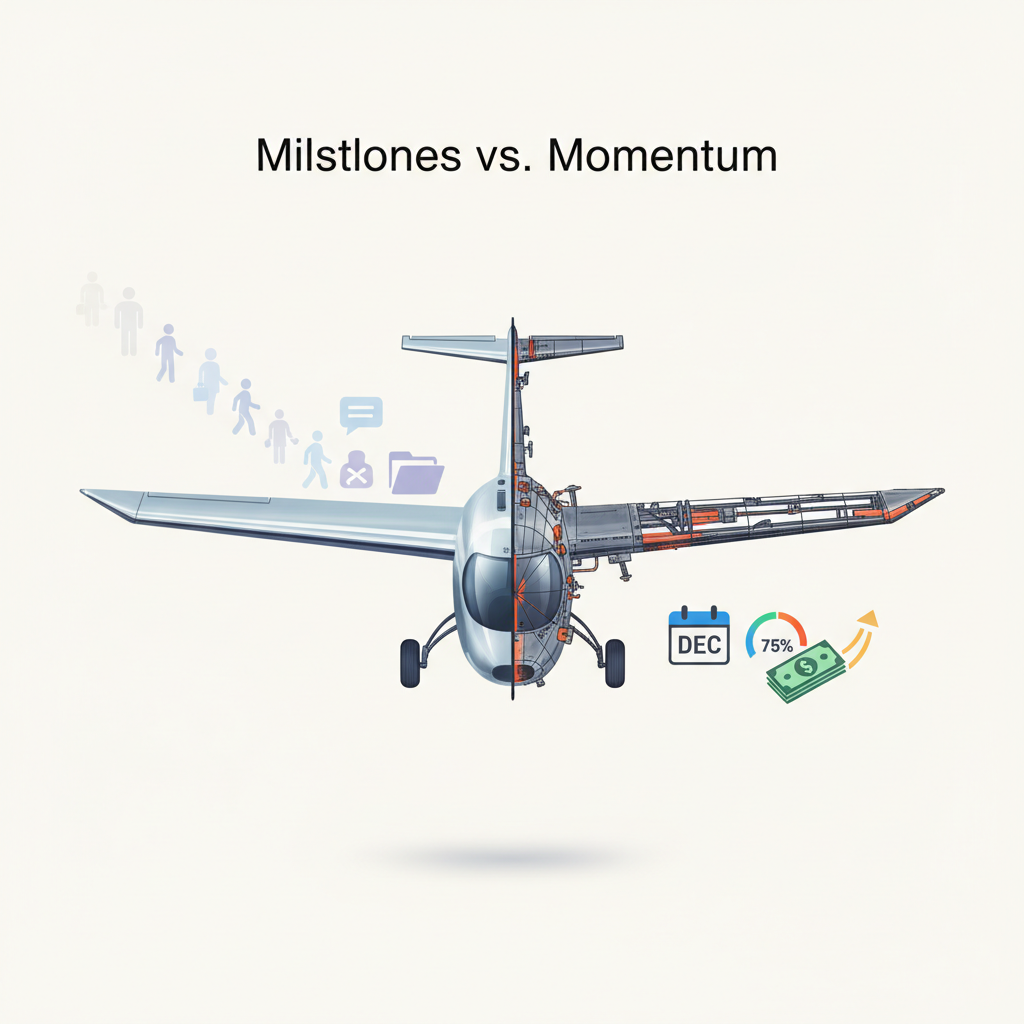
The Helix looks like something a hobbyist welded together in a garage, and that’s not entirely wrong — Pivotal has been building toward this moment since 2009, burning through two brand names, two CEOs, a dead sister company, and at least one founder-imposed ultimatum along the way. Now it’s taking $190,000 reservations and claiming a year’s worth of orders. That’s a headline. But beneath it is a company that laid off 10% of its staff in February 2024 to “make room for different skill sets,” lost one of its first ten employees — a woman who built its flight test program from scratch — and operates on funding conditioned on hitting specific unit and order targets by year-end. That’s not a product launch. That’s a managed survival event.
Larry Page’s involvement matters less than his absence. He founded Kitty Hawk in 2016, watched it sprawl across three companies simultaneously, and eventually consolidated what remained into Pivotal Air. The structure itself — a founder’s patient capital backing a decade-long hardware ambition — reads as a luxury most startups don’t have. In practice, it’s revealed something closer to what happens when governance evaporates and gets replaced by a single decision-maker’s changing priorities.
Milestone-contingent funding is a governance red flag dressed as discipline
Page’s continued cash injections are tied to production counts and customer orders by year-end. It sounds rigorous. It isn’t. What it actually does is transfer execution risk entirely onto the operator while keeping the funder insulated from the consequences of his own capital allocation decisions. If Pivotal hits the targets, Page’s judgment looks validated. If it doesn’t, Pivotal’s leadership absorbs the failure — and the funding dries up, or the company gets restructured under new management, or both.
This structure has a precedent inside Page’s own portfolio. Kittyhawk, the predecessor entity, collapsed in 2022 after internal leadership tensions derailed a planned merger with Opener. The narrative at the time was about “market conditions” and “timeline realities.” The actual story was simpler: when a single investor sets conditions rather than builds institutional resilience, the company becomes a vehicle for that investor’s confidence cycle, not an independent organization with its own momentum.
Hardware companies that operate under milestone-contingent funding don’t optimize for the product. They optimize for the milestone.
This distinction matters because it changes how every decision gets weighted. A team that needs to hit customer order counts by December doesn’t spend engineering cycles on the failure modes that will appear in year two. It doesn’t invest in the documentation and process maturity that would let someone else take over the program. It doesn’t hire for depth. It hires for speed, and it fires for anything that looks like a drag on near-term metrics. The aircraft that ships is the one that satisfies the condition. The organization that built it may not survive contact with reality.
Enterprise IT shops recognize this dynamic instantly because they live it constantly. A vendor whose roadmap is dictated by a single investor’s quarterly mood is a vendor you should dual-source around. A supplier whose product development is contingent on hitting a number by December is a supplier whose priorities don’t align with yours. Pivotal isn’t selling to enterprises — it’s selling to individual customers — but the governance problem is identical. When the company’s survival depends on moving units, the incentive to cut corners, minimize warranty obligations, or rush certification doesn’t vanish. It just gets buried in the operational decisions that the customer never sees until something breaks.
The CIO departure tells you more than the layoff announcement did
Celia Oakley was one of the first ten employees at Pivotal. She built the flight test program from the ground up. She built the internal software tooling that the company runs on. In April 2024, she left.
This happened two months after the February layoffs. CEO Ken Karklin’s memo framed those layoffs as a pivot — “make room for different skill sets and competencies.” The language is deliberate. It lets you avoid saying “we’re changing direction and some people won’t survive it.” In enterprise IT, you’ve seen this exact phrasing before. It’s the memo that precedes a cultural shift, a technology shift, or a leadership shift. Sometimes all three.
What makes Oakley’s departure significant isn’t that she was laid off. She wasn’t. She left voluntarily after watching the company she’d spent a decade building get restructured around her. Her reports were redistributed. No replacement was planned. The institutional knowledge she carried — the decision trees around why the flight control systems were architected the way they were, the failure modes she’d encountered and solved, the reasons certain approaches had been rejected — walked out the door with her.
Hardware companies that gut their foundational engineers to chase near-term metrics discover something consistent: the knowledge those people carried wasn’t documented anywhere.
It lives in Slack threads that get archived. It lives in conversations with people who’ve now left. It lives in the decision to use one component over another, or to validate one assumption instead of testing another, and when the person who made that decision is gone and the next person encounters a problem, they start from zero. This is how you build a company that can ship one generation of a product but can’t iterate on it. This is how you end up with a Helix that works but can’t be improved by anyone except the people who reverse-engineered it from first principles.
The February layoffs were announced as a skill-set pivot. The April departure of the person who built the test program and the internal tools suggests something different: a company in the middle of a structural realignment, shedding the people and practices that got it to a prototype and replacing them with people oriented toward production. This is a valid strategy if you’re shipping a finished product and moving to manufacturing. It’s a catastrophic strategy if you’re shipping a version 1.0 of something that will need iteration.
Pivotal claims a year’s worth of orders at full capacity. If that’s true, the company is betting that the Helix is finished enough that iteration can happen downstream — that customers will live with version 1.0 problems and that the company will have time and resources to fix them in later releases. That’s a plausible bet if you’re selling to customers who understand the risk. It’s a dangerous bet if you’re not.
What’s instructive here isn’t the personnel moves themselves. It’s the pattern they reveal: a company under pressure to hit a number, making structural decisions that prioritize short-term metrics over long-term capability, and losing the people who built the institutional knowledge that would let it recover if those metrics miss.
This is the enterprise story hiding inside the aircraft story. Not whether the Helix works. Whether the organization that built it can sustain what comes next.
Pivotal will ship aircraft this year if the engineering is done and the supply chain holds. Whether the company that emerges from this pressure cycle is still capable of the institutional learning that got it to a sellable product in the first place is a different question entirely. Hardware companies that gut their foundational engineers to chase near-term metrics tend to find out — usually eighteen months too late — that the knowledge those people carried wasn’t documented anywhere. The aircraft may be ready. The organization building it may not be.