The 91 Percent Claim Rate
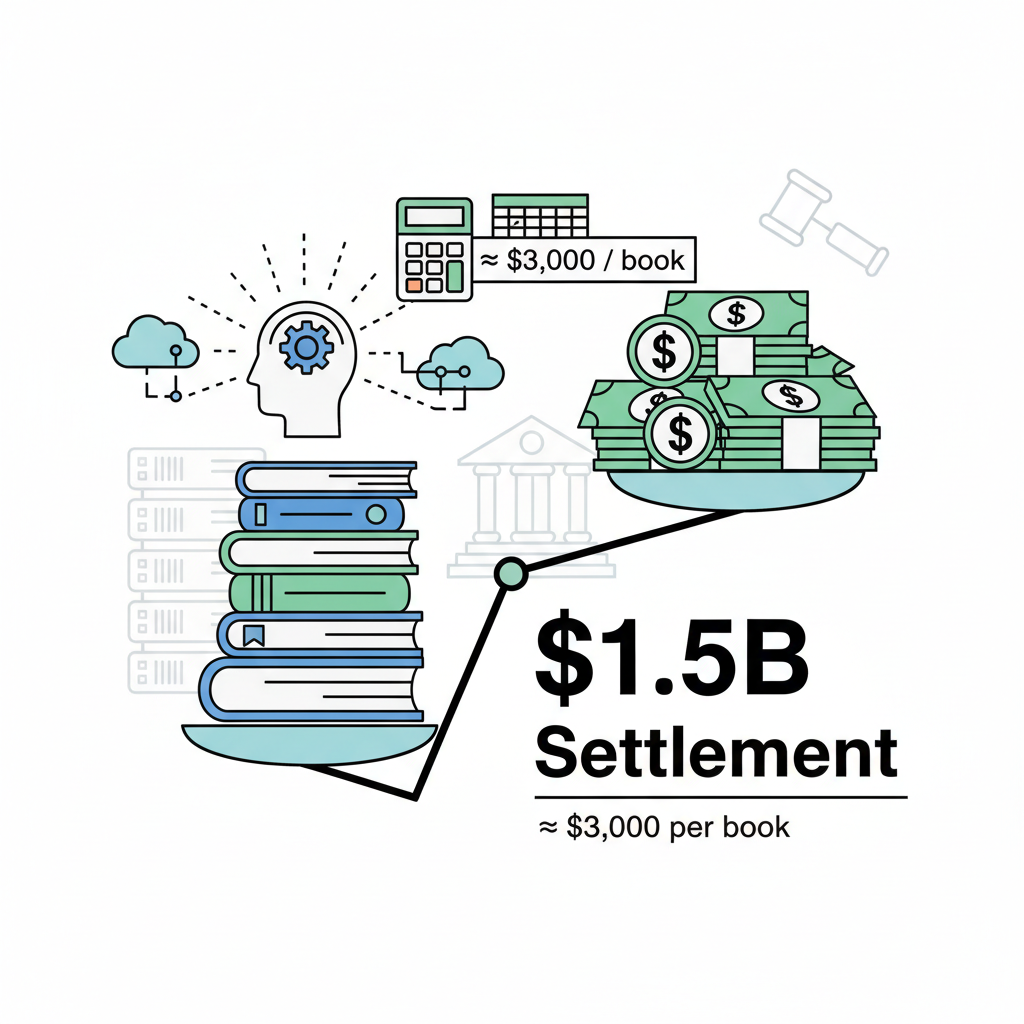
Anthropic pirated roughly 465,000 books. A federal judge found that fair use covered the training itself, but that storing 7 million pirated books in a “central library” crossed the line. The resulting settlement—$1.5 billion, approximately $3,000 per book—is being called the largest copyright recovery in U.S. history. Authors are celebrating. The Authors Guild is calling it historic. Ninety-one percent of covered works have already had claims filed. And somewhere in the legal departments of OpenAI, Meta, Google, and every other major model developer, someone is running the same arithmetic Anthropic just made public: here is what a half-million pirated books costs. Here is the number. Now decide if you can live with it.
The settlement is being framed as a watershed moment for creator protection. It is not. It is price discovery.
The buried lead in the Anthropic case is the one nobody seems to be emphasizing: Judge Alsup found that Anthropic’s use of copyrighted books to train Claude was fair use. The training itself—the actual computational process of extracting patterns from text—passed the fair use test. The liability attached to something else entirely: how Anthropic sourced and stored the material. Shadow libraries. A persistent “central library” of pirated works maintained as infrastructure. The judge’s ruling essentially says that training on copyrighted text at scale can be fair use, but the way you organize your piracy matters.
For a company backed by Amazon and Alphabet, $1.5 billion is a known, finite cost of doing business.
Consider what that number actually means in operational terms. Anthropic has raised roughly $6.5 billion in funding to date. The settlement represents about 23 percent of that capital. It is not negligible. But it is also not catastrophic. It is not an injunction. It is not a prohibition on training models on copyrighted material. It is a bill. A retroactive licensing fee. Maria Pallante, president of the Association of American Publishers, called it a message that “copying books from shadow libraries has serious consequences.” The consequence is a bill, not a prohibition. There is a meaningful difference.
Every other major AI company is now running the same calculation.
The question they are asking is not “should we train on copyrighted material?” They already have. The question is whether the cost of a settlement, amortized across the value of a large language model, makes financial sense. For OpenAI, which has been valued at $80 billion. For Meta, which is trying to justify its massive compute spend. For Google, which has the balance sheet to absorb almost any fine short of genuine antitrust penalties. The answer is almost certainly yes. The settlement establishes a ceiling on liability, not a floor on acceptable behavior. If Anthropic can pay $3,000 per book and call it settled, and if the model trained on those books is worth billions, the math is straightforward.
There is a scenario where this settlement actually creates competitive pressure to source training data more cleanly—through licensing, through synthetic generation, through techniques that don’t require access to shadow libraries. That scenario requires that clean data sourcing be substantially more expensive than the amortized cost of a settlement. It requires that regulators or courts treat future cases differently. It requires that customers actually care how their AI was trained. None of those conditions are obviously true.
The 91 Percent Claim Rate
Nearly 120,000 rights holders filed claims for 91 percent of covered works. That number is being cited as evidence of a successful class action settlement. In reality, it is evidence of how thoroughly authors and publishers were kept in the dark about their work’s use. The median claim rate in U.S. class actions is approximately 9 percent, according to a 2019 FTC report. A 91 percent participation rate does not happen when claimants are confident they are being fairly compensated. It happens when they are shocked to learn their work was in a pirated dataset and they want to register the fact before the window closes.
The attorney fee request tells a different story than the headlines.
Anthropic’s legal team originally sought $300 million in attorney fees. A federal judge found that excessive and reduced it to $187.5 million—12.5 percent of the settlement. That is not a trivial slice. The Authors Guild and the Association of American Publishers negotiated the settlement on behalf of the covered works, and individual authors had limited visibility into the process. The judge himself noted that the guild and the AAP were working “behind the scenes” in ways that could pressure authors to accept without fully understanding the terms. Several authors have filed objections arguing that the settlement undercompensates their work or improperly excludes foreign copyright holders who contributed to the pirated dataset.
Consider a concrete case: a mid-list author with five books in the dataset. Those five books might have contributed meaningfully to Claude’s capability in their specific genre—their style, their subject matter, their particular way of structuring narrative. The author would receive approximately $15,000 total. Those five books might have been trained on by thousands of people building systems that depend on Claude’s fluency in that genre. The gap between the contribution and the payout is where the real argument lives, and it is almost entirely invisible in the settlement terms.
The settlement does not resolve who bears the cost of the training data.
In a functioning market, the cost of using copyrighted material is negotiated between the creator and the user before the use occurs. Here, the cost was determined retroactively by a judge, and it was set at a level that reflected the defendants’ leverage, not the creators’ loss. The Authors Guild negotiated the best deal they could get from a company with substantial legal resources and an incentive to establish a precedent that training on copyrighted material is expensive but doable. That is not the same as the market clearing price for copyrighted training data. It is the price that results when one side has already extracted the value and the other side is negotiating over the cleanup cost.
What Happens Next
The companies watching this settlement most closely are not the ones being sued. They are the ones still in discovery, or not yet named, or quietly reviewing their data sourcing practices to see whether they look more like Anthropic’s shadow library problem or less. They are running the same arithmetic. They are asking whether their legal exposure is higher or lower than $1.5 billion. They are asking whether the value they extracted from copyrighted training data is higher or lower than the settlement would cost.
Some of them will decide to source training data more cleanly going forward.
Some of them will decide that the cost of a settlement is acceptable and that the advantage of having already trained on copyrighted material is worth the liability. Some of them will split the difference, licensing some material prospectively while accepting that they have already incurred liability for past use. None of those decisions represent a victory for creators. They represent a negotiation of the terms on which AI companies can use creative work without permission.
What this case did not resolve—and what no settlement can resolve—is whether training on copyrighted material at scale is fundamentally compatible with copyright law as written, or whether the industry has simply found a workable way to pay for the damage after the fact and call it progress. The fair use ruling on training itself suggests the latter. The settlement suggests the former. Both are true simultaneously. The law is unclear. The precedent is mixed. The companies are making bets based on what they think the next judge will decide.
That question is still live. The meter is still running.