Untitled Post
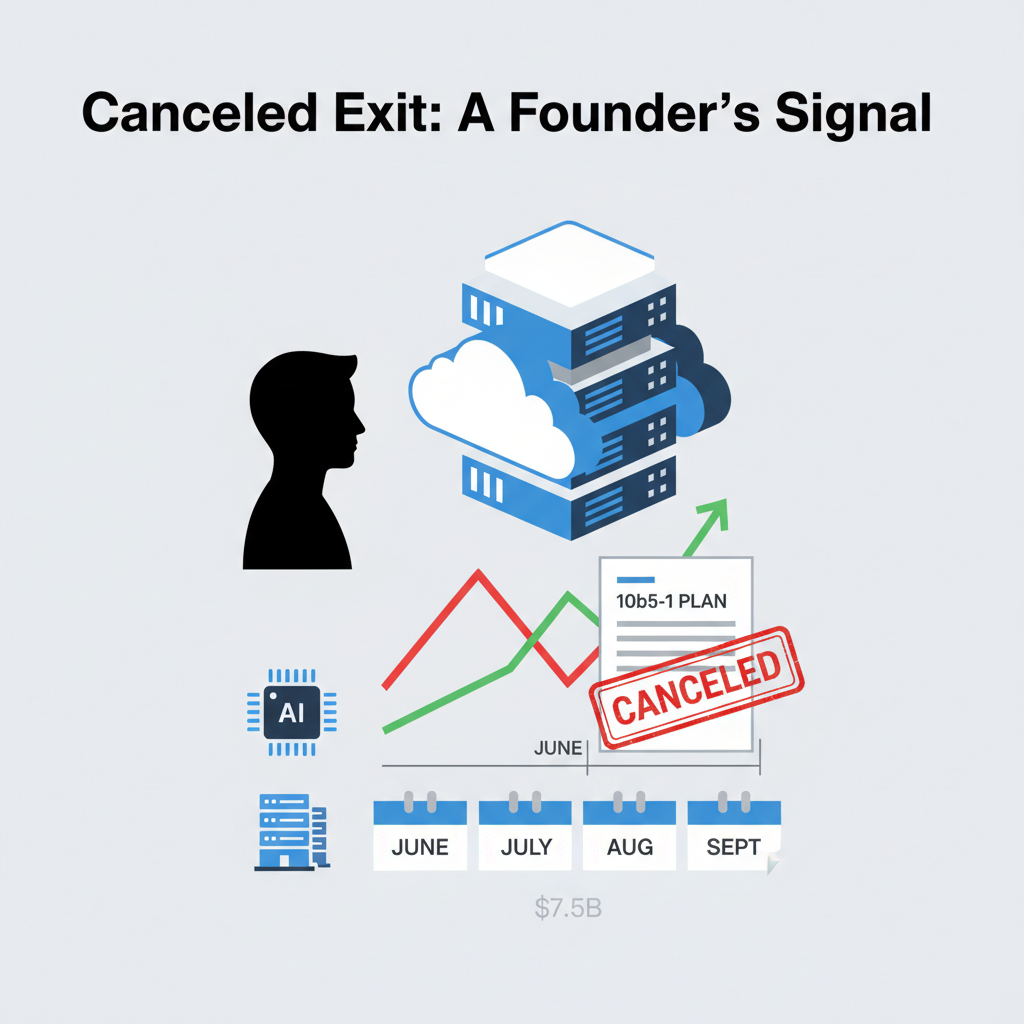
Oracle disclosed a 10b5-1 trading plan on a Friday. By Saturday, it was gone. No shares sold. No explanation given. Just a terse press release saying Larry Ellison “has no other plans to sell any of his Oracle stock.” The financial press treated it as a confidence signal and moved on. But the timeline is worth sitting with: Ellison adopted the plan on June 22, let it sit for nearly three months while Oracle’s stock shed more than 22% year-to-date, then pulled it the day after it became public knowledge. That sequence — set up a quiet exit, watch it leak, cancel it loudly — is not a routine insider transaction. It’s a message.
The question for anyone running Oracle infrastructure is what exactly that message is about.
Start with the stock price. Oracle closed 2025 at $193. By mid-September 2026, it was trading near $150. The 52-week high of $304.38 sits in the rearview mirror. That’s not a minor correction or the normal compression that follows a run. That’s a company whose valuation story has been aggressively repriced by the market.
The repricing has a specific cause: Oracle committed to a massive capex expansion to build cloud infrastructure for AI workloads. The company has flagged $45 to $50 billion in planned debt and equity raises for 2026 alone to fund capacity for customers including OpenAI, Meta, xAI, and Nvidia. Free cash flow is under pressure. The capital intensity is real and visible.
A founder holding 38% of a company does not set up a $7.5 billion liquidity plan casually.
When Ellison adopted the 10b5-1 on June 22, Oracle’s stock was still trading above $175. The plan allowed for the sale of up to 20 million shares at any price above a floor he set. That wasn’t a casual diversification move. That was insurance. A deliberate hedge against a capital-intensive year going sideways. The timing matters because June is when the reality of the capex commitment was starting to settle in across Wall Street. Ellison had the option to do this earlier. He chose June.
Then the stock fell.
By early September, when the plan became public, Oracle had shed more than $40 billion in market value from the point of adoption. The shares Ellison could have sold in June were now worth less. That’s the kind of environment where a $7.5 billion exit looks increasingly attractive. Except he canceled it.
The public narrative around Oracle in the middle of 2026 was consistent: Oracle is an AI infrastructure winner. The company is capturing a slice of the massive capex spend flowing to cloud providers building capacity for AI training and inference. Revenue is accelerating. Cloud infrastructure is doubling year-over-year. The story reads well in analyst briefings and earnings calls.
But Ellison’s private behavior in June told a different story.
He set up an exit when the stock was stronger and the narrative was cleanest. That’s what you do when you’re not confident the narrative holds. You lock in optionality before things get messier. You don’t do that if you believe the next 12 months are going to validate the bull case.
Then something changed.
Oracle reported Q1 FY2027 results in early September. Revenue grew 29.6% year-over-year. Cloud infrastructure revenue doubled. The numbers were strong — stronger than what the market had been pricing in after months of selling. The quarter landed during the same week Ellison canceled the trading plan. That’s not coincidence. He looked at those results and decided the floor was closer than he’d thought in June. The capex was paying off faster. The AI infrastructure trajectory was steeper. The stock, down 22% year-to-date, was cheap.
He canceled the plan.
There’s also forward optionality baked into the timing. Oracle has a calendar of catalysts coming: an agentic AI accelerator announcement at AI World in October, a $0.50 per share quarterly dividend with an October record date. Canceling the trading plan before those events maximizes upside capture and eliminates the execution risk of being locked into a preset selling schedule while news breaks. That’s the move of someone who thinks the near-term floor is solid and the ceiling is higher than the market is pricing.
For enterprise IT shops in the middle of infrastructure evaluations, this isn’t a signal about whether to buy Oracle stock.
It’s a signal about vendor longevity and conviction. The person with the deepest product knowledge and the most to lose — Ellison controls the company’s strategic direction and owns more of it than anyone — just decided that Oracle’s near-term trajectory is worth more than $7.5 billion in immediate liquidity. That’s different from what he believed three months earlier when he hedged. The repricing of that belief is worth noting.
It doesn’t change the total cost of ownership math on a multi-year cloud infrastructure commitment. It doesn’t resolve Oracle’s free cash flow pressure or eliminate the capex intensity. It doesn’t guarantee the AI infrastructure build pays off on the timeline Oracle is promising. Capital expenditure this large often disappoints. Timelines slip. Returns compress.
But it does suggest that the people running the company think the odds are good enough to hold instead of exit.
Enterprise infrastructure decisions rarely get the luxury of clean signals. Most of the time you’re reading tea leaves from product roadmaps, analyst briefings, and sales conversations engineered to reassure you. A founder quietly setting up a $7.5 billion exit and then canceling it the moment it surfaces is something different. It’s an unscripted data point. It doesn’t tell you whether Oracle’s strategy is correct. It tells you what the founder believes when he’s not performing for analysts. That’s worth filing away.