Automated Lead Scoring: How to Prioritize Your Best Prospects Without the Guesswork
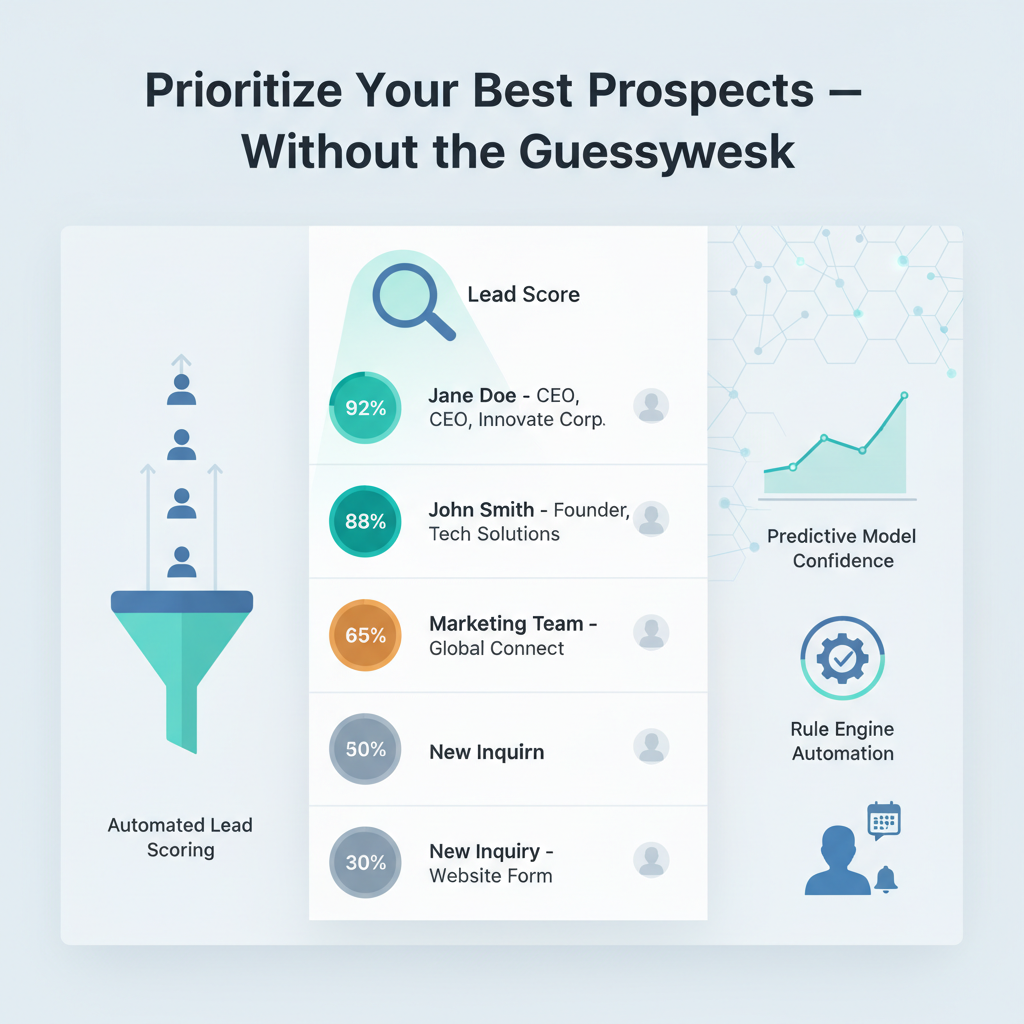
Automated Lead Scoring: How to Prioritize Your Best Prospects Without the Guesswork
Estimated reading time: 12 minutes
Key Takeaways
- Lead scoring assigns numerical values to prospects based on demographics, engagement, and behavioral signals to prioritize the hottest opportunities.
- Two main approaches exist: rule-based scoring (transparent and easy to audit) and predictive/AI-based scoring (dynamic and data-hungry). Choose based on data maturity and needs.
- Alignment and efficiency—automation creates cross-team alignment between marketing and sales and speeds up qualification and routing.
- Start with fundamentals like defining your ICP, identifying meaningful signals, and testing with a pilot before full deployment.
Table of contents
- What is Lead Scoring, Really?
- Why Automate Lead Scoring?
- Rule-Based Versus Predictive Lead Scoring
- Lead Scoring Tools: What to Evaluate
- How to Automate Lead Scoring: Step-by-Step Guide
- Best Practices for Automated Lead Scoring
- Metrics for Evaluating Automated Lead Scoring Success
- Case Studies and Evidence
- Taking Action: Your Lead Scoring Audit
Imagine your sales team drowning in hundreds of new leads every week, but nobody can agree on which ones deserve immediate attention. Some reps chase every inquiry that comes through the door. Others rely on gut feeling to decide who’s worth calling. Meanwhile, your best prospects might be sitting in a queue, waiting for someone to notice they’ve visited your pricing page three times this week.
This isn’t just inefficient—it’s expensive. And it’s exactly the problem that automated lead scoring was designed to solve.
Automated lead scoring is the process of assigning numerical values or ranks to leads using automated systems, helping you prioritize prospects based on their likelihood to buy. Instead of manually reviewing every contact or relying on inconsistent judgment calls, you’re using a combination of rules-based methods and—in more advanced cases—AI or machine learning to identify your hottest opportunities.
The impact on your sales funnel can be substantial. When implemented thoughtfully, automated lead scoring improves sales efficiency by filtering high-potential leads quickly, reduces wasted effort chasing uninterested contacts, and creates alignment between marketing and sales teams on what “lead quality” actually means.
But here’s the thing: not all automation is created equal. Before we dive into lead scoring tools and implementation strategies, let’s make sure we’re all speaking the same language about what lead scoring actually is and how it’s evolved.
What is Lead Scoring, Really?
How do businesses decide which leads deserve immediate attention and which need nurturing? That’s the fundamental question lead scoring answers.
At its core, lead scoring is a systematic way to assign values or points to prospects based on demographic data, engagement activities, and behavioral intent signals. Think of it like a credit score, but instead of predicting someone’s ability to repay a loan, you’re predicting their likelihood of becoming a customer.
The evolution of lead scoring tells you a lot about why automation matters. In the early days, human teams manually assigned points to leads—a process that was slow, inconsistent, and nearly impossible to scale. One sales rep might think a LinkedIn connection is worth pursuing, while another dismisses it entirely.
Rule-based automated scoring improved on this by creating predefined rules that assign points based on specific actions. Download a whitepaper? Add 10 points. Request a demo? Add 15 points. Located outside your service area? Subtract 10 points. This approach brought consistency, but it remained somewhat rigid.
Today’s most sophisticated systems use predictive or AI-based scoring, where machine learning models analyze historical data to dynamically assign scores. These systems can identify patterns that humans might miss and adapt as buyer behavior changes.
Regardless of which approach you use, effective lead scoring evaluates three core dimensions:
Fit refers to how well a prospect matches your ideal customer profile—company size, industry, role, budget, technology stack, and other characteristics that define your best customers.
Engagement measures how actively someone interacts with your brand through email opens, webinar attendance, content downloads, website visits, and other touchpoints that signal interest.
Intent and timing captures the signals that suggest someone is actively considering a purchase—visiting pricing pages, requesting demos, comparing products, or showing concentrated recent activity.
Here’s a simple example: A lead who visits your pricing page scores higher than someone who only read a blog post because pricing page visits signal readiness to buy. The behavior itself tells you something meaningful about where they are in the buying journey.
Understanding how to automate lead scoring starts with recognizing these fundamental dimensions. Now let’s explore why automating this process delivers such substantial benefits.
Why Automate Lead Scoring?
What if lead qualification could be faster, more consistent, and less prone to human error? That’s not a hypothetical—it’s what happens when you move from manual to automated lead scoring.
The efficiency gains alone are compelling. Sales reps spend less time sifting through contact records trying to figure out who to call next. Marketing teams don’t need to manually review form submissions to decide which ones warrant immediate routing to sales. The system handles the tedious review tasks, freeing people to focus on actual conversations with prospects.
Read more about business process automation
But efficiency is just the beginning. Consistency matters even more in many organizations. When you automate lead scoring, every lead gets evaluated using the same criteria. You’re no longer dependent on whether a particular rep is having a good day or whether they happen to recognize a brand name. The scoring logic applies uniformly across your entire database.
Speed becomes a competitive advantage. Scores update in real-time as leads engage with your content, visit your website, or take other actions. That means your hottest prospects get flagged for immediate follow-up rather than sitting in a queue until someone manually reviews them.
The prioritization benefit is straightforward but powerful: automated lead scoring highlights your most promising prospects so sales can focus their energy where it’s most likely to pay off. Instead of working leads in the order they arrived or making random choices, reps can systematically pursue the opportunities with the strongest combination of fit and intent.
Perhaps most importantly, automation creates alignment between marketing and sales. When both teams share a common definition of what makes a lead qualified—backed by objective scoring criteria—you eliminate the endless debates about lead quality. Marketing knows what thresholds to hit before routing leads to sales. Sales knows what to expect when they receive a qualified lead.
And unlike manual processes, automated scoring scales beautifully. Whether you’re handling 100 leads per month or 10,000, the system continues to operate without requiring proportional increases in staff.
Now, I’d be doing you a disservice if I didn’t acknowledge the limitations. Automated lead scoring isn’t a magic solution that guarantees results.
Poor data quality will skew your scores. If your CRM is full of duplicate records, incomplete fields, and outdated information, your scoring model will produce unreliable results. Garbage in, garbage out still applies.
Read our automation readiness checklist to improve data quality and readiness
The model needs regular updates. Buyer behavior changes. Your product evolves. Market conditions shift. A scoring model that worked brilliantly two years ago might miss important signals today if you haven’t reviewed and adjusted it.
Most importantly, scores are signals—not guarantees. A high score means someone is worth prioritizing, not that they’re definitely going to buy. You still need human judgment, good sales conversations, and appropriate follow-up to convert opportunities into customers.
Think of automated scoring like a GPS navigation system that adapts route recommendations as traffic changes. It’s incredibly helpful for getting you where you need to go more efficiently, but it’s not infallible. Sometimes you need to override the suggested route based on knowledge the system doesn’t have.
With that context in mind, let’s distinguish between the two main automation approaches you’ll encounter when evaluating lead scoring tools.
Rule-Based Versus Predictive Lead Scoring
Not all automation is created equal, and this is where many organizations get confused. What’s the actual difference between rule-based and AI-powered lead scoring?
Rule-based scoring is what most people think of when they first encounter automated lead scoring. Your marketing or sales team creates explicit scoring rules: “Give 15 points for requesting a demo. Give 10 points if the company has more than 500 employees. Subtract 10 points if they’re outside our target geography.”
The appeal of this approach is transparency and control. You know exactly why a lead received a particular score because you wrote the rules. It’s relatively easy to set up, especially if you’re starting with a simple model. And you can audit the logic whenever questions arise.
The limitation is rigidity. Your rules stay the same until someone manually updates them. If buyer behavior changes—maybe prospects now research differently or engage through new channels—your scoring model won’t automatically adapt. You’re also limited by what you can explicitly define. Complex patterns that might predict conversion aren’t captured unless you happen to think of them and write a rule.
Predictive scoring takes a fundamentally different approach. Instead of manually defining rules, you let machine learning algorithms analyze historical data to discover patterns in which leads convert. The system looks at your past opportunities and customers, identifies the characteristics and behaviors they shared, and assigns dynamic scores based on similarity to those patterns.
The power of predictive models lies in their ability to find non-obvious correlations. Maybe your best customers consistently engage with certain content combinations. Or perhaps there’s a particular sequence of website visits that strongly predicts conversion. The algorithm can identify these patterns even when they’re too subtle or complex for humans to spot.
Predictive scoring also adapts over time as new data becomes available. As your customer base grows and buyer behavior evolves, the model can incorporate those changes without requiring someone to manually rewrite rules.
But predictive scoring comes with its own challenges. It often operates as a “black box”—you can see the score, but understanding exactly why a lead received that score requires more effort. This can create trust issues, especially with sales teams who want to understand the reasoning behind prioritization decisions.
Predictive models also have significant data requirements. You need a substantial volume of historical conversions to train the algorithm effectively. If you’re a new company or you’ve recently pivoted to a new market, you might not have enough data to make predictive scoring reliable.
Here’s a quick comparison to help you think through which approach might fit your situation:
Rule-Based Scoring:
- Setup requires manual rule creation by your team
- Transparent and easy to audit
- Static rules that don’t change unless you update them
- Works with minimal historical data
- Best when buyer behavior is relatively straightforward and stable
Predictive (AI-Based) Scoring:
- Setup requires historical data and algorithm training
- Less transparent; requires trust in the model
- Dynamic and self-learning as new data arrives
- Requires large, reliable datasets to be effective
- Best when you have complex buyer journeys and substantial conversion history
Let me give you concrete examples of how each works in practice.
A rule-based scoring model might look like this: “+15 points for requesting a demo; +10 points for attending a webinar; +8 points for downloading a buying guide; +10 points if company size matches target; −10 points if outside target geography; −5 points for 30 days of inactivity.”
A predictive model would instead analyze your historical data and might discover: “Past buyers typically visited the pricing page at least three times in the week before converting, engaged with at least two pieces of content, and matched specific firmographic profiles. Leads showing similar patterns receive higher scores automatically.”
The decision between these approaches shouldn’t be based solely on which sounds more sophisticated. Consider your data maturity, your team’s ability to maintain the system, and whether you need to explain scoring decisions to skeptical stakeholders.
Many organizations start with rule-based scoring to establish the foundation, then graduate to predictive models once they have sufficient data and experience. That’s a perfectly reasonable path.
If you’re interested in the technical principles behind agentic AI and predictive systems, we also have a deep guide and downloadable resource that dives into agent design and architectures.
Learn more about predictive AI agents and download the principles guide (PDF)
Now that you understand the automation approaches, let’s look at what capabilities to evaluate when you’re choosing lead scoring tools.
Lead Scoring Tools: What to Evaluate
With so many lead scoring tools on the market, how do you choose the right one for your business? The answer depends less on feature checklists and more on how well the tool fits your specific situation.
Start with integration requirements. The best lead scoring tool is the one that connects seamlessly with your existing CRM and marketing automation platform. If you’re already using Salesforce, HubSpot, or another major system, native scoring features or purpose-built integrations will save you enormous headaches compared to standalone tools that require complex data syncing.
Learn more about sales and CRM automation
Data capabilities matter enormously. Your scoring tool needs to handle both behavioral data (website visits, email engagement, content downloads) and demographic or firmographic data (company size, industry, role, location). The most sophisticated tools also incorporate technographic data (what technology stack a company uses) and intent data (third-party signals about active research behavior).
Flexibility in scoring approaches gives you room to grow. Even if you’re starting with rule-based scoring, you might want predictive capabilities later. Look for tools that support both approaches rather than locking you into one methodology.
Customization and ease of rule creation determine how well you can adapt the system to your specific buyer journey. Can you easily add new scoring criteria as you learn what matters? Can you weight different signals appropriately? Can you create different scoring models for different products or segments?
Workflow automation capabilities extend the value of scoring beyond just assigning numbers. When a lead crosses a threshold, can the system automatically route them to the right sales rep, trigger a notification, add them to a specific nurture campaign, or update their status in your CRM? These integrations turn scores into action.
Score decay features are surprisingly important but often overlooked. A website visit from six months ago shouldn’t carry the same weight as yesterday’s pricing page view. Good scoring tools let you configure how quickly older activity loses value.
Some advanced tools separate fit scores from engagement scores, which helps you distinguish between prospects who match your ideal customer profile but haven’t engaged yet (good candidates for targeted outreach) and highly engaged prospects who don’t fit your profile (maybe researchers, students, or competitors).
Reporting and analytics tied to revenue impact help you validate that your scoring model actually works. Can you see conversion rates by score range? Can you track how scored leads progress through your pipeline? Can you measure revenue generated from high-scoring versus low-scoring leads?
Data governance, privacy compliance, and audit trails matter more than many people realize. You need to ensure your scoring practices comply with privacy regulations, and you need the ability to explain scoring decisions when questions arise.
Finally, consider ease of testing and updating. Your first scoring model won’t be perfect. You’ll need to iterate based on results. Tools that make it easy to test changes, compare model versions, and roll back if needed will serve you much better than rigid systems.
The tool landscape includes several categories worth understanding:
CRM-native tools like Salesforce’s Einstein or Microsoft Dynamics 365 offer scoring features built directly into the platforms you’re already using. The integration is seamless, but capabilities might be more limited than specialized tools.
Marketing automation platforms like Adobe Marketo Engage and HubSpot include lead scoring as core functionality. These work well if marketing owns lead qualification in your organization and you’re already using the platform for campaigns and nurturing.
Specialized predictive-scoring software focuses specifically on advanced scoring algorithms and often incorporates additional data sources beyond what’s in your CRM. These tools can be powerful but require more setup and ongoing maintenance.
Revenue-intelligence and intent-data platforms combine scoring with broader sales-intelligence capabilities, often incorporating signals from across the web about active research behavior. These tend to be more expensive but can provide earlier warning of buying intent.
I’m deliberately not recommending specific tools because the right choice depends entirely on your CRM environment, sales process, data maturity, team size, budget, and whether you need rule-based or predictive scoring. What works beautifully for a fast-growing SaaS company might be overkill for a small B2B services firm.
The most important question isn’t “which tool is best?” It’s “which tool fits our specific needs and can we actually implement it effectively?”
Once you’ve selected a tool, implementing automated lead scoring requires a structured approach. Let’s walk through exactly how to do that.
How to Automate Lead Scoring: Step-by-Step Guide
Implementing automated lead scoring doesn’t have to be overwhelming. Follow these actionable steps to get started, and you’ll avoid the most common pitfalls that derail scoring projects.
Step 1: Define the Desired Outcome
Before you touch any software, decide what success looks like. Don’t start with “we want automated lead scoring.” Start with the business problem you’re trying to solve.
Are you trying to improve your MQL-to-SQL conversion rate because too many unqualified leads are reaching sales? Are you trying to reduce sales cycle times by ensuring reps contact prospects at the right moment? Are you trying to increase pipeline volume by identifying more opportunities earlier? Are you trying to improve rep productivity by reducing time wasted on low-quality leads?
Your desired outcome shapes everything else—which signals matter most, what thresholds to set, and how to measure success. Get specific about what you’re optimizing for.
Step 2: Define Your Ideal Customer Profile
You cannot score leads effectively without a clear picture of who you’re looking for. Document the characteristics of your best customers in detail.
Start with firmographic attributes: industry, company size, geography, annual revenue, growth stage, and organizational structure. Then add role-based criteria: what job titles, seniority levels, and functional areas do your best customers come from?
Go deeper into use case and context. What problems are they trying to solve? What budget ranges do they typically have? What technology are they already using that might indicate fit or need? What other factors correlate with customer lifetime value or strategic importance?
This isn’t guesswork. Look at your actual customers. Which ones are most profitable? Which ones succeeded with your product? Which ones referred others or expanded their relationship? Those are your ideal customers. Document what they have in common.
Step 3: Identify Meaningful Signals
Now break down the signals that indicate someone matches your ideal customer profile and is showing buying intent.
Fit signals come from company and contact attributes: Does their company size match your target? Are they in the right industry? Does their role suggest they have purchasing authority or influence? Is their location within your service area?
Engagement signals come from content and website activity: Have they opened your emails? Downloaded content? Attended webinars? Visited your website? Engaged on social media? The key is distinguishing between casual browsing and serious research.
Intent signals are the strongest predictors of near-term buying activity: pricing page visits, demo requests, product comparison research, contact form submissions, and repeated visits to high-value pages. These behaviors suggest someone is actively evaluating solutions.
Negative signals help you avoid false positives: prolonged inactivity, unsubscribes, poor company fit, irrelevant job roles, or traffic patterns that suggest bot activity rather than human interest.
Here’s the critical part: use evidence from historical customer behavior rather than guessing. Look at what your past customers did before they bought. Which actions and attributes were most common among people who converted? Weight your scoring model accordingly.
Step 4: Establish Scoring Thresholds and Corresponding Actions
A score becomes useful only when it triggers a defined action. Otherwise, you’re just collecting numbers.
Define clear ranges and what happens at each level:
- Low score (0-30): Lead enters automated nurture campaigns designed to build awareness and engagement over time.
- Medium score (31-60): Marketing sends targeted content offers or invitations to educational events. These leads aren’t ready for sales yet but warrant more attention than basic nurture.
- High score (61-80): Lead receives sales review. A rep examines the record to determine whether direct outreach is appropriate.
- Very high score (81-100) plus strong fit: Immediate routing to an appropriate sales representative with notification and expected response time.
Include service-level agreements in the threshold definitions. For example, sales will contact hot leads within two business hours. This creates accountability and ensures high-scoring leads don’t sit in a queue.
The specific numbers don’t matter as much as having clear definitions that everyone understands and follows consistently.
Step 5: Configure the System
Map the data fields you’ll use for scoring. Make sure the information you need is actually captured in your CRM and marketing automation platform. If key fields are empty or unreliable, fix your data collection process first.
Input your point values or model parameters based on the signals you identified in Step 3. Configure score decay rules so older activity gradually loses weight. Set up exclusion rules for contacts who should never be scored (existing customers, employees, known competitors).
Configure the thresholds you defined in Step 4 and connect them to automated workflows. When someone crosses a threshold, what happens? Set up lead routing logic, notifications to sales reps, campaign enrollment, and CRM field updates.
Establish synchronization between your marketing automation platform and CRM so scores flow to wherever sales reps actually work. Nothing kills adoption faster than requiring reps to check multiple systems to see lead scores.
Build reporting dashboards so you can monitor how leads distribute across score ranges, track conversion rates by score, and identify patterns over time.
Step 6: Test Before Full Deployment
Do not launch your scoring model to the entire database without testing it first.
Run the scoring model against historical leads and compare its rankings with actual outcomes. Did leads who eventually became customers score highly? Or did your model assign high scores to leads that never converted?
Look specifically for false positives—leads scored highly by your model that didn’t convert. What do they have in common? Are you overvaluing certain behaviors? Are you missing important disqualifying factors?
Also identify false negatives—leads scored poorly that eventually became valuable customers. What signals did your model miss? Were there unconventional buyer journeys your rules didn’t account for?
Test with a small pilot group of sales reps before rolling out broadly. Get their feedback on whether the scores actually help them prioritize. Adjust based on what you learn.
Step 7: Monitor and Optimize Continuously
Your scoring model is never finished. Buyer behavior changes. Your product evolves. Markets shift. Effective lead scoring requires ongoing monitoring and optimization.
Review performance regularly across different segments, campaigns, lead sources, industries, and sales representatives. Are certain sources consistently producing high-scoring leads that convert? Are others generating high scores but poor outcomes?
Track the metrics we’ll discuss in the next section to validate that your scoring model is actually improving business results, not just assigning numbers.
Schedule quarterly or biannual reviews where marketing and sales jointly examine the model. What’s working? What needs adjustment? Have qualification standards changed? Are there new signals you should incorporate?
Don’t be afraid to make significant changes if the data suggests your model isn’t working. It’s better to iterate aggressively based on evidence than to stick with a model that’s producing poor results.
Best Practices for Automated Lead Scoring
Getting lead scoring right means combining technical configuration with strategic thinking. Here are the practices that matter most.
Use both fit and engagement signals to avoid false positives. This is perhaps the single most important principle. Engagement alone can over-prioritize students researching a topic, competitors monitoring your content, journalists gathering information, or existing customers browsing for unrelated reasons. You need to confirm that engaged leads also match your ideal customer profile before routing them to sales.
Implement score decay so older activity carries less weight than recent engagement. A webinar attended six months ago tells you much less about current buying intent than a pricing page visit yesterday. Configure your system to gradually reduce the point value of aging activities. A common approach is to reduce scores by a percentage each month for activities older than 30 or 60 days.
Differentiate scoring at account and contact levels for B2B sales. In complex B2B deals, multiple people from the same company might engage with your content. One engaged contact might not mean much, but three or four engaged contacts from the same account often indicates genuine organizational interest. Some advanced tools support account-level scoring that aggregates activity across all contacts.
Make scoring thresholds actionable with clear next steps. Every score range should correspond to specific actions that marketing or sales will take. If you can’t define what happens when a lead reaches a certain score, that threshold isn’t useful.
Involve sales reps in defining and refining scoring indicators. Marketing teams often build scoring models in isolation, then wonder why sales doesn’t trust them. Bring sales into the process from the beginning. They can identify subtle signals that analytics alone might miss—like certain questions that indicate serious interest or objections that predict poor fit.
Regularly audit results based on actual conversion and revenue outcomes, not just lead volume. A scoring model that generates lots of “qualified” leads isn’t successful if those leads don’t convert. Measure what matters: pipeline creation, opportunity conversion, revenue, and sales cycle length.
Ensure data quality to prevent garbage scores. Duplicate records will inflate scores. Incomplete fields will cause leads to be scored incorrectly. Bot traffic will generate false engagement signals. Inconsistent lifecycle stages will confuse your model. Invest in data hygiene as much as you invest in scoring logic.
Document the scoring logic clearly so users understand why scores are assigned. Sales reps are more likely to trust and act on scores when they understand the reasoning. Create simple documentation that explains what behaviors and attributes drive scores up or down.
Measure financial impact—pipeline and revenue—not just engagement metrics. It’s easy to get distracted by increases in email opens, content downloads, or webinar attendance. Those might correlate with better outcomes, but what you actually care about is whether high-scoring leads create more pipeline and generate more revenue.
HubSpot’s guidance on lead scoring emphasizes using the combination of demographic information and behavioral signals to prioritize leads, route them when they pass qualification criteria, and support more relevant nurturing based on what you know about them. That integrated approach—where scoring drives action across the entire go-to-market process—is what separates effective implementations from ones that just assign numbers.
One more best practice worth highlighting: be transparent with your team about the limitations. Automated lead scoring is a prioritization tool, not a crystal ball. High scores indicate where to focus attention first, but they don’t guarantee conversion. Sales judgment, good conversations, and appropriate follow-up still matter enormously.
So how do you know if your automated lead scoring is actually working? Let’s talk about the metrics that matter.
Metrics for Evaluating Automated Lead Scoring Success
How do you know if your automated lead scoring is truly driving sales results? You need to measure the right things.
- Lead-to-opportunity conversion rate measures the percentage of scored leads that progress to sales opportunities. Compare this rate for high-scoring versus low-scoring leads. If your scoring model is effective, high-scoring leads should convert at meaningfully higher rates.
- MQL-to-SQL conversion rate tracks how many marketing-qualified leads become sales-qualified leads. This metric reveals whether your scoring thresholds are set appropriately. If sales accepts most leads that cross the MQL threshold, your model is working. If they reject most of them, your thresholds need adjustment.
- Opportunity-to-customer conversion rate measures how many opportunities ultimately close. Again, compare rates for opportunities that originated from high-scoring versus low-scoring leads. You’re validating that your scoring model identifies leads who not only enter the pipeline but actually buy.
- Revenue per lead is a powerful metric that accounts for both conversion rates and deal sizes. Calculate the average revenue generated per lead in each score range. This helps you understand the economic value of your scoring model.
- Time from lead qualification to first sales contact measures speed. One of the primary benefits of automated scoring is faster response to hot leads. Track how quickly sales contacts leads after they cross qualification thresholds. Then measure whether faster contact correlates with better conversion.
- Sales cycle length reveals whether scored leads move through your pipeline more efficiently. If high-scoring leads close faster than low-scoring ones, your model is identifying prospects who are further along in their buying journey.
- Percentage of leads accepted versus rejected by sales shows whether sales trusts your scoring model. If sales rejects most leads that marketing routes based on scores, you have an alignment problem. Either your scoring criteria don’t match sales’ definition of qualified, or there’s a communication gap.
- False positive rate measures high-scoring leads that didn’t convert. Calculate what percentage of your highest-scoring leads fail to become opportunities or customers. Investigate patterns among false positives to identify scoring criteria that need adjustment.
- False negative rate measures low-scoring leads that did convert. These are the opportunities your scoring model missed. Analyze what these leads have in common to identify gaps in your scoring logic.
- Pipeline volume generated from high-scoring leads tracks the total dollar value of opportunities created from leads in different score ranges. This connects your scoring model directly to revenue impact.
- Score distribution analysis by lead source or segment helps you understand whether certain sources consistently produce higher-scoring leads. This can inform where to invest marketing resources.
- Rate of sales adoption measures how actively sales reps engage with scored leads. Are they prioritizing high-scoring leads in their daily work? Are they following up on routed leads promptly? If adoption is low, scores aren’t useful no matter how accurate they are.
The evaluation framework that works best is to establish a clear baseline before implementing automated lead scoring, then compare these metrics after implementation while controlling for other major changes. If you launch a new product, adjust pricing, or significantly change your marketing strategy at the same time you implement scoring, it’s hard to isolate the impact of scoring itself.
Track metrics monthly but make judgments quarterly. Short-term fluctuations are normal. What matters is the trend over time.
Now let’s ground this in reality by looking at examples of automated lead scoring in action.
Case Studies and Evidence
Let’s look at examples where businesses improved lead qualification and sales results through automated lead scoring. But I want to be transparent about something important: most published case studies come from vendors or marketing sources rather than independent research, so we need to interpret them carefully.
One documented case from the education sector provides a useful reference point. After introducing predictive scoring integrated with their CRM and lead-generation sources, the organization saw their lead conversion rate increase from 11.5% to 13.3%. That’s a meaningful improvement—roughly 15% relative increase in conversion—though not the dramatic transformation sometimes claimed in marketing materials.
The key is recognizing this was one organization’s specific result, not a universal guarantee. Their data quality, sales follow-up, traffic sources, deal complexity, and dozens of other factors influenced the outcome.
Other reported cases describe various benefits: increased qualified lead volume, higher demo booking rates, faster sales response times, and improved conversion rates after implementing automated scoring. A SaaS company might report that high-scoring leads convert at twice the rate of low-scoring ones. A B2B services firm might find that automated scoring reduced the time sales spends on unqualified leads by 30%.
These outcomes are plausible and align with the logical benefits of better prioritization. But here’s what’s often missing from these stories: what else changed during the implementation period? Did the company also improve their content? Launch new products? Adjust pricing? Hire better sales reps? Increase marketing budget?
Isolating the impact of lead scoring alone is genuinely difficult because smart companies don’t just implement scoring in isolation—they also improve other parts of their go-to-market process.
The most valuable case studies include several elements:
Clear problem definition: The organization faced too many unqualified leads, inconsistent qualification standards, slow sales follow-up, or poor alignment between marketing and sales.
Specific approach: They used rule-based scoring, predictive models, or a combination. They incorporated specific data sources and signals. They set defined thresholds and routing rules.
Process changes: They didn’t just turn on a scoring tool—they changed how marketing and sales work together, how leads are routed, how follow-up happens, and how performance is measured.
Defined baseline and measurement period: They established clear before metrics, implemented changes, and measured after metrics over a specific timeframe.
Honest caveats: They acknowledged other changes made during the period, limitations in their data, and factors specific to their industry or organization.
When you encounter case studies claiming 215% increases in conversion or 300% improvements in qualified leads, ask questions. What exactly was measured? Over what period? What was the starting point? What else changed? Is this a vendor-reported case or independently verified research?
I’m not suggesting these results are fabricated. I’m suggesting they’re often cherry-picked examples from ideal conditions, presented without context about variability or other contributing factors.
The honest truth is that automated lead scoring, when implemented thoughtfully with good data and appropriate follow-up, typically produces meaningful but not miraculous improvements. Conversion rates might improve by 10-30%. Sales might respond to hot leads 50% faster. Pipeline from scored leads might be 20% more likely to close.
Those improvements are genuinely valuable—they can translate to significant revenue impact at scale. But they require ongoing work to maintain, and they’re not a substitute for good products, effective sales conversations, and appropriate marketing.
Use case studies as inspiration and proof of concept, not as performance guarantees. Your results will depend on your specific situation, data quality, implementation rigor, and how well you optimize over time.
Taking Action: Your Lead Scoring Audit
Automated lead scoring, when done right, combines reliable data, meaningful buyer signals across fit, engagement, and intent, clear actions triggered at appropriate thresholds, and continuous review based on actual business outcomes. It’s a powerful prioritization tool that helps sales and marketing teams work more efficiently and effectively.
But it’s not magic, and it’s not a one-time implementation project. It’s an ongoing practice that requires attention, optimization, and honest evaluation.
So here’s what I’d recommend you do next. Conduct a brief audit of your current situation by answering these questions:
- Do we have a documented ideal customer profile? If you can’t clearly describe who you’re looking for, you can’t score leads effectively. Start there before worrying about tools or algorithms.
- Which behaviors genuinely correlate with sales opportunities in our business? Look at your historical data. What did past customers do before they bought? Don’t guess—analyze.
- Do marketing and sales share the same definitions of what makes a lead qualified? If these teams are using different criteria, automated scoring will just create more conflict. Align on standards first.
- What actions are triggered when a lead reaches specific score thresholds? If the answer is “nothing” or “someone is supposed to review them,” your scoring isn’t operational. Define clear workflows.
- Can we measure the revenue impact of score-based prioritization? If you can’t connect scores to pipeline and revenue, you can’t validate whether your model works. Build this measurement capability.
- Is our current data clean and sufficient for the scoring approach we want to use? Predictive scoring requires substantial historical conversion data and clean records. Rule-based scoring is more forgiving but still needs accurate information. Assess your data readiness honestly.
Based on your answers, you might need to start with foundational work—documenting your ICP, cleaning your data, aligning marketing and sales on qualification standards—before implementing sophisticated scoring.
Or you might be ready to compare available lead scoring tools based on the criteria we discussed: integration with your existing systems, support for the data types and scoring approaches you need, workflow automation capabilities, and reporting tied to business outcomes.
If you already have automated lead scoring in place, use this article as a checklist to evaluate whether you’re following best practices. Are you using both fit and engagement signals? Have you implemented score decay? Are you regularly auditing results based on actual conversions?
The most important thing is to start somewhere and iterate based on evidence. Automated lead scoring isn’t about achieving perfection immediately—it’s about systematically improving how you prioritize and pursue opportunities.
Your best prospects are out there, showing signals of interest and fit. Automated lead scoring helps you identify them faster and more consistently so your sales team can focus their energy where it matters most. That’s a competitive advantage worth pursuing.