Mastering the Automation Audit: Your Blueprint for Governance and Scaling Success
Estimated reading time: 9 minutes
Key Takeaways
- Automation audits evaluate efficiency, security, and compliance across RPA, AI, and cloud-based systems.
- Automation governance works with audits to maintain ongoing compliance and performance management.
- Scaling automation should be guided by audit findings rather than gut feelings.
- Full-population data analysis, strong security controls, and integrated tools enable scalable automation.
Table of contents
Introduction to automation governance and audits is essential in today’s digital landscape. Imagine your business relying heavily on automated systems—RPA bots handling invoices, AI tools analyzing customer data, cloud platforms managing workflows—but without really knowing if they’re truly efficient or secure.
That’s where an automation audit comes in. At its core, it’s the process of evaluating an organization’s automated processes, tools, and workflows to ensure they operate efficiently, securely, and compliantly. We’re talking about everything from robotic process automation (RPA) and AI analytics to cloud-based systems—basically, all those digital workhorses that keep your business humming along.
Here’s the thing: in today’s digital transformation era, an automation audit isn’t just some nice-to-have checklist item. It’s essential for improved efficiency, better governance, and sustainable business growth. Think about it—when you streamline repetitive tasks and reduce errors through automation, you’re freeing up your team to focus on strategic work. But without regular audits, you’re flying blind. You don’t know if those automated processes are creating bottlenecks, security vulnerabilities, or compliance gaps.
Now, automation governance works hand-in-hand with audits. It’s the oversight framework that uses audit insights for ongoing compliance, security, and performance management. While an audit gives you a snapshot of where things stand, governance keeps everything running smoothly over time. And when you’re ready to grow? That’s where scaling automation enters the picture—expanding your automated systems based on solid audit findings rather than gut feelings.
So, what exactly does an automation audit entail, and how can it transform your business operations? Let’s dive in.
What is an Automation Audit?
How do organizations know if their automated systems are truly delivering value? That’s the million-dollar question that keeps executives up at night.
An automation audit is essentially a detailed health check for your company’s automation infrastructure. It’s a comprehensive assessment of automated workflows, data collection methods, analytics tools, engagement management processes, and compliance measures within your systems. Just like you’d take your car to a mechanic for a thorough inspection, you’re examining every component of your automation ecosystem to see what’s working, what’s not, and what could be better.
During an audit, you’re evaluating several key components. First, there’s the workflow itself—how data moves through your systems, where it gets processed, and how it reaches its final destination. Then you’re looking at how data is gathered and analyzed. Are you using the right tools? Are they talking to each other properly? And critically, you’re checking whether compliance measures are actually being enforced, not just documented in some policy manual gathering dust.
What’s fascinating is what these audits often reveal. You’ll frequently find siloed applications that don’t communicate with each other—like having three different departments using three different systems to track the same customer data. There are outdated on-premises tools limping along when cloud-based alternatives would be faster and more secure. And manual process bottlenecks? They’re everywhere. It’s like identifying traffic jams in a city’s road network—once you spot them, you can finally do something about them.
The benefits are tangible and immediate. On the cost savings front, faster data extraction and reporting dramatically reduce manual labor and rework. Instead of your team spending hours reconciling spreadsheets, automated systems can handle it in minutes. One firm I came across reduced their audit completion time by 30% simply by adopting proper audit automation tools and conducting regular assessments.
For risk management, the value is even clearer. When you analyze full datasets instead of samples, you’re more likely to catch anomalies before they become disasters. Plus, you can verify that proper data protection measures—encryption, access controls, audit trails—are actually in place and working. It’s not enough to assume your data is secure; you need to verify it.
And here’s something that often gets overlooked: enhanced productivity. Real-time collaboration tools and KPI dashboards give your teams visibility into performance metrics they never had before. People work better when they can see how they’re doing and where improvements are needed.
Learn more about business process automation and why it matters.
Audit automation and its benefits for firms
The Role of Automation Governance
If audits are snapshots, governance is the ongoing movie. That’s the key distinction people often miss.
Automation governance is the set of policies, rules, and frameworks that oversee automated processes to ensure they remain compliant, secure, and performing well over time. It’s not a one-and-done exercise—it’s continuous oversight that adapts as your business evolves, regulations change, and new technologies emerge.
Think of governance objectives this way: you’re maintaining consistency across all your automated processes, securing sensitive data throughout its lifecycle, detecting risks early before they escalate, and meeting regulatory demands that seem to change every other month. It’s like being the traffic control system for your entire automation infrastructure, ensuring all parts move harmoniously rather than crashing into each other.
Here’s where it gets interesting. Audits and governance have this symbiotic relationship that’s absolutely crucial. Your audits provide concrete data on gaps, inefficiencies, and risks. Governance then uses that information for proactive management rather than reactive firefighting. Instead of waiting for something to break, you’re constantly adjusting and improving based on audit insights.
For example, let’s say an audit reveals that certain automated workflows have permission settings that are too broad—too many people can access sensitive financial data. A strong governance framework would immediately update those workflows, adjust permissions dynamically, and implement monitoring to ensure the issue doesn’t recur. Without governance, you might fix the immediate problem but never address the underlying process that allowed it to happen.
I’ve seen companies implement governance frameworks that automatically review audit reports quarterly and flag any deviations from established baselines. When performance metrics slip or compliance gaps appear, governance protocols kick in with predetermined responses. It’s systematic, it’s scalable, and it works.
But here’s the question that should be on every leader’s mind: without governance, how can organizations be confident that their automation continues to deliver value safely? You can’t. You’re essentially hoping for the best while preparing for the worst.
Data Snipper on audit-automation benefits and challenges and Deloitte on internal audit and RPA adoption.
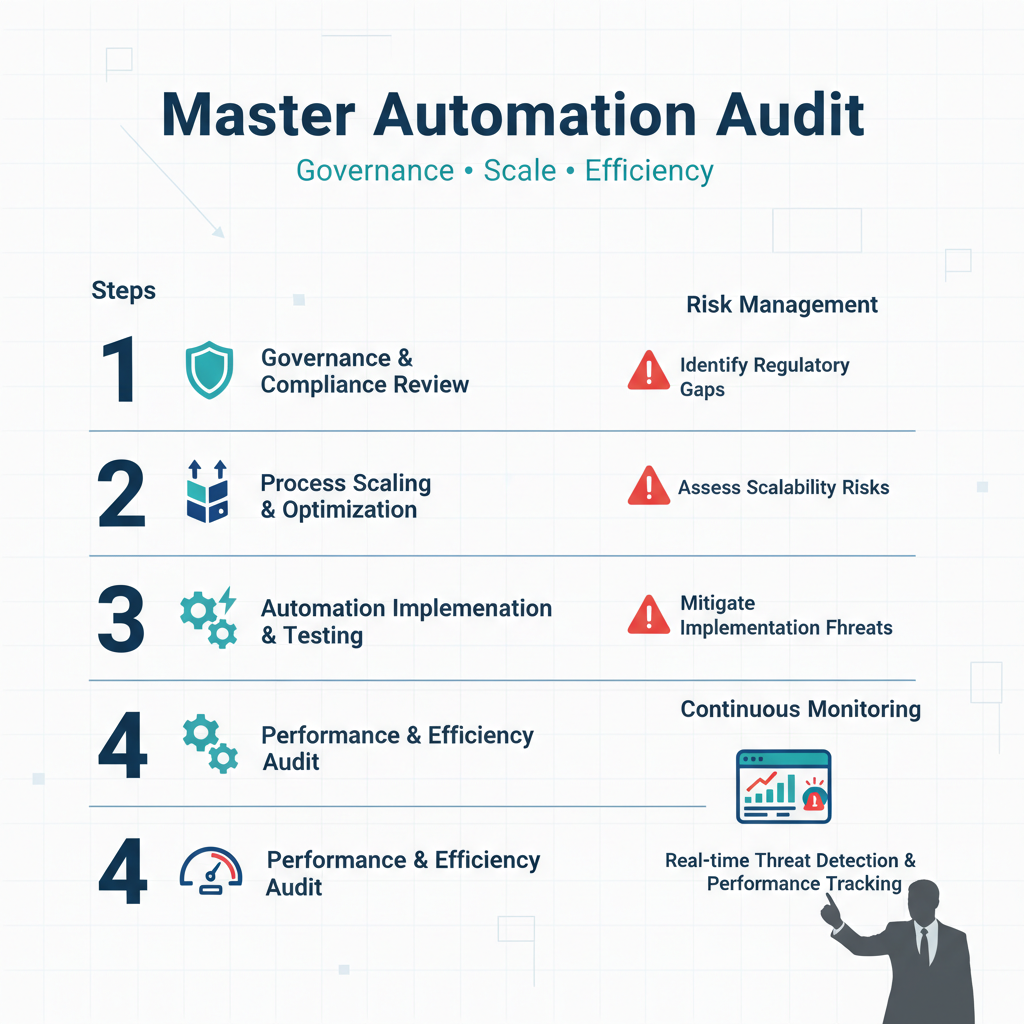
Steps for Conducting an Automation Audit
Embarking on an automation audit might seem daunting, but breaking it down step-by-step clarifies the process considerably. Let me walk you through it.
Step 1: Identify Scope and Objectives
First things first—you need to clarify what you’re actually auditing. Are you looking at specific tools like your RPA bots or OCR systems? Particular workflows like accounts payable or customer onboarding? Or are you focusing on risk areas like data security or regulatory compliance?
This is like setting a destination before a road trip. Without clear objectives, you’ll waste time and resources examining everything instead of focusing on what matters most. Align your audit scope with key business goals so you can measure real impact. If your company’s priority is reducing processing time for customer orders, your audit should zero in on those specific automated workflows.
Learn how to plan your first automation project and define scope
Step 2: Gather Data and Documentation
Now you’re collecting the raw materials you’ll need. This means pulling together relevant automation system details, audit workpapers, trial balances, and any recent regulatory updates. Centralized platforms or dashboards make this infinitely easier—you want accurate visibility into what’s actually happening, not just what people think is happening.
The importance of comprehensive data can’t be overstated. Incomplete information leads to incomplete audits, which lead to missed problems. I’ve seen audits fail simply because teams didn’t have access to all the relevant system logs or couldn’t track down documentation on how certain automated processes were originally configured.
Step 3: Evaluate Performance Metrics and Compliance
This is where you roll up your sleeves and dig into the details. You’re reviewing end-to-end datasets for anomalies, benchmarking KPIs like process speed and error rates, and ensuring standards like data security and reconciliation are actually being met.
Here’s a critical point: whenever possible, use full population analysis rather than sampling. Sampling might catch major issues, but it can easily miss subtle patterns or edge cases that cause problems down the line. Automation makes it feasible to examine 100% of transactions or data points, so why settle for less?
You’re also checking compliance against whatever standards apply to your industry—whether that’s financial regulations, data privacy laws, or industry-specific requirements. It’s quality assurance at scale.
IAAA on audit-automation benefits for firms and Trullion on automated audit benefits.
Step 4: Collaborate with Stakeholders
Don’t conduct your audit in isolation. Engage with audit teams, IT staff, and process owners to gain insights on real-time issues, gather feedback on tools, and understand version control management challenges.
The people actually using these systems every day often know about quirks and workarounds that aren’t documented anywhere. They can tell you which automated processes consistently require manual intervention, which tools are frustrating to use, and where data quality issues originate. That frontline knowledge is gold.
Learn more about audit-automation benefits and MDAudit on workflow automation for compliance.
Step 5: Document Findings and Recommendations
Finally, you’re preparing traceable, clear reports that highlight performance gaps, risks, improvement areas, and scaling opportunities for decision-makers. Your documentation should tell a story: here’s what we found, here’s why it matters, and here’s what we recommend doing about it.
Good documentation isn’t just about covering your bases—it’s about creating a roadmap for improvement. Your recommendations should be specific, actionable, and prioritized. “Improve data security” is too vague. “Implement multi-factor authentication for all users accessing financial automation tools within 60 days” gives people something concrete to work with.
Throughout this entire process, remember that this structured approach enhances efficiency, strengthens risk management, and prepares your organization for robust governance. It’s not bureaucracy for its own sake—it’s building a foundation for sustainable automation success.
https://www.inaa.org/what-is-audit-automation-and-how-can-it-benefit-firms/
Scaling Automation Effectively
Scaling automation transforms isolated wins into enterprise-wide success—but it requires strategic planning, not just enthusiasm and budget.
Scaling automation means expanding automation capabilities across multiple business units or processes to handle higher volumes without proportional increases in cost or risk. When done right, it’s how you maintain agility and competitive edge as your business grows. When done poorly, it’s how you create expensive, fragile systems that break under pressure.
Here’s why this matters so much: growing businesses face increasing demands on their operations. More customers, more transactions, more data, more complexity. Manual processes don’t scale well—they require proportionally more people, more time, and more potential for errors. But thoughtfully scaled automation can handle 10x the volume with minimal additional resources.
So how do audit results guide scaling decisions? They identify the bottlenecks that would sabotage your expansion efforts. Maybe your current data aggregation process can barely handle existing volumes, let alone double or triple the load. Perhaps your risk visibility is incomplete, meaning scaling would amplify blind spots. Or your tools don’t integrate properly, creating workflow disruptions that would multiply as you expand.
Let me walk you through some common pitfalls I’ve seen repeatedly:
Overlooking Full-Population Analysis
When companies scale based on sampled data rather than comprehensive analysis, they miss hidden errors that become catastrophic at larger volumes. A 1% error rate might seem acceptable when you’re processing 1,000 transactions monthly. But scale to 100,000 transactions, and suddenly you’ve got 1,000 errors to deal with. Audits should encourage full data reviews using automation tools that can handle complete datasets, not just representative samples.
Ignoring Security Measures During Scale-Up
This is where organizations get into real trouble. They focus so much on expanding capabilities that they forget to expand security proportionally. As you scale, you’re handling more sensitive data, creating more access points, and potentially introducing new vulnerabilities.
Your audit should verify that cloud encryption is properly configured, access controls are granular and enforced, and monitoring systems can handle increased activity without generating false positives that drown out real threats. Scaling without adequate security is like building a bigger house but leaving all the doors unlocked.
Poor Integration of Disparate Tools
I can’t stress this enough: if your existing tools don’t play nicely together, scaling will only magnify those integration problems. You’ll end up with data silos, duplicate entries, manual reconciliation processes, and frustrated employees trying to make incompatible systems work.
Explore no-code/low-code automation tools for better integrations
I worked with a mid-sized company that learned this lesson the hard way. They were eager to scale their automated order processing across three new regional offices. The system worked beautifully at headquarters, so what could go wrong? Turns out, plenty. Their audit had identified integration gaps between the order system and inventory management, but leadership decided to proceed anyway.
Within two months, they were dealing with inventory discrepancies, delayed shipments, and customer complaints. They had to pause the rollout, address the integration issues their audit had flagged, and then restart the expansion. They eventually succeeded, but it cost them six months and significant customer goodwill. Had they addressed those audit findings before scaling, they could have avoided the entire mess.
Audit-automation benefits from IAAA and Hubifi on audit-automation software.
To reap the full benefits of audits and governance, businesses should adopt best practices ensuring continuous improvement.
Best Practices for Automation Audits and Governance
Effective audits and governance don’t happen by chance—they require adopting proven strategies and tools that have worked across industries and company sizes.
Use Cloud-Based Platforms
Cloud platforms enable real-time collaboration that’s simply impossible with traditional on-premises systems. Your audit team in New York can work simultaneously with process owners in Singapore, all viewing the same data, making the same annotations, and tracking changes in real time.
Beyond collaboration, cloud platforms offer advanced analytics capabilities that would be prohibitively expensive to build in-house. They provide secure confirmation processes, automatic backups, and the ability to scale storage and computing power as needed. Plus, they’re typically updated regularly with new features and security patches, keeping you current without massive IT projects.
Automate Repetitive Tasks
This might seem obvious in an article about automation, but you’d be surprised how many audit processes still rely on manual work. Sample selection, report generation, follow-up reminders, data extraction—these are all tasks that automation handles beautifully.
By automating these repetitive elements, you reduce manual errors, save enormous amounts of time, and free up your team to focus on analysis and judgment calls that actually require human expertise. Your auditors should be interpreting results and making recommendations, not copying data between spreadsheets.
Implement Continuous Monitoring
Here’s where AI and machine learning really shine. Instead of periodic audits that provide snapshots, continuous monitoring gives you an ongoing video of your automation performance.
AI-powered tools can detect anomalies in real time—unusual transaction patterns, unexpected system behaviors, performance degradation. They can benchmark KPIs automatically and alert you when metrics drift outside acceptable ranges. This catches issues early when they’re still manageable, rather than discovering them months later during your next scheduled audit.
The beauty of continuous monitoring is that it transforms your governance model from reactive to proactive. You’re not waiting for problems to surface; you’re identifying and addressing them as they emerge.
Data Snipper on audit-automation types and Deloitte on RPA adoption in internal audit.
Conduct Regular Reviews
Technology changes, regulations evolve, and business processes shift. What worked perfectly six months ago might be inadequate today. Regular reviews—quarterly or at minimum annually—ensure your automated systems adapt to these changes.
This isn’t about finding fault; it’s about fostering a culture of continuous improvement. Each review is an opportunity to optimize, to learn from what’s working and fix what isn’t, and to stay ahead of emerging risks. Companies that embrace this mindset tend to be more resilient and adaptable than those treating audits as one-time compliance exercises.
Leverage RPA and Other Automation Tools Within Governance Frameworks
Robotic process automation isn’t just for business processes—it’s incredibly valuable for governance itself. RPA can enforce governance rules automatically, ensure traceability of all actions, and produce high-quality outputs consistently.
For example, you might use RPA to automatically review new automated workflows against your governance standards before they go live. Or to generate compliance reports on a regular schedule without human intervention. Or to monitor user access and flag any deviations from approved permission levels.
The key is integrating these tools within your governance framework rather than treating them as standalone solutions. They should reinforce and support your governance objectives, not operate independently.
Here’s the mindset: audits aren’t one-time events but part of a continuous lifecycle supporting scalable automation. When you internalize that perspective, you stop seeing audits as interruptions or necessary evils and start seeing them as strategic tools for optimization and growth.
IAAA overview, Trullion blog on benefits and tools, Data Snipper resources, MDAudit on compliance and efficiency, Deloitte on RPA adoption.
Conclusion
The critical role of automation audits in modern business can’t be overstated. They’re your mechanism for evaluating and improving automated processes, enhancing automation governance, and enabling confident scaling automation for sustainable business growth.
Think about the tangible benefits we’ve discussed: increased efficiency through streamlined workflows and reduced errors, mitigated risks through comprehensive analysis and security verification, compliance assurance in an increasingly regulated environment, and scalable technology adoption that grows with your business rather than constraining it.
But here’s what I really want you to take away from this: automation audits aren’t optional tasks you squeeze in when you have time. They’re strategic necessities for optimizing your automated systems and protecting your organization from the risks that come with digital transformation.
The companies that thrive in today’s environment are the ones that view audits as opportunities rather than obligations. They’re the ones that build strong governance frameworks informed by regular audit insights. They’re the ones that scale thoughtfully based on data rather than hunches.
By mastering automation audits, your business sets the foundation for sustainable, controlled, and secure automation growth. You’re not just implementing technology—you’re building systems that deliver consistent value while managing risk effectively. That’s the difference between automation that transforms your business and automation that creates more problems than it solves.
Take the Next Step
Ready to strengthen your automation audit practices and governance framework? Don’t go it alone.
Subscribe to our newsletter for expert insights on automation best practices, emerging trends, and practical strategies you can implement immediately. We share real-world case studies, detailed guides, and analysis of new tools and techniques that are actually making a difference for businesses like yours.
Or if you’re facing specific challenges with your current automation systems, let’s talk. Our team offers personalized consultations on conducting comprehensive automation audits and enhancing automation governance tailored to your business size, industry, and automation maturity level.
Find out whether to DIY or hire an automation consultant and get help fast
We also provide audit readiness assessments that identify gaps before they become problems, tool demonstrations showing how modern platforms can transform your audit process, and governance framework workshops that give your team the knowledge and resources they need to maintain excellence over time.
The investment you make in proper automation audits and governance today will pay dividends for years to come. Let’s make sure your automation infrastructure is built to last.
Frequently Asked Questions
What is an automation audit?
An automation audit is a detailed health check of your automation infrastructure, including workflows, data collection, analytics tools, engagement management processes, and compliance measures. It assesses what’s working, what’s not, and what could be improved, with the goal of improving efficiency, security, and governance.
How does automation governance relate to audits?
Governance provides ongoing oversight and policy-driven control based on audit findings. Audits supply the data and insights; governance uses them to maintain compliance, security, and performance over time.
How should you start an automation audit?
Begin by defining scope and objectives, gather necessary data and documentation, evaluate performance and compliance, collaborate with stakeholders, and document findings with concrete recommendations.
What are best practices for scaling automation?
Use full-population data analysis, strengthen security as you scale, ensure tool integrations work together, automate repetitive tasks, and implement continuous monitoring with regular reviews.