Autonomous Vehicles in 2026: Self-Driving Car Updates & Laws
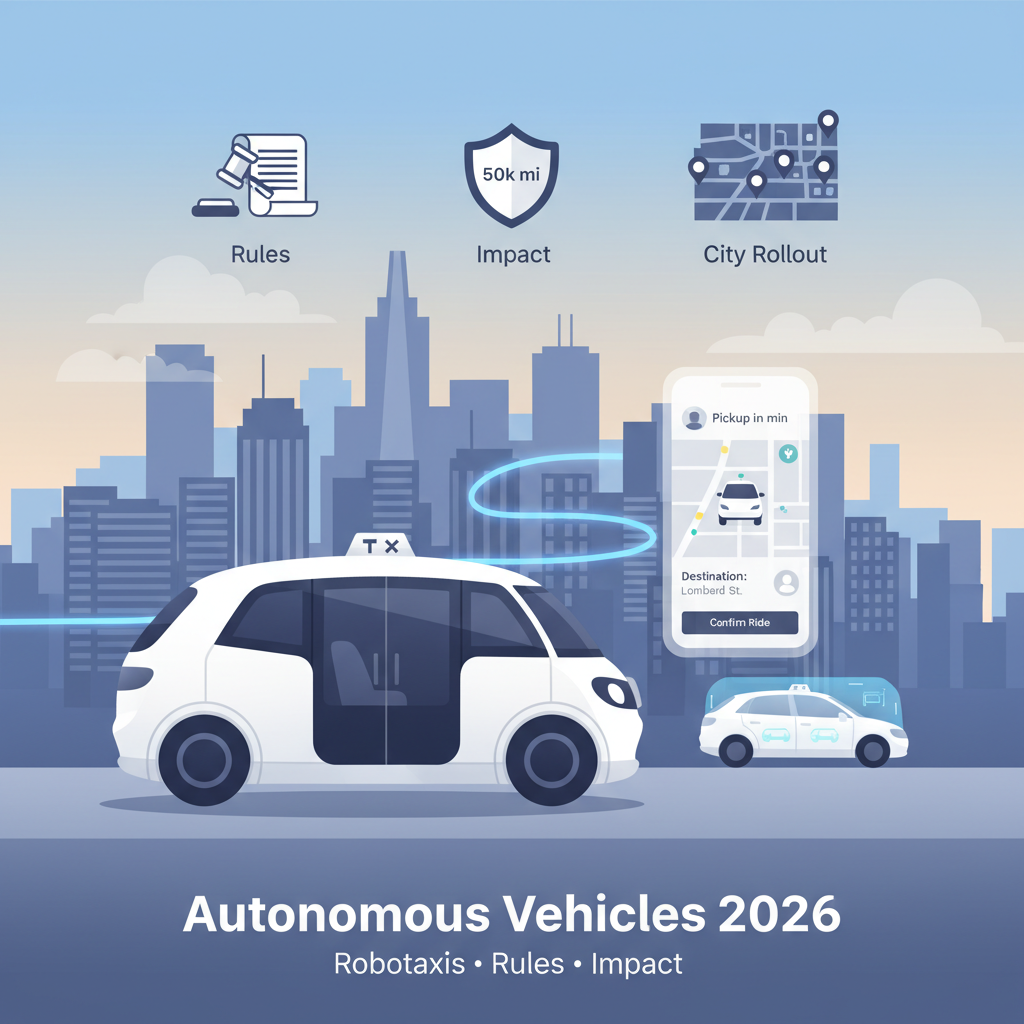
Autonomous Vehicles in 2026: Self-Driving Car Updates & Laws
Imagine hailing a cab with no driver — no small talk, no tipping, no human error. In 2026, that’s not science fiction anymore. It’s Tuesday morning in San Francisco, and you’re sliding into a Waymo robotaxi that’s been waiting for you. No steering wheel. No pedals. Just you, your phone, and a car that knows exactly where to go.
But here’s the thing: as self-driving cars multiply on public roads, most of us are scrambling to understand what’s actually happening. The technology keeps advancing. The regulations keep shifting. And honestly? The risks are very real.
This guide breaks down everything you need to know about autonomous vehicles in 2026 — from the latest updates on Zoox, Ford, and Audi, to California’s landmark new AV regulations, to what robotaxi expansion actually means for everyday drivers and urban planning. We’re going to cut through the hype and give you the real story.
What Are Autonomous Vehicles? A 2026 Primer
Let’s start with the basics, because the terminology gets confusing fast. When people talk about autonomous vehicles in 2026, they’re usually talking about one of two very different things — and it matters.
On one end, you’ve got your consumer vehicles with advanced driver assistance systems (ADAS). Think of a Ford with BlueCruise that can handle highway driving hands-free, or an Audi with Level 3 autonomy that takes over in specific conditions. The human driver is still responsible. They’re still in control. The car just helps out.
On the other end, you’ve got fully driverless robotaxis — vehicles with no steering wheel, no pedals, no expectation that a human will take over. These are purpose-built machines designed from the ground up to operate without human intervention. Waymo’s been running these in San Francisco for years now. Zoox is scaling up. Tesla’s pushing hard into this space.
The Society of Automotive Engineers (SAE) has a formal classification system that goes from Level 1 (driver does almost everything) all the way to Level 5 (car does everything, anywhere, anytime). Most consumer vehicles today are Level 2 or Level 3. True robotaxis are Level 4 or Level 5.
Here’s what’s interesting though: in 2026, the term “automated vehicle” has become almost synonymous with “robotaxi” in the public conversation. That’s largely because Waymo’s market dominance — they’re the clear leader in fully driverless robotaxis in the United States [Source 3] — has shaped how people think about the category.
Why is 2026 such a pivotal year? Because we’re hitting that sweet spot where the technology has matured enough to actually work reliably, the regulatory frameworks are finally catching up, and major companies are making serious bets on deployment. It’s not theoretical anymore. It’s happening now.
Major AV Players in 2026 — Who’s Actually Winning?
The autonomous vehicle space in 2026 looks radically different than it did even three years ago. Some companies have doubled down. Others have quietly backed away. And a few new players have emerged that nobody was really expecting.
Waymo: The Undisputed Leader
Waymo’s in a league of its own right now. They’ve got the most driverless miles under their belt, the most refined technology, and the most cities where they’re actually operating robotaxis at scale [Source 3]. San Francisco, Phoenix, Los Angeles — these aren’t pilots anymore. They’re commercial services.
What makes Waymo different isn’t just the technology. It’s the experience. They’ve learned how to handle edge cases — the weird situations that humans navigate instinctively but are incredibly hard to program. Pedestrians doing unexpected things. Broken traffic lights. Construction zones. They’ve seen it all.
Zoox: The Ambitious Upstart
Amazon’s Zoox is fascinating because they didn’t try to retrofit existing vehicle designs. They built something completely new from scratch — a bidirectional vehicle with no traditional front or back. It’s weird-looking. It’s also brilliant for urban robotaxi work.
In 2026, Zoox is expanding urban robotaxi deployments, and they’re particularly active in places like Las Vegas [Source 1]. The fact that they’re owned by Amazon gives them resources that most startups could only dream about. But it also means they need to prove they can actually compete with Waymo in real-world operations.
Tesla: The Wild Card
Tesla’s Robotaxi network is actively scaling in 2026, and they’re operating under California’s new regulatory framework — which is high stakes given that California is the largest auto market in the United States [Source 2]. Elon’s been promising full autonomy for years, and now they’re actually putting real vehicles on real roads.
The question everyone’s asking is whether Tesla’s approach — using camera-only vision without lidar — can actually compete with Waymo’s more traditional sensor suite. Time will tell, but they’re definitely not backing down.
Ford: The Practical Pivot
Here’s something interesting: Ford actually stepped back from the full robotaxi race. They realized that the real money isn’t necessarily in driverless taxis — it’s in selling millions of consumer vehicles with really good autonomous driving features.
Ford’s targeting eyes-off autonomy by 2028 [Source 1], which means drivers can literally take their eyes off the road in certain conditions. Their BlueCruise system is already doing hands-free highway driving for thousands of customers. It’s not flashy, but it’s practical. And it’s profitable.
Audi: The Luxury Play
Audi’s taking a different approach entirely. They’re integrating autonomous driving technology into luxury consumer vehicles — not building separate robotaxi fleets. In 2026, they’re expanding Level 3 autonomy features in select markets, which means the car can handle certain driving tasks completely autonomously, but the driver needs to be ready to take over if things get weird.
It’s a more conservative strategy than some competitors, but it’s also lower risk. They’re not betting the company on one technology bet.
California’s Landmark 2026 AV Regulations — The Game Changer
If you want to understand where autonomous vehicles are actually headed, you need to understand what happened in California on April 28, 2026.
That’s the day the California Department of Motor Vehicles finalized new autonomous vehicle regulations that had been in development for over a year [Source 4]. And they’re not messing around.
The Three-Tier Permitting System
California’s new framework has three distinct categories. First, there’s testing with a safety driver — basically what companies have been doing for years. A trained operator sits in the driver’s seat, ready to take control if needed.
Second, there’s driverless testing — no human driver required, but it’s still limited to specific routes and conditions. This is where companies prove they can actually handle real-world complexity without someone ready to grab the wheel.
Third is full deployment — and this is where it gets real. Before a company can deploy robotaxis commercially across California, they need to complete 50,000 autonomous miles on public roads [Source 4]. That’s not a suggestion. That’s a requirement.
Why 50,000 miles? It’s based on research showing that’s roughly the threshold where you can start to have statistical confidence in a system’s safety. It’s a number with actual meaning behind it, not just bureaucratic theater.
The Accountability Shift: Who Gets Ticketed?
Here’s the part that actually changes everything. Starting July 1, 2026, when a robotaxi runs a red light or fails to yield to a pedestrian, law enforcement can issue a traffic violation notice directly to the AV company — not to a human driver [Source 2].
Think about what that means. Your Waymo robotaxi commits a traffic violation. Waymo gets the ticket. Waymo has to answer for it. This closes a massive accountability gap that’s been bothering regulators and safety advocates for years.
These aren’t small fines either. We’re talking about real financial consequences that create genuine incentives for companies to get their systems right. You can’t just shrug and blame the technology. The company is on the hook.
Why does California have this kind of leverage? Because California is the largest auto market in the United States. For any autonomous vehicle company, losing operating rights in California would be commercially devastating [Source 2]. So they have to comply. They have to get it right.
What This Means in Practice
Let’s walk through a real scenario. A Tesla Robotaxi is operating in downtown Los Angeles under the new regulations. It approaches a traffic light that’s malfunctioning — the red light sensor is broken, and the light is stuck. The car runs it. A police officer sees it and pulls over the vehicle (or rather, pulls up the data).
Under the old system? Nobody really knew who to ticket. The car wasn’t human. There was no driver. So what happens?
Under the new system? Tesla gets a notice of noncompliance. They have to respond. They have to explain why their system made that decision. They have to pay any associated fines. And they have to prove they’ve fixed whatever gap in their programming allowed it to happen.
That accountability mechanism is genuinely transformative. It means companies can’t just deploy and hope for the best. They have to actually care about edge cases and safety scenarios because they’re directly liable.
Robotaxi Regulation Beyond California — The Bigger Picture
California’s not the only state taking autonomous vehicles seriously. Utah passed HB 0581 — Autonomous Vehicle Amendments — showing that this is a nationwide trend, not just a California thing [Source 5].
But here’s the problem: we’ve got a patchwork of state regulations, and there’s real tension between states that want to regulate strictly and states that want to be competitive by staying hands-off. It’s messy.
The Southern California Law Review has done some genuinely interesting research on this. Their key insight? The social impact of robotaxis depends heavily on how they’re regulated, not just on the technology itself [Source 3].
Think about it. A robotaxi network could expand mobility for people with disabilities who can’t drive. It could provide transportation for people with low incomes who can’t afford cars. Or it could become an expensive luxury service that only rich people use, and regular taxis could disappear.
The policy choices matter. Transparent and rider-neutral fares. Mandated fleet sizes for emergencies. Requirements around accessibility. These aren’t technical questions. They’re political questions. And they’re going to shape what autonomous vehicles actually mean for society.
The Urban Planning Angle
Here’s something most people don’t think about: parking. American cities have sacrificed enormous amounts of valuable land to parking — land that could be housing, parks, restaurants, whatever. Robotaxis could change that equation dramatically.
If you don’t own a car, you don’t need a parking spot. Your apartment doesn’t need dedicated parking. Your workplace doesn’t need a massive parking garage. That land becomes available for other uses. One researcher called it “liberating land from the tyranny of parking” [Source 3], and honestly, that’s exactly what it is.
But that only happens if the regulations and business models actually support it. If robotaxis just become another way to own a vehicle (you buy a robotaxi instead of a regular car), then we haven’t solved anything. The policy choices are going to determine which future we actually get.
What This All Means for You
So what does all this actually mean for someone who’s just trying to get around in 2026?
If you live in San Francisco, Phoenix, or Los Angeles, you can probably already hail a robotaxi. It’s real. It works. It’s a bit weird at first (no driver, no small talk), but most people adjust quickly. And honestly? It’s kind of nice.
If you drive a newer car with ADAS features, those are getting better every year. The technology is genuinely helpful for highway driving and heavy traffic. But understand that you’re still responsible. You still need to pay attention. The car’s assisting, not replacing.
If you’re thinking about buying a car in 2026, you’ve got to consider what kind of driving you actually do. If you’re commuting on highways, a vehicle with good hands-free driving features might be worth paying for. If you’re in a city with robotaxi service, you might not need to own a car at all.
And if you’re a policymaker or urban planner? Pay attention to what’s happening in California. The regulations they’re putting in place right now are going to influence how autonomous vehicles develop across the country.
The Bottom Line
2026 is the year autonomous vehicles stopped being a future technology and became an actual transportation option. The regulations are real. The companies are deploying at scale. The accountability frameworks are in place.
It’s not perfect. There are still edge cases. There are still safety questions. There are still policy decisions that need to be made about equity and access.
But the momentum is real. The technology works. And the next few years are going to determine whether robotaxis become a transformative public good or just another luxury service for rich people. That choice hasn’t been made yet. It’s still being written.
Ready to understand how autonomous vehicles might impact your business or community? Contact our experts for personalized guidance on navigating the 2026 AV landscape and regulatory changes.
Sources
- [Source 1] – AV technology updates from Zoox, Ford, and Audi; Ford’s eyes-off autonomy target by 2028; Las Vegas robotaxi deployments
- [Source 2] – Tesla Robotaxi scaling; July 1, 2026 traffic violation enforcement; California as largest U.S. auto market
- [Source 3] – Waymo as U.S. automated driving market leader; Southern California Law Review policy research; social impact of robotaxi regulation; equity considerations; parking liberation concept
- [Source 4] – California DMV finalization date (April 28, 2026); three-tier permitting structure; 50,000-mile deployment requirement
- [Source 5] – Utah HB 0581 Autonomous Vehicle Amendments; state-level regulatory trends