Effective Context Engineering for AI Agents: The Next Frontier in Building Reliable AI Systems
Effective Context Engineering for AI Agents: The Next Frontier in Building Reliable AI Systems
Estimated reading time: 9 minutes
Key Takeaways
- Context engineering is a paradigm shift that structures, manages, and optimizes all information and tools an AI agent needs, not just prompts link.
- Most AI failures today stem from inadequate or malformed context, making effective context management critical for reliability.
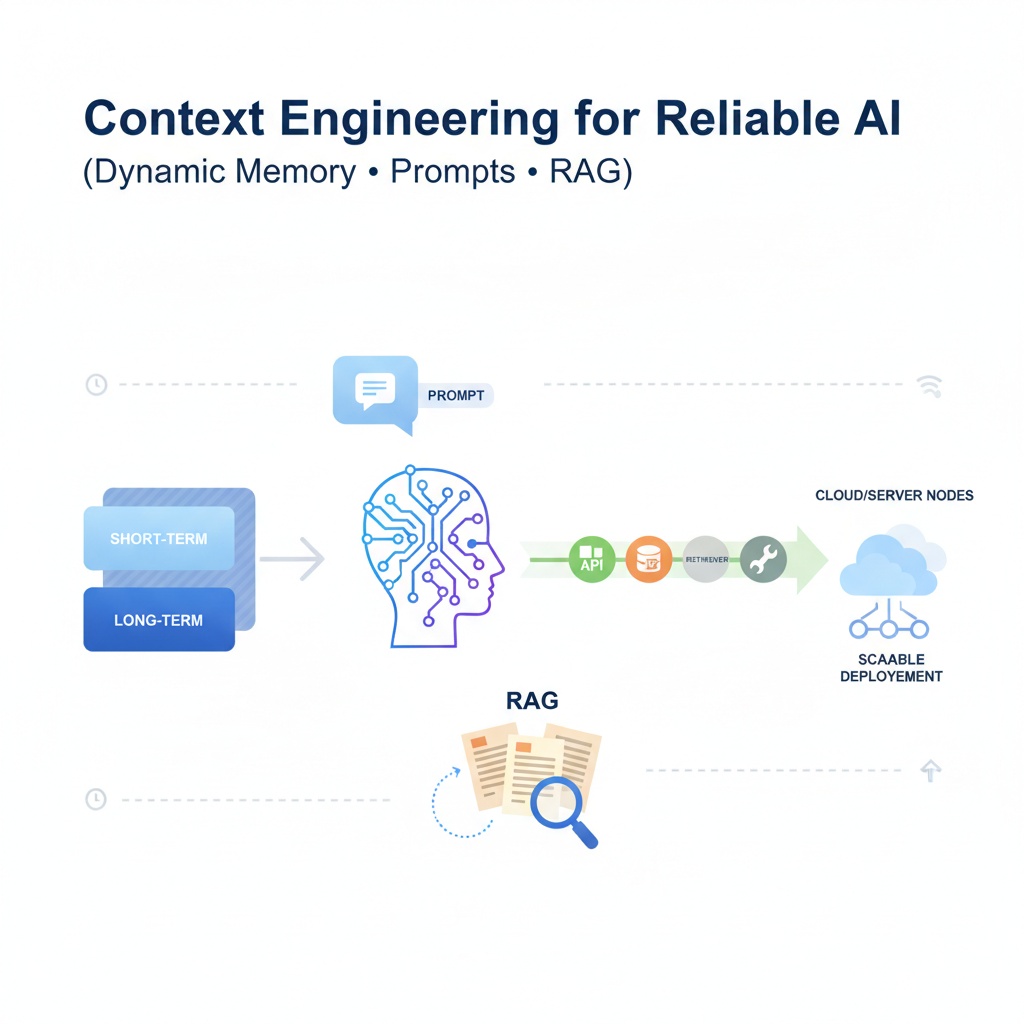
- Key building blocks include Instructions and System Prompts, User Prompts, State Management, External Knowledge Integration, Tool Access, and Response Formatting, all acting as an integrated ecosystem.
- Best practices emphasize Dynamic Context Assembly, Content Optimization, Error Recovery Mechanisms, and a Scalable Architecture (12-Factor Agent framework) link.
- Implementation strategies such as Regular Context Refreshing, Just-in-Time Data Retrieval, and sophisticated Conversation Management help maintain contextual freshness and relevance link.
- Looking ahead, context engineering is set to expand AI reliability and adaptability across complex, real-world environments link.
Table of contents
- Understanding Context Engineering
- Why Context Engineering Matters Now More Than Ever
- The Building Blocks of Effective Context Engineering
- Best Practices for Implementing Context Engineering
- Practical Implementation Strategies
- Beyond Prompt Engineering: A Comparative Analysis
- Looking Ahead: The Future of Context Engineering
- Conclusion
- Frequently Asked Questions
Understanding Context Engineering
Context engineering represents a paradigm shift in how we approach AI agent development. Rather than focusing solely on crafting the perfect prompt, it encompasses the entire process of structuring, managing, and optimizing all information and tools an AI agent needs to function effectively. As highlighted by OpenAI’s Andrej Karpathy, it’s about “filling the context window with just the right information for the next step.” Learn more.
Why Context Engineering Matters Now More Than Ever
The AI community has reached a fascinating realization: most AI failures today aren’t due to limitations in the underlying models or imperfect prompt phrasing. Instead, the primary culprit is inadequate or malformed context. This insight has profound implications for how we approach AI development and deployment.
A particularly challenging issue that context engineering addresses is context degradation – where AI agents forget or misremember critical details during extended tasks. This phenomenon can lead to costly errors and frustrated users, highlighting the urgent need for better context management strategies. read more.
The Building Blocks of Effective Context Engineering
Let’s dive into the essential elements that make up a well-engineered context:
- Instructions and System Prompts
These serve as the foundational rules and behaviors that govern an AI agent’s operation. Think of them as the agent’s operating manual, defining its basic parameters and expected behavior patterns. - User Prompts
While simpler than traditional prompt engineering, user prompts remain crucial as the immediate commands or questions that trigger the agent’s actions. - State Management
– Short-Term State/History: Tracking the current session’s conversation and actions
– Long-Term Memory: Maintaining persistent information about user preferences and previous interactions source - External Knowledge Integration
Through Retrieval-Augmented Generation (RAG), agents can access up-to-date information from various sources, including documents, databases, and the web. learn about RAG - Tool Access and Integration
Defining and managing the functions and APIs an agent can use, complete with proper schemas for reliable execution. - Response Formatting
Establishing consistent output structures for downstream processing, whether in JSON, forms, or other formats.
Best Practices for Implementing Context Engineering
- Dynamic Context Assembly
Context isn’t static – it needs to be actively assembled and tailored for each task. This dynamic approach ensures the agent always has the most relevant information at hand. more details - Content Optimization
The key to effective context engineering lies in presenting only essential information. This includes:
– Summarizing lengthy content where appropriate
– Filtering out unnecessary noise
– Adhering to established schema standards - Error Recovery Mechanisms
Modern AI agents should be designed to:
– Monitor their own context window
– Detect and correct errors automatically
– Learn from mistakes to prevent future issues - Scalable Architecture
Following the 12-Factor Agent framework, developers should build small, focused agents with clear context boundaries. This approach improves:
– System transparency
– Maintenance efficiency
– Overall resilience source
Practical Implementation Strategies
- Regular Context Refreshing
Implement periodic memory refreshes to prevent context degradation, ensuring critical information remains accessible throughout long-running tasks. read more - Just-in-Time Data Retrieval
Utilize retrieval-augmented generation to fetch external data precisely when needed, rather than maintaining large amounts of static information in context. details - Conversation Management
Develop sophisticated approaches to managing conversational history without overwhelming the agent’s context window, including intelligent summarization of older interactions. techniques
Beyond Prompt Engineering: A Comparative Analysis
To understand the revolutionary nature of context engineering, let’s compare it with traditional prompt engineering: While prompt engineering focuses on crafting single input strings with a narrow, per-request scope, context engineering takes a holistic approach to the entire agent environment. The main challenge shifts from writing perfect prompts to properly structuring and managing all relevant information, resulting in dramatically improved agent reliability. compare approach.
Looking Ahead: The Future of Context Engineering
As we move through 2025, context engineering has emerged as a critical developmental leap in building truly autonomous AI agents. Its importance continues to grow as organizations seek to deploy more sophisticated AI systems in complex, real-world environments. future implications.
Conclusion
Context engineering represents a fundamental shift in how we approach AI agent development. By moving beyond simple prompt engineering to encompass the entire context ecosystem, we’re building more reliable, capable, and contextually aware AI systems. As the field continues to evolve, mastering context engineering will become increasingly crucial for anyone working in AI development and deployment. Learn more.
Frequently Asked Questions
Is Context Engineering the same as Prompt Engineering?
Not exactly. Prompt engineering focuses on crafting inputs, while context engineering treats the entire information ecosystem—prompts, memories, tools, and external knowledge—as a coupled system to improve reliability and adaptability.
What are the first steps to adopt Context Engineering?
Begin by mapping the agent’s information and tool dependencies, then implement core blocks (instructions, prompts, state management, and RAG access). Gradually introduce dynamic assembly and memory refresh mechanisms.
How does Retrieval-Augmented Generation help?
RAG allows agents to fetch up-to-date information from external sources, reducing stale context and enabling better decision-making in real-time tasks. learn more.
Can context engineering improve reliability?
Yes. By actively managing context, avoiding degradation, and using structured tool access, agents become more robust across longer, more complex tasks.
Where can I learn more about the 12-Factor Agent framework?
Explore the 12-Factor Agent principles in the context of modular, scalable AI agent design. PDF overview.
}