How to Build an Enterprise Automation Strategy for Digital Transformation
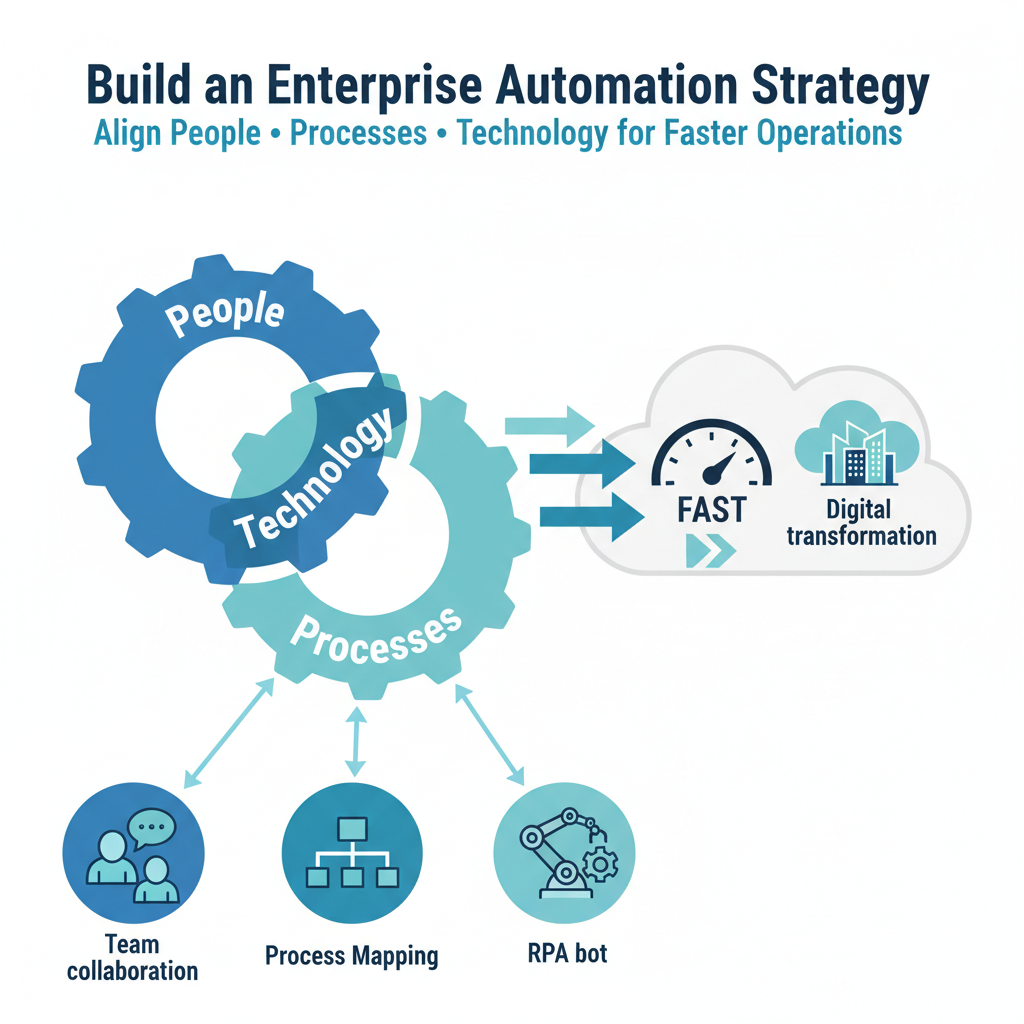
How to Build an Effective Enterprise Automation Strategy to Drive Digital Transformation
Estimated reading time: 14 minutes
Key Takeaways
- Strategic automation aligns people, processes, and technology to drive digital transformation.
- End-to-end scope focuses on end-to-end processes across departments with a clear automation roadmap.
- Measurable impact relies on defined KPIs, governance, and phased rollout to avoid islands of automation.
- Benefits include increased efficiency, reduced costs, improved quality, and higher employee engagement.
- Key elements cover process identification, stakeholder engagement, objective setting, tools, training, and change management.
Table of contents
- What is an Enterprise Automation Strategy?
- Benefits of Implementing an Enterprise Automation Strategy
- The Role of Digital Transformation in Enterprise Automation
- Key Elements of a Successful Enterprise Automation Strategy
- Challenges in Developing an Enterprise Automation Strategy
- Steps to Develop an Effective Enterprise Automation Strategy
- Conclusion
- Ready to Transform Your Organization?
- Frequently Asked Questions
What is an Enterprise Automation Strategy?
Think of an enterprise automation strategy like a city’s master plan. You wouldn’t build roads, bridges, and buildings randomly across a city, right? You’d have a comprehensive plan guiding growth, ensuring everything connects properly and serves the community’s needs. That’s exactly what an enterprise automation strategy does for your business.
An enterprise automation strategy is the structured approach that goes beyond automating isolated tasks. It transforms entire end-to-end processes through technology integration. We’re not talking about automating one person’s spreadsheet—we’re talking about reimagining how entire departments work together.
Read more about business process automation basics
Understanding enterprise automation – what it is and why it matters
Let me break down the core components that make up a solid enterprise automation strategy:
- Automation Scope — This defines what parts of your business you’re including in your automation efforts. Are you focusing on finance? HR? Customer service? Manufacturing? Most successful strategies eventually touch multiple departments, but you need clarity on where you’re starting and where you’re heading.
- Maturity Levels — Your automation maturity ranges from initial pilots—those first tentative steps—to full-scale deployment across the organization. Understanding where you are on this spectrum helps you set realistic expectations and timelines.
- Technology Stack — This is your toolkit. It includes AI agents that can handle complex decision-making, robotic process automation (RPA) for repetitive digital tasks, workflow tools that connect different systems, machine learning algorithms that improve over time, and cloud platforms that provide the infrastructure for it all.
- Integration Targets — Your automation doesn’t exist in a vacuum. It needs to connect with existing systems and data sources. This means identifying your CRM, ERP, legacy databases, and other platforms that automation will need to communicate with.
- Stakeholder Involvement — Automation affects everyone, so everyone needs a seat at the table. This includes leadership who set the vision, IT teams who implement solutions, department heads who understand process nuances, and frontline employees who’ll actually use the automated systems.
- Governance Models — How will you manage automation efforts? Who makes decisions about what gets automated? How do you ensure consistency across different initiatives? Good governance prevents chaos and ensures your automation efforts align with broader business objectives.
- KPIs for Success — You need measurable outcomes. Cost reduction by a specific percentage. Efficiency gains in hours saved. Error rate improvements. Customer satisfaction scores. Without clear metrics, you’re flying blind.
- Risk Management and Implementation Phases — Every automation initiative carries risks—from technical failures to employee resistance. A solid strategy evaluates these risks upfront and plans a phased rollout that allows you to learn, adjust, and succeed incrementally rather than betting everything on a big-bang approach.
So why does automation need to be strategic? Because piecemeal automation creates islands of efficiency in a sea of manual processes. You might speed up one department while creating bottlenecks in another. Enterprise-wide automation, by contrast, looks at the whole picture. It considers how processes flow across departments and optimizes the entire value chain.
Understanding these building blocks brings us to why companies invest so heavily in enterprise automation strategies—the tangible benefits.
Benefits of Implementing an Enterprise Automation Strategy
Picture this: A mid-sized insurance company was drowning in paperwork. Claims processing took weeks. Customer service reps spent 70% of their time on data entry. Employee turnover was through the roof because nobody wanted to do mind-numbing work all day.
Then they implemented an enterprise automation strategy. Within eighteen months, claims processing time dropped to days. Customer service reps now spend most of their time actually helping customers solve problems. And employee satisfaction scores? They jumped 40%.
That’s not fiction—it’s the kind of transformation happening across industries right now. Let’s look at the specific benefits driving this change.
- Increased Efficiency and Productivity — Automation cuts through repetitive manual tasks like a hot knife through butter. When software robots handle data entry, invoice processing, and routine customer inquiries, your employees are freed to focus on higher-value work that actually requires human creativity and judgment.
- Reduced Operational Costs — Here’s where CFOs start paying attention. Streamlined workflows mean you can handle more volume with the same headcount—or even less. You’re spending less time correcting errors. You’re reducing overtime. You’re cutting the costs associated with manual processing.
- Improved Quality and Consistency — Humans make mistakes—it’s just part of being human. We get tired. We get distracted. We misread things. Automation doesn’t have these problems. When you automate a process, it executes the same way every single time. No variations. No “oops, I forgot that step.” This consistency dramatically reduces error rates and ensures higher accuracy across operations. Your customers get the same great experience whether it’s their first interaction or their hundredth.
- Enhanced Employee Satisfaction — This benefit surprises some people, but it shouldn’t. Nobody dreams of spending their career copying data from PDFs into spreadsheets. When you remove tedious tasks from people’s plates, they experience greater job engagement and morale.
These benefits translate directly into competitive advantage. While your competitors are still processing orders manually, you’re fulfilling them in a fraction of the time. While they’re correcting errors, you’re delivering flawless experiences. While their best employees are leaving due to boring work, yours are engaged and growing.
And yes, automation absolutely improves employee wellbeing. When work is less frustrating, less repetitive, and more meaningful, people are happier. It’s that simple.
These benefits clearly illustrate why enterprise automation is pivotal—but how does it fit within digital transformation initiatives?
The Role of Digital Transformation in Enterprise Automation
What is the strategic relationship between enterprise automation and digital transformation? It’s a question I get asked constantly, and the answer reveals why so many organizations struggle with both initiatives.
Let’s reinforce what digital transformation really means: it’s the holistic modernization that includes culture, processes, and technology. It’s not just implementing new software. It’s fundamentally rethinking how your organization creates and delivers value in a digital world.
Enterprise automation strategy acts as the execution arm of digital transformation. Think of digital transformation as the vision—where you want to go—and automation as the engine that gets you there. You can have the best vision in the world, but without automation to implement it at scale, you’re stuck dreaming.
Automation enables the agility, speed, and scalability essential to digital transformation success. When processes are automated, you can pivot quickly in response to market changes. You can scale operations up or down without massive hiring or layoffs. You can experiment with new business models without rebuilding everything from scratch.
Let me give you a concrete example. Consider a traditional retail bank trying to compete with digital-first fintech companies. Their digital transformation vision includes offering instant loan approvals, personalized financial advice, and seamless omnichannel experiences.
To make this vision real, they implement an enterprise automation strategy. They use AI and RPA to automate credit checks, income verification, and risk assessment. What used to take days now happens in minutes. They deploy chatbots and virtual assistants that handle routine customer service inquiries 24/7, reducing response times from hours to seconds.
Read about the future of work with AI agents
The automation doesn’t just speed things up—it generates data that machine learning algorithms analyze to provide personalized product recommendations. It connects previously siloed systems so customers have the same experience whether they’re in a branch, on the website, or using the mobile app.
That’s digital transformation in action, powered by strategic automation.
Can automation be a standalone strategy without digital transformation? Technically, yes. You can automate processes within your existing business model. But you’ll be leaving massive value on the table. Automation without transformation is like putting a more efficient engine in a horse-drawn carriage. Sure, it helps, but you’re still fundamentally limited.
On the flip side, digital transformation without automation is mostly just talk. You can redesign customer experiences all you want, but if you’re still relying on manual processes behind the scenes, you can’t deliver at the speed and scale modern markets demand.
These strategies reinforce each other in a virtuous cycle. Automation makes transformation possible. Transformation creates new opportunities for automation. Organizations that understand this relationship are the ones pulling ahead in their industries.
With this synergy in mind, what are the critical elements to focus on when building your enterprise automation strategy?
Key Elements of a Successful Enterprise Automation Strategy
Here’s a truth that might sting a bit: even the best technology won’t succeed without foundational elements in place. I’ve seen organizations spend millions on cutting-edge automation tools only to watch those initiatives sputter and die because they skipped the fundamentals.
- Identifying Processes Suitable for Automation — Not every process should be automated—at least not right away. You need a systematic approach to identify the best candidates. Process mining tools can analyze your actual workflows to find bottlenecks and repetitive tasks. Stakeholder interviews reveal pain points that might not show up in data. The sweet spot? Repetitive, rule-based workflows with high volume and low exception rates. Think invoice processing, employee onboarding paperwork, data entry, report generation, and routine customer inquiries. These processes deliver quick wins that build momentum for more complex automation down the road. Learn more about a process-first strategy
- Engaging Stakeholders — This is where many automation strategies live or die. You need leadership buy-in to secure budget and organizational priority. But you also need buy-in from the people doing the actual work—they understand process nuances that might not be documented anywhere. Create cross-functional teams that include representatives from IT, operations, and the business units affected by automation. Make them champions who can advocate for automation within their departments. When people feel involved rather than imposed upon, adoption skyrockets.
- Setting Clear Objectives and KPIs — Vague goals like “improve efficiency” don’t cut it. You need measurable objectives tied directly to business outcomes. Reduce invoice processing time by 60%. Cut customer service response time from four hours to fifteen minutes. Decrease error rates in order fulfillment from 5% to 0.5%. These clear targets serve multiple purposes. They help you prioritize which processes to automate first. They provide benchmarks to measure success. They justify continued investment to skeptical executives. And they keep everyone aligned on what you’re actually trying to accomplish. Read more on KPIs and strategy
- Choosing the Right Tools and Technologies — The automation technology landscape is crowded and confusing. You’ve got RPA vendors, AI platforms, workflow tools, integration solutions, and countless specialized options for specific industries or processes. Don’t get seduced by shiny new technology. Start with your process needs and work backward to the tools that fit. Does this process require complex decision-making? You might need AI. Is it straightforward but high-volume? RPA might be perfect. Do you need to connect multiple systems? Focus on integration capabilities. Explore no-code/low-code automation tools
- Employee Training and Change Management — Technology is the easy part. People are the hard part. Your automation strategy will fail if employees don’t have the skills to work with new systems or if they actively resist the changes. Invest in comprehensive training that goes beyond basic tool usage. Help people understand why automation matters and how it benefits them personally. Create support systems—like automation help desks or peer mentors—that employees can turn to when they hit roadblocks. Address the elephant in the room: job security concerns. Be transparent about how automation will affect roles. In most cases, automation eliminates tasks, not jobs. People’s roles evolve to focus on higher-value work. Communicate this clearly and back it up with concrete examples and commitments. See training and change management guidance
So how do you prioritize which processes to automate first? Use a simple matrix: impact versus effort. High-impact, low-effort processes are your quick wins. High-impact, high-effort processes are your strategic initiatives. Low-impact processes can wait.
What’s the role of leadership versus IT in execution? Leadership sets vision, secures resources, and removes organizational barriers. IT provides technical expertise and implementation support. But the business units themselves should drive process requirements and success criteria. It’s a partnership, not a handoff.
Despite these clear elements of success, developing and implementing these strategies presents challenges that all organizations must be ready to tackle.
Challenges in Developing an Enterprise Automation Strategy
Let’s be honest: embarking on an enterprise automation journey is intimidating. I’ve worked with organizations paralyzed by fear of what could go wrong. And you know what? Some of those fears are legitimate. But they’re also manageable if you understand them upfront.
- Resistance to Change — This is the big one. Employees worry automation will eliminate their jobs. Managers fear losing control over their domains. Executives are concerned about disruption to current operations.
- Integration with Existing Systems — Your organization probably runs on a patchwork of systems accumulated over decades. Legacy mainframes. Custom-built applications. Modern cloud platforms. Spreadsheets held together with macros and prayers. Automation needs to work across all of these systems, and that’s complex. Phased integration approaches help. Start with systems that have good API support. Use middleware platforms that can translate between different systems. Consider API-based integration methods that don’t require modifying core legacy systems. And sometimes, honestly, you need to bite the bullet and replace systems that are simply too old to automate around. ITMonks on integration challenges
- Data Security and Compliance — Automation touches sensitive data—customer information, financial records, employee details, intellectual property. You need to ensure automated processes meet legal and regulatory standards while safeguarding this information. This requires strong governance from day one. Implement role-based access controls so automated processes only access data they need. Encrypt data in transit and at rest. Maintain detailed audit trails of what automation does with sensitive information. Ensure compliance with regulations like GDPR, HIPAA, or industry-specific requirements. Don’t treat security as an afterthought. Build it into your automation strategy from the beginning. Involve your security and compliance teams early in planning. They’ll help you avoid costly mistakes and redesigns later.
- Budgeting and Resource Allocation — Automation requires investment—in technology, training, and ongoing support. Many organizations underestimate these costs and then struggle when reality hits. Create realistic budgets that include not just software licenses but also implementation services, training programs, change management support, and ongoing maintenance. Factor in the cost of integration work, which often exceeds the cost of the automation tools themselves. Also budget for failures. Not every automation initiative will succeed. Some will need to be reworked. Others might need to be abandoned. That’s okay—it’s part of the learning process. But you need financial cushion to absorb these setbacks without derailing your entire strategy.
How do you overcome employee resistance? Through empathy, involvement, and proof. Understand why people are resistant. Involve them in solution design. Show them small wins that demonstrate automation’s benefits. Celebrate people whose roles have evolved positively because of automation.
What are common pitfalls in integration? Underestimating complexity. Assuming “this should be simple.” Not involving the people who actually maintain the systems you’re trying to integrate. Trying to do too much at once instead of starting with simpler connections and building from there.
Knowing these challenges helps create a more resilient approach—so how should you develop your automation strategy step-by-step?
Steps to Develop an Effective Enterprise Automation Strategy
Let me give you a clear, actionable roadmap to turn automation aspirations into results. This isn’t theory—it’s the approach organizations actually use to succeed.
- Step 1: Assessment — Start with a comprehensive review of your current workflows. You’re looking for bottlenecks where work piles up. Repetitive tasks that consume hours of employee time. Error-prone processes that create rework. Areas where customers complain about slow service. Use multiple assessment methods. Analyze process documentation if it exists (though it’s often outdated). Interview employees who do the work—they’ll tell you where the pain points are. Use process mining tools to see how work actually flows through your systems, not how you think it flows. Evaluate automation potential based on volume, repetition, rule-based decision-making, and business impact. A high-volume, repetitive process with clear rules and significant business impact? That’s your prime candidate. Learn how to plan your first automation project
- Step 2: Design — Now map your existing workflows end-to-end. Document every step, decision point, exception, and handoff. This detailed mapping often reveals inefficiencies you’ll want to fix before automating—there’s no point automating a broken process. Select automation technologies aligned to your business priorities and process requirements. A simple, high-volume data entry process might need basic RPA. A complex customer service scenario might require AI-powered virtual assistants with natural language processing. Most organizations end up with a mix of technologies working together. Design your governance model. Who approves new automation initiatives? How do you ensure consistency across different projects? What standards will you enforce? Getting this right at the design stage prevents chaos later.
- Step 3: Pilot — Start small. Automate limited processes to validate your approach and gather feedback. This pilot phase is your opportunity to learn without betting the farm. Choose pilot processes carefully. You want something meaningful enough to demonstrate value but contained enough to manage if things go wrong. Include diverse stakeholders in the pilot so you get feedback from different perspectives. Expect to adjust based on what you learn. Your first design won’t be perfect. Users will identify issues you didn’t anticipate. Technical challenges will emerge. That’s exactly why you pilot—to work through these issues on a small scale. Netsuite: Steps for a pilot
- Step 4: Deployment — Once your pilot succeeds, roll out automation more broadly. But don’t just flip a switch and hope for the best. Deploy with performance monitoring and quality checks built in. Monitor key metrics continuously. Are processes completing successfully? Are error rates acceptable? Are response times meeting targets? Are users actually adopting the automation or finding workarounds? Provide robust support during deployment. Users will have questions. Technical issues will arise. Having dedicated support resources during this critical phase makes the difference between smooth adoption and chaos.
- Step 5: Scaling — Extend your automation footprint across departments and regions. This is where you really start seeing enterprise-wide benefits. But scaling isn’t just doing more of the same. As you expand, you’ll encounter new challenges—different regional regulations, varying business processes, integration with different systems. Learn from each expansion and apply those lessons to subsequent rollouts. Maintain your governance standards as you scale. It’s tempting to let individual departments do their own thing, but that creates the same fragmented automation landscape you were trying to avoid.
- Step 6: Optimization — Your strategy is a living plan, continuously improved based on real-world performance and feedback. Regularly review your automated processes for efficiency and alignment with evolving business goals. Technology improves. New capabilities emerge. Business priorities shift. Your automation needs to evolve accordingly. Schedule regular optimization reviews—quarterly is often a good cadence—to identify improvement opportunities. Encourage feedback from users. They’re working with automation daily and will spot opportunities and issues that might not show up in metrics. Create easy channels for them to share suggestions. How do you measure success and know when to scale? Set clear metrics at the beginning. When your pilot consistently hits those targets over a reasonable period—usually a few months—you’re ready to scale. Don’t rush this. Better to scale from a solid foundation than to scale problems across your organization. What feedback mechanisms are effective? Regular user surveys. Analytics on system usage and performance. Structured feedback sessions with key stakeholders. Help desk tickets and support requests—they reveal pain points. And direct observation of people using automated systems—sometimes what people say and what they do are different.
By following these steps, organizations can build a strategy that delivers real impact and supports long-term transformation.
Conclusion
An enterprise automation strategy isn’t just another IT initiative—it’s essential to accelerate and sustain digital transformation. It’s how modern organizations compete, innovate, and thrive in markets that demand speed, efficiency, and flawless execution.
We’ve covered a lot of ground here. From understanding what an enterprise automation strategy actually is to navigating the challenges of implementation. From identifying the right processes to automate to scaling automation across your entire organization. The path isn’t always easy, but it’s absolutely worth it.
The organizations winning in today’s market aren’t the ones with the most resources or the longest history. They’re the ones that strategically automate to free their people for higher-value work, deliver better customer experiences, and adapt quickly to changing conditions.
So here’s my challenge to you: evaluate your current automation maturity honestly. Where are you on the journey? Are you still automating in silos, or do you have a true enterprise strategy? Are you just getting started, or are you ready to scale?
Whatever your starting point, the important thing is to start. Begin with assessment. Identify your highest-impact opportunities. Build your coalition of stakeholders. And take that first step toward strategic automation.
The transformation won’t happen overnight. But with a solid enterprise automation strategy aligned to your digital transformation goals, you’ll be amazed at what becomes possible.
Ready to Transform Your Organization?
If you’re serious about building or refining your enterprise automation strategy, don’t stop here. There’s a wealth of resources available to help you on this journey.
Consider downloading comprehensive guides and whitepapers on enterprise automation and digital transformation. Many leading automation vendors and consultancies offer free resources that dive deeper into specific aspects of strategy development and implementation.
Subscribe to newsletters from automation thought leaders and industry analysts. The field evolves rapidly, and staying current on trends, technologies, and best practices gives you a competitive edge.
Join communities of practice where automation professionals share experiences, challenges, and solutions. Learning from others’ successes and failures accelerates your own journey.
And if you found this guide valuable, share it with colleagues who are grappling with similar challenges. The more aligned your organization is on automation strategy, the more successful your initiatives will be.
Want more expert articles on automation, digital transformation, and enterprise technology strategy? Follow our blog for regular insights that help you navigate the complex world of business transformation. We’re here to help you succeed.
The future belongs to organizations that automate strategically. Make sure yours is one of them.
Frequently Asked Questions
Q1: What is an enterprise automation strategy?
A structured approach that goes beyond automating isolated tasks to transform end-to-end processes through technology integration, aligning people, processes, and technology with business goals.
Q2: What are the main benefits?
Increased efficiency and productivity, reduced operational costs, improved quality and consistency, and enhanced employee satisfaction—leading to competitive advantage.
Q3: What are common challenges?
Resistance to change, integration with existing systems, data security and compliance, and budgeting/resource allocation concerns.
Q4: How do you start developing a strategy?
Begin with an assessment of current processes, map end-to-end workflows, pilot limited processes, deploy with monitoring, scale responsibly, and continuously optimize.
}