Ford Rehires 350 Engineers After AI Fails Quality Tests (2026)
Ford Rehires 350 Engineers After AI Fails Quality Tests (2026)
Ford just won the most coveted quality award in the American auto industry — its first JD Power top ranking in 16 years. The surprising part? They got there by admitting a very expensive mistake.
Like dozens of major manufacturers before them, Ford bet heavily on AI-powered quality inspection systems to streamline operations, cut costs, and modernize its engineering workforce. The results were quietly catastrophic. Quality slipped. Junior engineers weren’t developing. And decades of hard-won institutional knowledge began evaporating.
Here’s the thing — this isn’t just a Ford story. It’s a pattern I’ve watched play out across industries, and the lessons here matter whether you’re running an auto plant or a software company. Let’s break down exactly what went wrong, why Ford quietly rehired 350 veteran “gray beard” engineers, and what every business leader needs to understand before making the same costly mistake.
Ford’s Big Bet on AI — And Where It Went Wrong
Ford’s COO Kumar Galhotra didn’t mince words when he finally addressed the issue publicly. The company had been “relying more and more on automated quality systems” with results that were, frankly, disappointing. [TechCrunch]
But here’s what makes this story different from the usual “AI hype vs. reality” narrative. Ford didn’t just experiment with AI quality inspection tools — they deployed them as replacements, not supplements. That’s a critical distinction.
Charles Poon, Ford’s VP of vehicle hardware engineering, put it even more bluntly: Ford “mistakenly believed it could swap in AI and still produce a high-quality product.” [The Next Web] And honestly? I get why they thought it would work. The pitch is seductive. AI doesn’t take vacation days. It doesn’t retire. It processes data at speeds humans can’t match.
The shift happened gradually, which made the failure slow and hard to detect early. It’s like watching your vision deteriorate — you don’t notice until you try to read something important and realize you can’t. Ford’s quality problems didn’t announce themselves with sirens. They accumulated quietly, one missed defect at a time, one junior engineer who never learned the fundamentals at a time.
This wasn’t some rogue decision by a single executive. It was a corporate pattern I’ve seen repeated across manufacturing: AI deployed as a cost-cutting measure under the assumption it could replicate human expertise at scale. Cut the expensive veteran engineers, train the AI on their old reports, and watch the savings roll in.
Except the savings never came. The problems did.
The Two Specific Things AI Couldn’t Do
Look, I’m not here to bash AI. I use AI tools every day. But Ford’s experience exposes two precise failure modes that every leader needs to understand — because these aren’t bugs that’ll get patched in the next software update. They’re fundamental limitations.
Failure #1: Preserving Institutional Knowledge
Charles Poon admitted something that probably made Ford’s board wince: the company “had not done enough in prior years to preserve the knowledge of its most experienced engineers, some of whom left the company before their expertise was fully integrated into Ford’s systems.” [Business Insider]
Here’s what that actually means in practice. An AI can be trained to flag a weld defect it has seen before. It can even get pretty good at catching variations of that defect. But a veteran engineer? They know why that defect appears at mile 40,000 under specific load conditions in humid climates. They can redesign the process upstream to prevent it entirely. They can look at three seemingly unrelated problems and recognize the common thread.
That’s tacit knowledge — judgment, pattern recognition, intuition built over decades. You can’t document it in a training manual. You can’t capture it in a database. It lives in the space between what’s written down and what actually happens on a production line at 2 AM when something goes wrong.
And when those engineers left? That knowledge walked out the door with them.
Failure #2: Developing Junior Engineers
This one’s more insidious because it compounds over time. AI quality inspection tools didn’t just fail to preserve institutional knowledge — they actively prevented the next generation from developing it. [ByteIota]
Think about how engineers used to learn. A junior engineer would work alongside a veteran, get assigned to investigate a quality issue, make mistakes, get corrected, gradually build intuition. It was messy and slow and expensive. It was also how expertise got transferred.
But when you insert AI tools that mask the complexity underneath? Junior staff aren’t learning — they’re operating a black box. They can push buttons and read outputs, but they’re not developing the fundamental engineering judgment that lets them solve novel problems.
So Ford ended up with a double crisis. The veterans were leaving. The juniors weren’t ready to replace them. And the AI couldn’t bridge that gap because it was never designed to.
ByteIota nailed the diagnosis: “AI quality inspection tools struggled with two things Ford did not anticipate: preserving institutional knowledge and developing junior engineers.” [ByteIota] That’s the highest-confidence framing of Ford’s problem I’ve found, and it’s dead accurate.
Who Are the “Gray Beards” — And What Did Ford Actually Ask Them to Do?
Here’s where the story gets interesting — and where Ford deserves credit for course-correcting.
The company internally refers to these rehired specialists as “gray beards.” I love that term. It signals respect for experience, not just seniority. These aren’t people brought back to warm chairs — they’re brought back because they know things the organization desperately needs.
Ford sourced 350 engineers from two pools: former Ford employees who’d retired or left, and experienced engineers from supplier companies. [ByteIota] That’s a smart move. Supplier engineers often have cross-industry perspective that internal folks lack.
But here’s the crucial part that most headlines miss. Their mandate wasn’t to rip out the AI systems. It was to fix them and train junior staff. [ByteIota]
That’s worth pausing on. Ford didn’t abandon automation. They recognized that AI is a tool that requires human expertise to function correctly — not a replacement for human expertise.
These gray beards filled three core roles:
- Mentoring younger staff on engineering fundamentals and judgment — the stuff that doesn’t fit in a textbook
- Leading design reviews to catch defects earlier in the development cycle, before they become expensive problems
- Reprogramming and improving the AI and automated quality tools based on real-world understanding of what actually matters [Business Insider]
Poon said it best: “Artificial intelligence is a fantastic tool, but it’s only as good as information you use to train it.” [Business Insider] You know what makes training data good? Experienced engineers who understand the difference between noise and signal.
This wasn’t a retreat from technology. It was an upgrade to the human infrastructure that makes technology work.
The Business Case — $1 Billion in Savings and a JD Power Crown
Let’s talk numbers, because this is where Ford’s strategy gets validated in the language executives actually care about.
Ford anticipates $1 billion in reduced costs in 2026 as a direct result of the rehiring initiative. [TechCrunch] That’s not a projection pulled from thin air — that’s warranty claims avoided, recalls prevented, production efficiency gained, and brand damage reversed.
And then there’s the prize that matters most in the auto industry: Ford earned the #1 spot among mainstream brands in JD Power’s 2026 Initial Quality Survey. First time at the top in 16 years. [The Next Web]
Do you know how hard it is to move the needle on JD Power rankings? These surveys measure problems per 100 vehicles in the first 90 days of ownership. They’re ruthlessly objective. You can’t marketing-speak your way to the top. Your cars either work or they don’t.
So let’s connect the dots. The cost of not investing in human expertise — quality failures, recalls, brand damage, lost market share — far exceeded the cost of rehiring 350 engineers. Even at generous salary estimates, you’re talking maybe $50-70 million annually for that engineering talent. Against $1 billion in savings? That’s a 14:1 return minimum.
But the real ROI isn’t just financial. It’s the institutional knowledge that’s now being transferred to junior engineers. It’s the AI systems that actually work because they’re being trained and supervised by people who understand the domain. It’s the cultural shift from “replace expensive humans” to “amplify human expertise with technology.”
That’s the kind of strategic advantage you can’t buy with software licenses.
Why This Keeps Happening — The Broader Pattern of AI Over-Reliance
Ford isn’t alone. Not even close.
I’ve watched this pattern repeat across industries: healthcare systems replacing diagnosticians with AI tools, financial firms automating risk assessment, tech companies using AI to replace QA testers. The initial results look promising — costs drop, processes speed up. Then the hidden costs start accumulating.
Here’s why it keeps happening. AI vendors (and I say this with respect for what they’re building) have a vested interest in positioning their tools as replacements rather than supplements. The business case is simpler. The ROI projections are cleaner. “Replace 100 engineers with our AI” sells better than “help your engineers work 20% more efficiently.”
But the second pitch is almost always the truth.
There’s also a generational factor at play. Executives who didn’t come up through engineering often struggle to value tacit knowledge because they can’t see it on a spreadsheet. An engineer’s salary is visible. The cost of losing their judgment only shows up later, in quality problems that are hard to trace back to a single decision.
And then there’s the uncomfortable reality that preserving institutional knowledge requires admitting you need it — which means admitting your senior people are irreplaceable. That’s a hard pill to swallow in a business culture that celebrates disruption and “moving fast and breaking things.”
But you know what’s harder? Explaining to your board why quality rankings tanked and warranty costs exploded.
What Every Business Leader Should Learn From Ford’s Mistake
If you’re leading a team that’s considering AI implementation — and honestly, who isn’t these days — here’s what Ford’s experience should teach you.
First: AI works best as an amplifier, not a replacement. Use it to handle the routine stuff so your experts can focus on the complex judgment calls. Don’t use it to eliminate expertise.
Second: Map your tacit knowledge before it walks out the door. Who on your team has institutional knowledge that isn’t documented anywhere? What happens when they leave? Start capturing that knowledge now, while you still can. And recognize that “capturing” doesn’t mean writing it down — it means creating mentorship structures where it gets transferred to the next generation.
Third: Junior development can’t be automated away. If your younger employees aren’t struggling with complex problems and learning from experienced colleagues, they’re not developing. They’re just getting older. There’s a difference.
Fourth: The true cost of AI failures shows up late. Ford’s quality problems didn’t crater overnight. They accumulated slowly enough that it was easy to rationalize each individual issue. By the time the pattern became undeniable, billions in brand equity were at risk. Build in early warning systems that measure the things AI can’t do well — judgment calls, novel problem-solving, cross-domain insights.
And finally: Course-correcting isn’t failure. Ford could’ve doubled down, blamed external factors, or slowly declined while insisting the AI strategy was working. Instead, they admitted the mistake, brought back the expertise they’d lost, and turned it into a competitive advantage. That takes courage.
The Future Isn’t AI vs. Humans — It’s AI + Humans
Look, I’m not suggesting we abandon AI. That would be just as silly as over-relying on it.
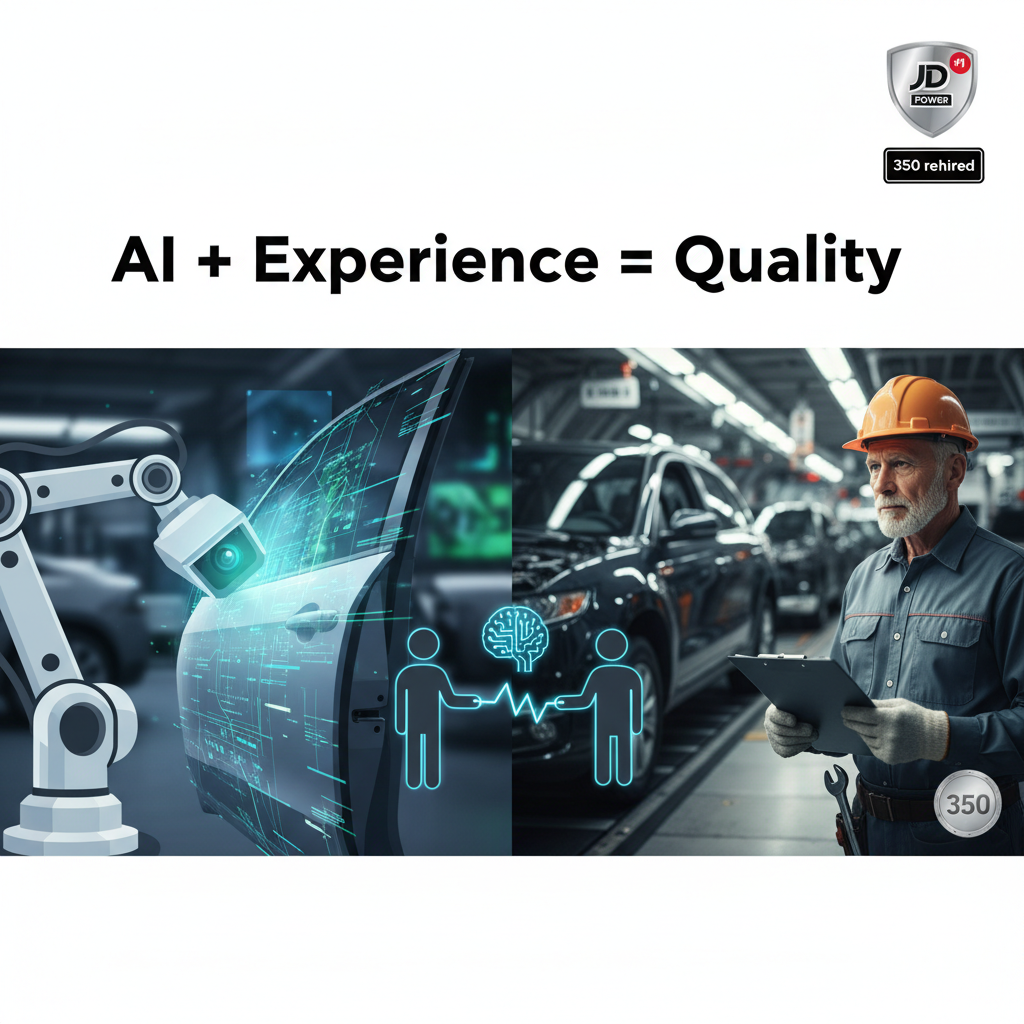
The future Ford is building — and the one every smart company should be building — puts AI and human expertise in the right relationship. AI handles pattern matching at scale. Humans handle judgment, context, and novel problem-solving. AI processes data. Humans decide what data matters.
It’s not sexy. It doesn’t make for simple ROI projections. But it works.
Ford’s gray beards aren’t there to replace the AI systems. They’re there to make those systems actually useful. They’re training the AI with better data, mentoring the junior engineers who’ll maintain those systems, and providing the judgment that prevents small problems from becoming recalls.
That’s the model. Not AI instead of people. AI because of people.
And if a company as massive and bureaucratic as Ford can course-correct this effectively, there’s hope for the rest of us. You just have to be willing to admit when the expensive experiment isn’t working — and bring back the expertise you need to fix it.
The $1 billion in savings and the JD Power crown? Those are just the visible results. The real win is the institutional knowledge that’s being preserved and transferred right now, ensuring Ford doesn’t have to learn these lessons again in another 16 years.
Ready to build AI systems that actually work with your team’s expertise? Contact our experts for personalized guidance on implementing AI without losing the institutional knowledge that makes your business valuable.