How YouTubers Are Taking Over the 2026 Box Office
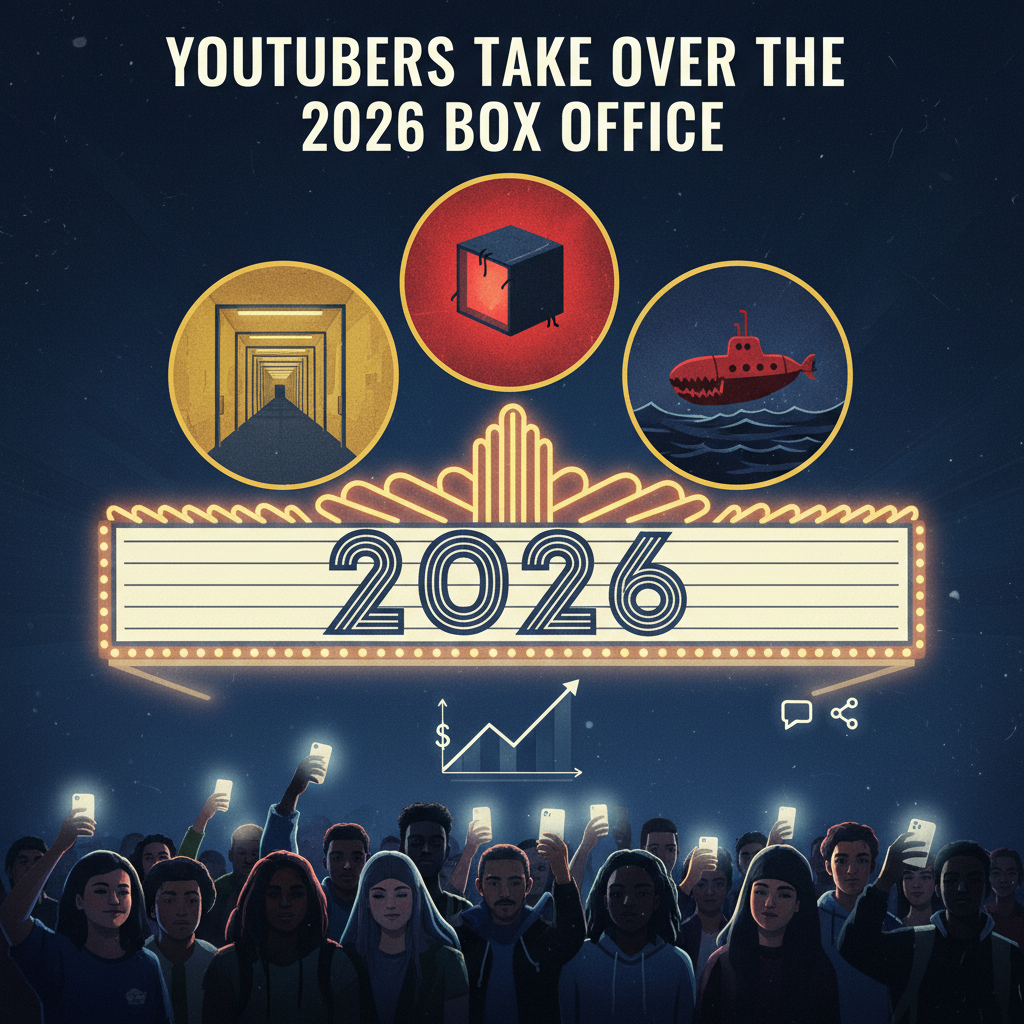
How YouTubers Are Taking Over the 2026 Box Office
Hollywood insiders have long insisted that YouTube fame doesn’t translate to theatrical success. You know what? In 2026, three creator-led films are proving them spectacularly wrong — and honestly, it’s not even close.
For years, the path from YouTube to the big screen was littered with failed experiments. As Rutgers Cinema general manager Mark DelVecchio bluntly noted, “lots of YouTubers have tried to make the leap to mainstream movies and come up short.” [Source: New York Times] And look, he wasn’t wrong. Until now.
Here’s the thing — Iron Lung, Obsession, and Backrooms didn’t just meet expectations. They shattered them. We’re talking about a seismic shift in how films get made, marketed, and monetized. This post breaks down exactly how these three films rewrote Hollywood’s rulebook, what separates these creators from everyone who came before, and what this means for the future of cinema.
Because honestly? The movie industry will never be the same.
The Numbers Don’t Lie — A Historic Weekend at the Box Office
Let me hit you with some numbers that should make every studio executive sweat. Backrooms, directed by teenage VFX prodigy Kane Parsons, earned $38 million on opening Friday alone. Not the weekend. Friday. The film’s projected to pull in $80M–$90M domestically for its opening weekend. [Source: Multiple box office trackers]
But here’s where it gets wild.
Obsession, directed by 26-year-old YouTuber Curry Barker, earned $8 million on its Friday with an estimated $28.5 million weekend. Solid numbers, right? That’s not even the story. The real story is what happened next — the film grew 30% from its opening weekend ($17.2M from 2,615 cinemas) to its second weekend. [Source: FanBolt]
I’ve been following box office trends for over a decade, and I can’t remember the last time I saw that happen with a wide release. Comscore box office analyst Paul Dergarabedian, who’s got 30+ years of experience tracking this stuff, said it best: “I don’t know if I’ve ever seen a movie have a jump like this in weekend two.” [Source: FanBolt]
And it didn’t stop there. Obsession‘s third weekend is projected to grow another 19%, making it the first film since 1982 to grow on both its second and third weekends. [Source: Hollywood Reporter] Let that sink in. 1982. We’re talking about a box office pattern that hasn’t existed for 44 years.
Oh, and both Backrooms and Obsession debuted the same weekend — making this the first time in memory where the two biggest movies were both directed by YouTubers. They beat Star Wars at the box office. Star Wars. [Source: Fox23]
Then there’s Iron Lung. Markiplier (Mark Fischbach) turned a $3 million budget into over $51 million worldwide when it released January 30, 2026. [Source: Box Office Mojo] That’s a 17x return on investment. Most indie films pray for 3x.
These aren’t flukes. This is a revolution.
Meet the Creators — Who Are Parsons, Barker, and Fischbach?
So who are these people rewriting Hollywood’s playbook? Let’s break it down.
Kane Parsons (Kane Pixels) — Backrooms
Kane Parsons is what happens when a teenage VFX prodigy discovers 4chan creepypasta and decides to build a cinematic universe. His YouTube channel, Kane Pixels, turned the internet’s collective nightmare about endless yellow hallways into a viral phenomenon. Then A24 — yeah, the studio behind Everything Everywhere All at Once and Hereditary — came calling.
The resulting film stars Chiwetel Ejiofor and Renate Reinsve. These aren’t YouTube personalities playing dress-up. These are serious, acclaimed actors. And Parsons built massive, physical 30,000-square-foot sets to capture the signature dread of his original series. [Source: A24 production notes]
The path? 4chan → YouTube → A24 → nationwide theaters. That’s the new pipeline, folks.
Curry Barker — Obsession
Curry Barker is one half of That’s a Bad Idea, a popular comedy duo on YouTube. But Obsession isn’t comedy — it’s psychological horror centered on a “wish in a box” concept that’s been described as “one of the creepiest, most uniquely terrifying films of 2026.” [Source: Multiple reviews]
Here’s what blows my mind: the production budget was sub-$1 million. Less than a million dollars. And it’s on track to clear $100 million total with Focus Features handling distribution. [Source: Focus Features]
The math doesn’t just work — it’s revolutionary.
Mark Fischbach (Markiplier) — Iron Lung
Markiplier’s a gaming icon with millions of subscribers. But with Iron Lung, he went full auteur — directing, writing, and self-financing the film. That’s rare even for established Hollywood directors. He adapted David Szymanski’s indie submarine horror game about a convict trapped on a desolate alien moon covered in an ocean of blood.
Critics were polarized. Some loved it. Some hated it. But you know what? It still earned $51M+ worldwide on a $3M budget. [Source: Box Office tracking] In Hollywood, money talks louder than reviews.
Why These Films Succeeded Where Others Failed
Remember DelVecchio’s quote about YouTubers coming up short? So what’s different this time?
First — and this is crucial — each creator brought a pre-sold fanbase that studios literally cannot manufacture. When Markiplier announces a film, millions of people who’ve watched him for years show up. That’s not marketing. That’s trust built over thousands of hours of content.
Second, genre alignment matters more than anyone wants to admit. All three films are horror. And horror rewards word-of-mouth, repeat viewings, and social media reactions like no other genre. It’s the perfect match for creator audiences who live on platforms where sharing reactions is the entire point.
Third, the IP already had proven internet resonance before production started. The Backrooms creepypasta, the Iron Lung game, Barker’s “wish in a box” concept — these weren’t Hollywood pitches. They were internet-native ideas that already worked.
But here’s where it gets interesting. Each creator chose a different business model. Parsons leveraged A24’s prestige and distribution muscle. Barker partnered with Focus Features for wider reach. Fischbach self-financed for maximum creative control. Three different approaches. All successful.
Roger Smith from Movie Nation pointed out something I’ve been thinking about — these creators are applying the YouTube business model to cinema: low overhead, direct audience connection, iterative storytelling. [Source: Movie Nation] It’s not Hollywood trying to do YouTube. It’s YouTube doing cinema their way.
And Obsession‘s weekend-to-weekend growth? That mirrors how YouTube’s algorithm works. Content doesn’t have to explode on day one. It can find its audience over time, building momentum through genuine engagement rather than front-loaded marketing blitzes.
Compare this to traditional Hollywood sequels and reboots that underperformed in the same period. Audiences are choosing original, creator-driven IP over legacy properties. That should terrify every studio executive banking on franchise recognition.
The Gen Z Factor — How Creator Cinema Is Reshaping Who Goes to the Movies
Here’s what nobody expected: Gen Z showed up.
For years, industry analysts have cited Gen Z as a disengaged moviegoing demographic. They stream. They game. They scroll. They don’t buy movie tickets. Except — and this is the part that’s rewriting the playbook — they’re flooding theaters for YouTuber-directed films. [Source: Fox23]
Why? Parasocial trust.
If you’ve watched Markiplier play horror games for five years, you feel like you know him. When he makes a film, you’re not buying a ticket to see a movie from a stranger. You’re supporting someone you’ve invested hours of your life watching. No marketing campaign can replicate that emotional connection. None.
These films also speak in the visual and narrative language of the internet. Creepypasta lore. Gaming aesthetics. Viral “what if” scenarios. Gen Z didn’t need these concepts explained — they grew up consuming them. The Backrooms isn’t a weird art film to them. It’s a shared cultural reference point.
And then there’s the social media reaction loop. Horror films are prime content for reaction videos, TikTok walkthroughs, Reddit theory threads. Every post drives additional ticket sales. That’s why Obsession kept growing. The film became a social media event, and events demand participation.
Meanwhile, franchise fatigue is real. When given the choice between another Star Wars installment and an original creator-driven horror film, Gen Z chose the creators. That’s not a fluke. That’s a preference shift.
What This Means for Hollywood (And Every Creator Watching)
So what happens next?
Studios are already scrambling. I’ve heard through industry contacts that multiple major studios are reaching out to mid-tier YouTube creators with horror or sci-fi channels, offering development deals. Some will work. Most won’t. Because here’s the thing — you can’t manufacture what Parsons, Barker, and Fischbach built over years of consistent content creation.
For creators, the path is clearer than it’s ever been. But it’s not easy. You need proven IP that resonates with your audience. You need genre alignment (horror and thriller are your best bets right now). And you need to decide: do you partner with a studio for resources and distribution, or do you self-finance for creative control?
There’s no single right answer. All three models worked in 2026.
What won’t work? Trying to make a “YouTube movie” that panders to your audience without cinematic substance. Audiences are smarter than that. They’ll support creators they trust, but only if the film delivers genuine value beyond parasocial loyalty.
The YouTuber box office revolution of 2026 isn’t about YouTube beating Hollywood. It’s about a new generation of filmmakers using different tools, different business models, and different audience relationships to create cinema that actually connects. And honestly? That’s what the industry needed.
The question isn’t whether more creators will follow this path. They will. The question is whether Hollywood will adapt fast enough to stay relevant — or whether the future of cinema is being built on platforms they still don’t fully understand.
Ready to take your content creation or film project to the next level? Contact our experts for personalized guidance on navigating the creator economy and building audiences that translate to real-world success.