Automation for E-commerce Business: A Deep Dive into Smart Automation and Its Impact (With Cross-Sector Insights)
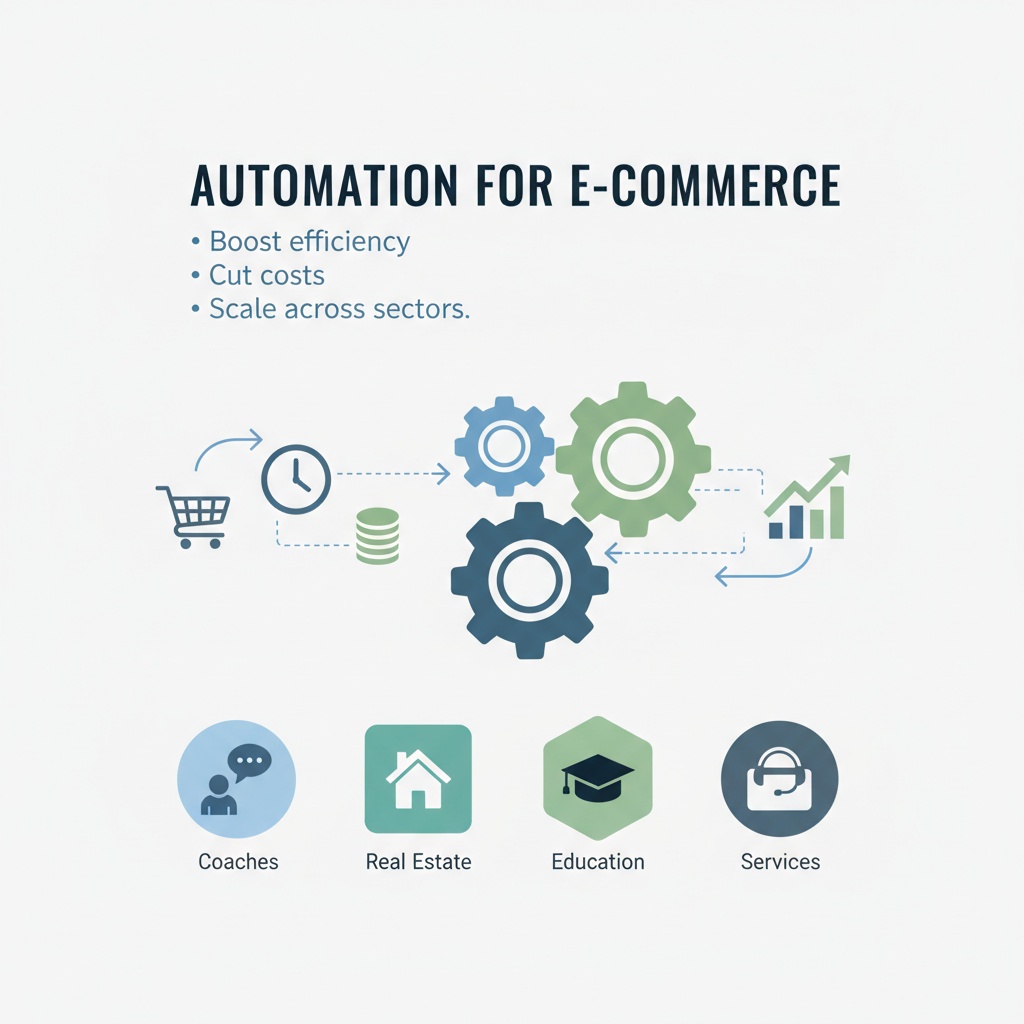
Automation for E-commerce Business: A Deep Dive into Smart Automation and Its Impact (With Cross-Sector Insights)
Estimated reading time: 12 minutes
Key Takeaways
- Increased operational efficiency
- Significant cost reduction
- Fewer manual errors
- Enhanced customer experience
- Better process visibility
- Improved scalability
Table of contents
- What is Business Automation?
- Understanding Business Automation Across Sectors
- E-commerce Automation: A Closer Look
- Automation for Coaches and Consultants
- Automation for Real Estate Agents
- Automation for Online Educators
- Automation for Service-Based Business
- Choosing the Right Automation Tools
- Implementation Strategy
- Measuring Success
- Conclusion
- The Future of AI in Software Development
- Frequently Asked Questions
In today’s digital age, automation for e-commerce business has become more than just a luxury – it’s a necessity for survival and growth. As online retail continues to evolve, businesses across sectors, from coaches and consultants to real estate agents, online educators, and service-based businesses, are discovering the transformative power of automation.
Let’s explore how automation is reshaping business operations and driving success across different industries, with a special focus on e-commerce.
What is Business Automation?
Business automation refers to using technology to execute repetitive tasks and processes with minimal human intervention. It’s about working smarter, not harder, by letting software handle routine operations while humans focus on strategic thinking and relationship building.
Key benefits of business automation include:
- • Increased operational efficiency
- • Significant cost reduction
- • Fewer manual errors
- • Enhanced customer experience
- • Better process visibility
- • Improved scalability
For a deeper dive into the fundamentals, see Introduction to Business Automation.
Understanding Business Automation Across Sectors
While automation benefits vary by industry, certain fundamental advantages remain consistent. These include:
- • Time savings through task automation
- • Reduced operational costs
- • Improved accuracy in routine processes
- • Enhanced customer satisfaction
- • Better data management and reporting
For e-commerce specifically, automation addresses unique challenges like high-volume transactions, inventory management, and customer service scaling.
To explore practical automation ideas for small businesses, see Common Processes to Automate in Small Businesses.
E-commerce Automation: A Closer Look
E-commerce businesses face unique challenges that make automation particularly valuable:
Inventory Management:
- • Automated stock level updates
- • Smart reordering systems
- • Real-time inventory tracking
- • Multi-channel synchronization
Order Processing:
- • Automated order confirmation
- • Shipping label generation
- • Status updates
- • Invoice creation
Customer Service:
- • AI-powered chatbots
- • Automated email responses
- • Self-service portals
- • Ticket routing systems
Marketing Automation:
- • Abandoned cart recovery
- • Personalized email campaigns
- • Social media scheduling
- • Customer segmentation
Source: The High Gear blog on business process automation benefits No-code/Low-Code options are also discussed here.
For practical tool choices including CRM and automation platforms, see CRM and Sales Automation Tools.
Automation for Coaches and Consultants
For coaches and consultants, automation streamlines:
- Scheduling: Calendar management, appointment reminders, meeting confirmations, follow-up scheduling
- Client Management: CRM automation, document sharing, progress tracking, billing and invoicing
- Marketing: Lead nurturing, email sequences, content scheduling, campaign tracking
Source: Greystone Tech blog on automation benefits Automation Use Cases for Freelancers and Agencies.
Automation for Real Estate Agents
Real estate professionals benefit from automation in:
- Lead Generation: Website lead capture, lead scoring, automated follow-ups, property matching
- Property Management: Maintenance scheduling, rent collection, lease renewals, tenant communications
- Marketing: Listing updates, virtual tours, email campaigns, social media posting
Source: Grant Bot real estate automation article CRM and Sales Automation Tools are useful for agent workflows.
Automation for Online Educators
Online educators leverage automation for:
- Course Delivery: Content scheduling, assignment distribution, progress tracking, resource sharing
- Student Management: Enrollment processing, attendance tracking, grade management, communication systems
- Assessment: Automated grading, progress reports, certificate generation, feedback delivery
Automation for Service-Based Business
Service businesses implement automation in:
- Appointment Management: Online booking, reminder systems, calendar sync, resource allocation
- Client Relations: CRM automation, follow-up sequences, feedback collection, review management
- Operations: Invoice generation, payment processing, service tracking, reporting systems
Choosing the Right Automation Tools
Consider these factors when selecting automation solutions:
- Essential Features: Scalability, integration, user-friendly interface, support, and cost-effectiveness
- Implementation Requirements: Training, technical support, customization, and maintenance
For a quick tour of no-code options and tool comparisons, see No-Code/Low-Code Automation Tools.
Implementation Strategy
Follow these steps for successful automation:
- Assessment Phase: Identify manual processes, document current workflows, set automation goals, calculate ROI
- Planning Phase: Choose tools, design workflows, create training materials, set timeline
- Execution Phase: Run pilots, train team, monitor results, gather feedback
- Optimization Phase: Analyze performance, adjust, scale, add features
Measuring Success
Track these metrics to evaluate automation impact:
- Efficiency Metrics: Time saved, error reduction, cost savings, productivity increase
- Customer Metrics: Satisfaction scores, response times, resolution rates, engagement levels
- Business Metrics: Revenue growth, operational costs, customer retention, team satisfaction
Conclusion
Automation for e-commerce business and other sectors represents a fundamental shift in how companies operate. Whether you’re running an online store, consulting practice, real estate agency, educational platform, or service-based business, automation can transform your operations and drive growth.
Start small, focus on high-impact areas, and gradually expand your automation initiatives. The key is to begin the journey and continuously optimize your automated processes for maximum benefit.
Remember, successful automation isn’t about replacing humans – it’s about enhancing human capabilities and freeing up time for what matters most: strategy, creativity, and meaningful customer interactions.
Source: The U.S. Chamber of Commerce on what is business automation The Future of Work with AI Agents is explored further here.
The Future of AI in Software Development
Devin represents just the beginning of AI’s integration into software development. As the technology evolves, we can expect improvements in:
- Context understanding: Better comprehension of complex business requirements
- Collaboration capabilities: Enhanced ability to work alongside human developers
- Specialized knowledge: Domain-specific expertise in various industries
- Creative problem-solving: More innovative approaches to challenging technical problems
The future likely holds a collaborative model where AI handles routine implementation while humans focus on strategy, creativity, and complex problem-solving.
Frequently Asked Questions
Is Devin AI going to replace human developers?
While Devin can automate many routine coding tasks, it currently lacks the creative problem-solving, business understanding, and strategic thinking that senior developers provide. It’s more likely to augment human capabilities rather than replace them entirely.
How much does Devin AI cost?
Pricing details vary depending on usage levels and enterprise requirements. Contact Cognition Labs for current pricing information and enterprise packages.
What programming languages does Devin support?
Devin supports major programming languages including Python, JavaScript, Java, C++, and Go. Support for additional languages is continuously being expanded based on user demand.
Can Devin work with existing codebases?
Yes, Devin can analyze and work with existing codebases, though performance varies depending on code quality, documentation, and complexity. It works best with well-structured, documented projects.
Is Devin suitable for enterprise-level development?
Devin shows promise for enterprise use, particularly for routine development tasks and maintenance work. However, enterprises should carefully evaluate their specific needs and conduct thorough testing before full implementation.
How does Devin compare to other AI coding assistants?
Unlike tools like GitHub Copilot or ChatGPT, Devin claims full autonomy in software development. While other tools assist developers, Devin aims to function as an independent software engineering team member.