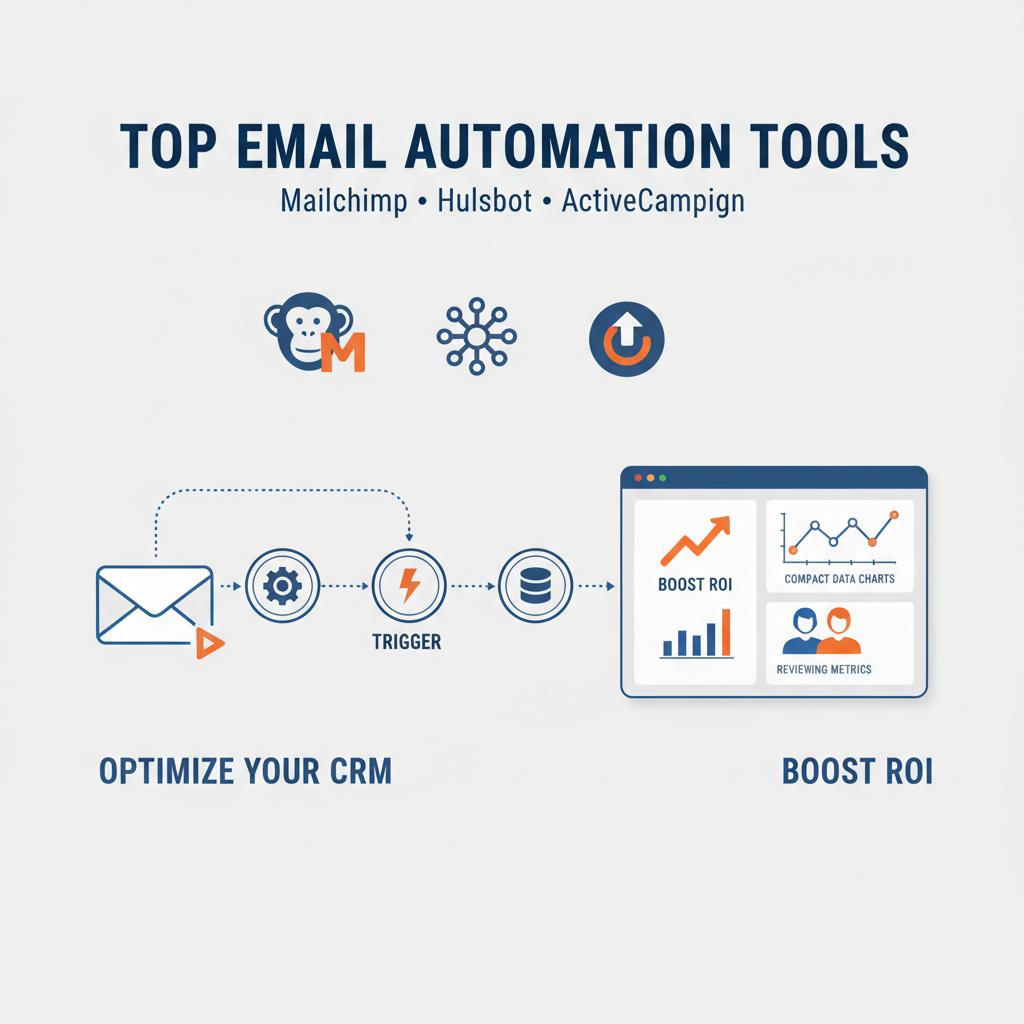
The Best Email Marketing Automation Tools to Streamline Your Campaigns in 2025
Estimated reading time: 8 minutes
Key Takeaways
- Automation accelerates growth by delivering the right message to the right person at the right time, boosting ROI up to 320% compared to manual campaigns.
- Choose tools with growth in mind prioritize user-friendliness, robust analytics, and advanced features like segmentation and A/B testing to scale with your business. Think about where your business will be in two years.
- CRM integration matters — the best results come from unified data, automated lead scoring, real-time behavior tracking, and seamless handoffs between marketing and sales. See also CRM and Sales Automation Tools.
Table of contents
Imagine running your email marketing campaigns while you sleep, delivering personalized messages to prospects exactly when they’re most engaged. That’s not science fiction – it’s the power of email marketing automation, and it’s transforming how businesses connect with their audiences. I’ve spent years helping companies implement these tools, and I’ll tell you what I tell my clients: choosing the right email automation platform can be the difference between drowning in manual tasks and scaling your marketing effortlessly. Let’s explore the best email marketing automation tools that can help you achieve that transformation. For a broader introduction to automation in small business, see Introduction to Business Automation.
What is Email Marketing Automation?
At its core, email marketing automation is like having a super-smart assistant who knows exactly when and how to communicate with your prospects. It’s software that handles repetitive email tasks based on triggers – things like welcome sequences when someone signs up, follow-up emails after a purchase, or re-engagement campaigns when subscribers go quiet. The impact? It’s pretty dramatic. Businesses using automation see up to 320% higher ROI compared to traditional manual campaigns. Why? Because these tools don’t just send emails – they deliver the right message to the right person at exactly the right time. #ROI
What to Look for in Email Marketing Automation Tools
Before we dive into specific platforms, let’s talk about what really matters when choosing an automation tool. I’ve helped dozens of companies make this decision, and here’s what I’ve learned:
User-Friendliness
- Does it have a drag-and-drop builder?
- Can you create workflows without coding?
- How steep is the learning curve?
Analytics and Tracking
- Can you monitor open rates and clicks?
- Does it show conversion data?
- Are the dashboards clear and actionable?
Advanced Features
- How sophisticated is the segmentation?
- Does it offer A/B testing?
- Can it handle multi-channel campaigns?
I always tell clients: “Think about where your business will be in two years, not just today.” You want a tool that can grow with you.
Let’s look at three standout platforms that consistently deliver results:
Mailchimp: The Small Business Champion
If you’re just starting with email automation, Mailchimp is like that friendly neighbor who’s always ready to help. Its strength lies in its simplicity:
- Intuitive drag-and-drop email builder
- Pre-built automation workflows
- Extensive template library
- Solid e-commerce integrations
The free tier is generous, making it perfect for small businesses. But here’s the catch – as your list grows, costs can climb quickly, and you might outgrow its basic automation features.
For broader automation options, see No-Code/Low-Code Automation Tools.
HubSpot: The All-in-One Powerhouse
HubSpot is what I recommend when clients say, “We need everything to work together.” It’s like having your entire marketing department in one platform:
- Deep CRM integration
- Powerful behavior-based triggers
- Advanced lead scoring
- Comprehensive analytics
The free CRM is a great starting point, but the real automation magic happens in the premium tiers. Yes, it’s pricier, but the unified platform often justifies the investment for growing businesses.
ActiveCampaign: The Automation Specialist
This is my go-to recommendation for clients who say, “We need sophisticated automation without hiring a tech team.” ActiveCampaign strikes an impressive balance:
- Advanced automation workflows
- AI-powered predictive sending
- Deep segmentation capabilities
- Strong multi-channel support
Their mid-range pricing and excellent customer support make them particularly attractive for medium-sized businesses looking to scale their email marketing.
Integrating with Your CRM
Here’s something crucial that often gets overlooked: your email automation is only as good as its integration with your CRM. Think of it like this – your CRM is the brain storing all your customer information, and your email automation is the voice that communicates with them. They need to work in perfect harmony.
The best setups I’ve seen combine:
– Unified customer data
– Automated lead scoring
– Real-time behavior tracking
– Seamless handoffs between marketing and sales
For CRM automation strategies, see CRM and Sales Automation Tools.
Making Your Choice
After helping countless businesses implement these tools, here’s my advice: start with your specific needs and work backward. Ask yourself:
- What’s your current email list size?
- How complex are your automation needs?
- What’s your budget comfort zone?
- Which other tools need to integrate?
Mailchimp is perfect if you’re starting out and want simplicity. HubSpot makes sense if you need a complete marketing suite. ActiveCampaign is ideal if you want advanced automation without overwhelming complexity.
Remember, most of these platforms offer free trials – use them. There’s no better way to know if a tool is right for you than by testing it yourself.
The landscape of email marketing automation is constantly evolving, but these tools have consistently proven their worth. The best choice is the one that fits your specific needs while giving you room to grow.
For more reading on automation basics, see Automate Small Business Processes.
Have you tried any of these platforms? I’d love to hear about your experiences in the comments below. And if you’re still unsure which tool is right for you, let’s discuss your specific needs – that’s what the comment section is for!
For additional workflow ideas, see Workflow Automation Basics.
If you’d like broader CRM automation perspectives, see CRM & Sales Automation Tools.
For more automation use cases in various industries, see Automation Use Cases by Industry.
For general business process automation concepts, see Business Process Automation.
Want more on email marketing automation? See Email Marketing Automation.
If you’re exploring broader email tooling, also peek at Email & Marketing Automation Tools.
For a broader look at no-code automation, see No-Code/Low-Code Automation Tools.
The landscape of email marketing automation is constantly evolving, but these tools have consistently proven their worth. The best choice is the one that fits your specific needs while giving you room to grow.
Have you tried any of these platforms? I’d love to hear about your experiences in the comments below. And if you’re still unsure which tool is right for you, let’s discuss your specific needs – that’s what the comment section is for!