Hire Automation Consultant: A Complete Guide to Finding and Working with Automation Experts
Estimated reading time: 12 minutes
Key Takeaways
- Automation consultants help translate business needs into scalable, technology-driven processes that boost efficiency and reduce manual tasks.
- DIY automation may seem cheaper upfront, but professional consultants often deliver better ROI through expertise, risk reduction, and scalable solutions.
- Understand typical cost structures (hourly, project-based, and retainer) and assess ROI factors like reduced labor, fewer errors, and faster time to value.
- Follow a practical hiring path: audit current processes, define requirements, evaluate potential consultants, and plan implementation milestones.
- Whether you hire a consultant or DIY, start by documenting processes and exploring practical resources to guide your automation journey.
Table of contents
- What is an Automation Consultant?
- Understanding What Automation Consultants Do
- Common Projects
- Benefits of Hiring a Freelance Automation Consultant
- Cost of Hiring an Automation Consultant
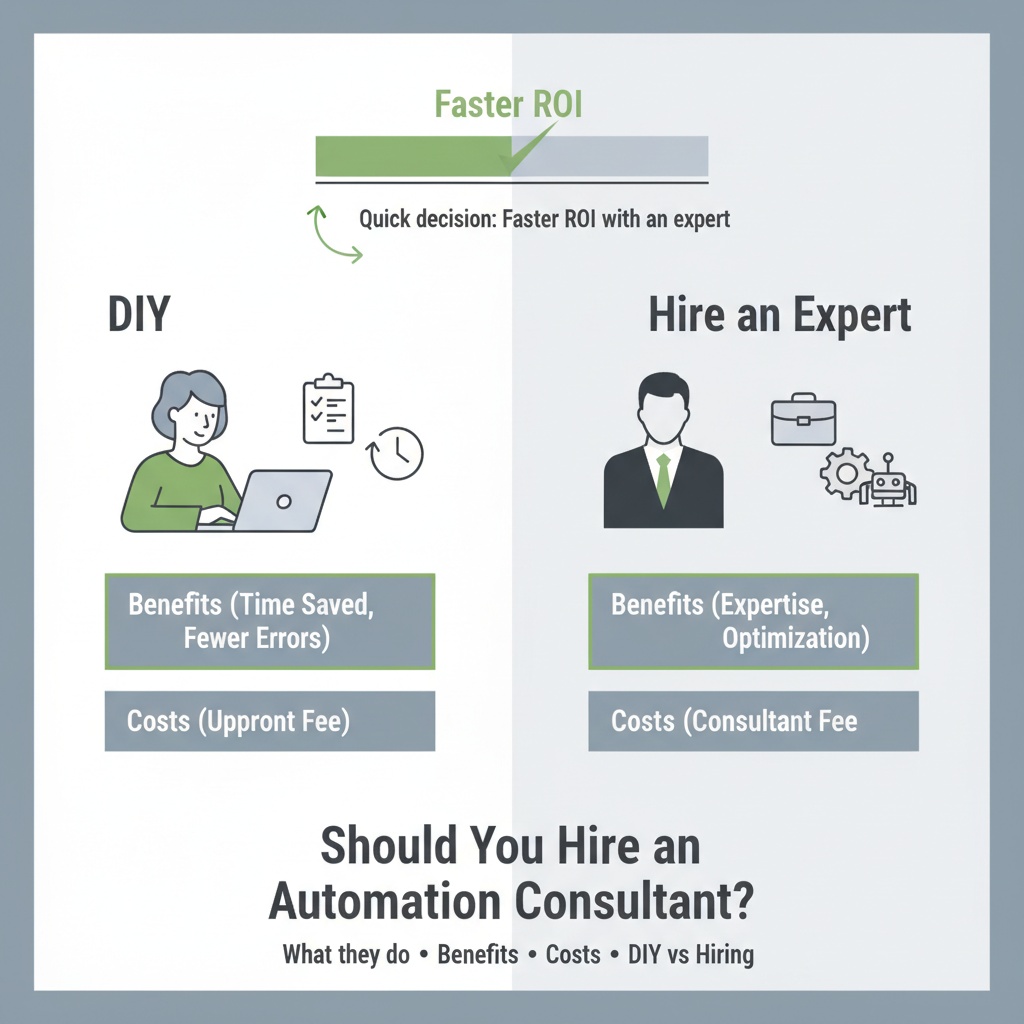
- DIY Automation vs. Hiring an Automation Consultant
- Should I Hire an Automation Expert? Key Considerations
- Making Your Decision
- Next Steps to Hire an Automation Consultant
- Conclusion
- Frequently Asked Questions
Executive Summary
An automation consultant is a specialized professional who helps businesses implement technology solutions to streamline operations, reduce manual work, and improve efficiency. While DIY automation might seem cost-effective initially, professional Automation consultants often deliver better ROI through their expertise, risk reduction, and ability to implement scalable solutions. For a quick primer on business process automation, see Introduction to Business Automation.
Understanding what automation consultants do helps you evaluate fit and value. Their primary role is to analyze, design, and implement automated processes that boost efficiency and reduce costs across departments.
Source: Automation consultants bring strategic technical expertise to bridge business needs and technology.
For a quick look at practical project types, see Process automation consulting.
Common projects include:
- RPA (Robotic Process Automation) implementation
- AI-powered customer service solutions
- Automated data entry systems
- Smart analytics dashboards
- Workflow automation across departments
To explore freelance advantages, read about Freelance automation consultants for flexibility and expertise.
ROI considerations include reduced manual labor, fewer errors, improved efficiency, scalability, and lower operational risk. See the source for more details: Trafft.
DIY automation vs. hiring a professional also has a clear ROI dimension. Compare approaches with insights from Process automation consulting.
For additional foundational reading, see Introduction to Business Automation.
Next, consider practical steps to begin your automation journey. See No-Code/Low-Code Automation Tools for quick wins.
When you’re ready to plan, follow the structured steps outlined in the sections below.
For a broader business perspective, check out Automation Use Cases by Industry.
Understanding What Automation Consultants Do
Automation consultants are strategic technical experts who bridge the gap between business needs and technological solutions. Their primary role is to analyze, design, and implement automated processes that enhance business efficiency and reduce operational costs.
Key Responsibilities Include:
- Conducting thorough workflow analysis
- Designing optimized business processes
- Selecting and implementing appropriate automation tools
- Providing staff training and ongoing support
- Developing long-term automation strategies
Source: Automation consultants
Common projects include:
- RPA (Robotic Process Automation) implementation
- AI-powered customer service solutions
- Automated data entry systems
- Smart analytics dashboards
- Workflow automation across departments
Source: Process automation consulting
Common Projects
- RPA (Robotic Process Automation) implementation
- AI-powered customer service solutions
- Automated data entry systems
- Smart analytics dashboards
- Workflow automation across departments
Source references provide examples of project types and outcomes. See the following for more details: Process automation consulting, Automation consultants.
Benefits of Hiring a Freelance Automation Consultant
Choosing to work with a freelance automation consultant offers several distinct advantages:
Flexibility and Specialized Expertise
- Access to up-to-date knowledge across multiple platforms
- Ability to scale services up or down as needed
- Exposure to diverse industry best practices
Cost-Effectiveness
- Pay-for-service model eliminates full-time employee costs
- No long-term commitments or benefit packages
- Reduced training and onboarding expenses
Source: Trafft
Faster Implementation
- Immediate access to expert knowledge
- Reduced learning curve
- Quicker problem resolution
- Faster time to value
Source: Boardroom Advisors
Cost of Hiring an Automation Consultant
Understanding the financial investment required is crucial for decision-making. Here’s a breakdown of typical cost structures:
Pricing Models:
- Hourly Rates ($100-$300/hour)
- Project-Based Fees ($5,000-$50,000+)
- Retainer Agreements (Monthly fees starting at $2,000)
Cost Factors:
- Project scope and complexity
- Consultant’s experience level
- Required technology stack
- Training and support needs
- Implementation timeline
Source: Trafft
DIY Automation vs. Hiring an Automation Consultant
To make an informed decision, consider these key differences:
DIY Automation
- Advantages:
- Greater internal control
- Lower upfront costs
- Built-in institutional knowledge
- Challenges:
- Limited technical expertise
- Higher risk of mistakes
- Longer implementation time
- Hidden costs in training and tools
Professional Consultant
- Advantages:
- Expert implementation
- Faster deployment
- Best practice integration
- Risk mitigation
- Scalable solutions
- Challenges:
- Higher initial investment
- Dependency on external expertise
- Change management needs
Source: Process automation consulting
Should I Hire an Automation Expert? Key Considerations
Evaluate your needs by asking these critical questions:
Process Assessment
- How complex are your automation needs?
- What’s your timeline for implementation?
- Do you have compliance requirements?
- What’s your expected ROI timeline?
Internal Resources
- Does your team have automation expertise?
- Can you allocate staff time to implementation?
- What’s your training budget?
Strategic Alignment
- How does automation fit your growth plans?
- What’s your long-term technology roadmap?
- How will automation impact your competitive position?
Source: Boardroom Advisors
Making Your Decision
Consider hiring an automation consultant if you need rapid implementation, have complex processes, regulatory compliance concerns, lack internal automation expertise, or require scalable, long-term automation.
Consider DIY automation if your needs are simple, you have in-house technical capabilities, timelines are flexible, budgets are tight, and processes are stable.
No matter which path you choose, deepen your understanding by exploring practical resources like the broad primer on automation in a business context: Introduction to Business Automation.
Next Steps to Hire an Automation Consultant
-
Audit Your Current Processes
- Document existing workflows
- Identify pain points
- Set clear automation goals
For a quick read on signs you may need automation, see Signs Your Business Needs Automation.
-
Define Your Requirements
- Create a project scope
- Set budget parameters
- Establish timeline expectations
-
Evaluate Potential Consultants
- Check credentials and experience
- Review past projects
- Request client references
- Discuss methodology and approach
For a focused look at practical automation implementations, see Common Processes to Automate in Small Businesses.
-
Plan for Implementation
- Set clear milestones
- Establish communication protocols
- Define success metrics
- Create a change management plan
Source: Trafft
Conclusion
The decision to hire automation consultant services can significantly impact your business’s efficiency and growth potential. While the initial investment may be higher than DIY automation, the expertise, reduced risk, and faster implementation often deliver superior long-term value. Consider your specific needs, resources, and goals to make the choice that best serves your organization’s future.
Ready to explore automation consulting? Start by documenting your current processes and challenges, then reach out to qualified consultants for initial consultations. For a broad primer on automation applications by industry, see Automation Use Cases by Industry.
Source: Process automation consulting
Frequently Asked Questions
Is hiring an automation consultant worth it compared to DIY?
Yes, for complex processes, faster delivery, risk mitigation, and scalability. DIY can work for simple, well-understood workflows but may incur hidden costs and longer timelines.
What does an automation consultant typically do?
They audit processes, design automated solutions, select tools, implement integrations, train staff, and provide ongoing support and strategies for long-term automation success.
How much does hiring an automation consultant cost?
Costs vary. Typical models include hourly ($100-$300/hour), project-based ($5,000-$50,000+), or monthly retainers starting around $2,000. ROI depends on project scope and potential savings.
How long does a typical automation project take?
Timeline depends on scope, but smaller projects can take weeks, while large, cross-department initiatives may span several months. A well-defined plan helps maintain momentum.
How do I choose the right automation consultant?
Evaluate domain experience, industry relevance, past results, client references, and alignment with your goals and timeline. Clear milestones and communication expectations are essential.
Can I start with no-code/low-code tools?
Yes. No-code/low-code tools offer quick wins and faster time-to-value for straightforward automation, with the option to scale to more complex solutions later.