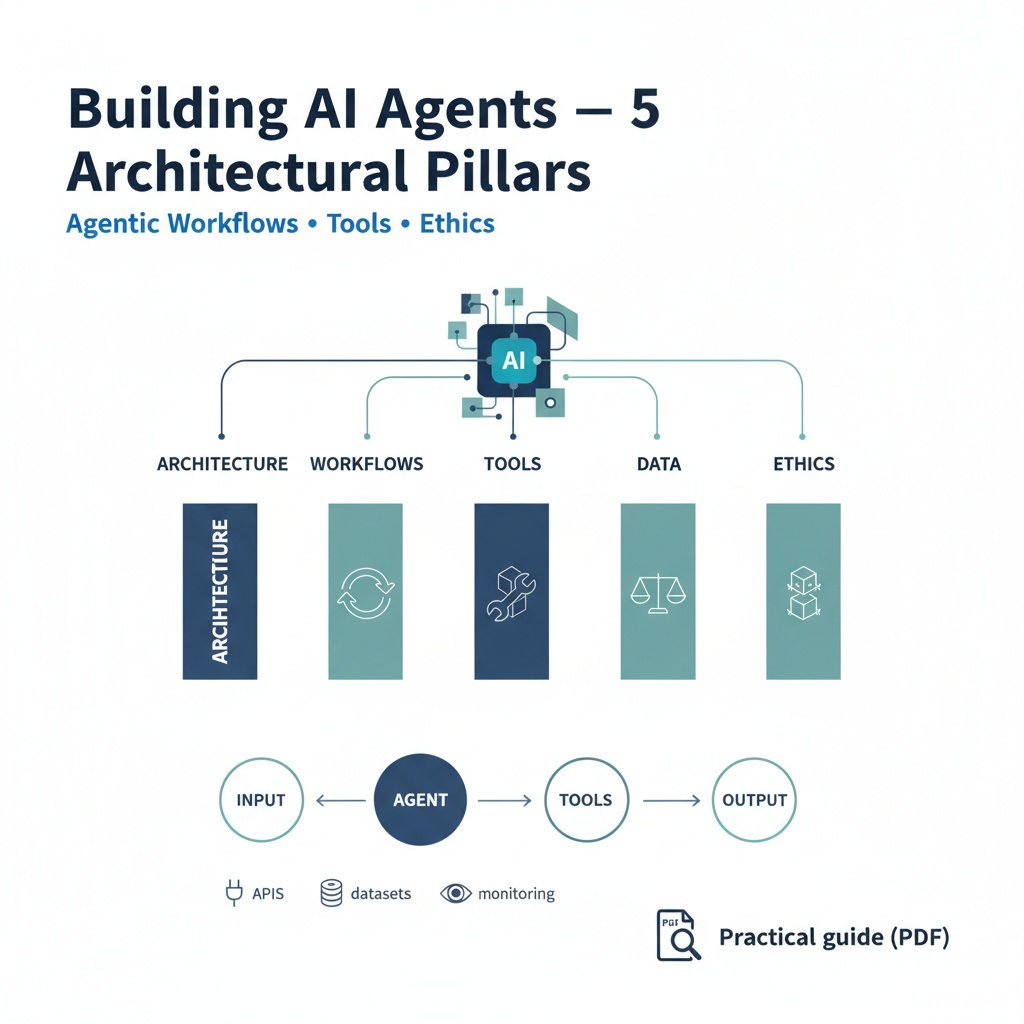
Principles of Building AI Agents: A Comprehensive Guide to Modern Agent Architecture
Estimated reading time: 12 minutes
Key Takeaways
- Autonomy spectrum: AI agents operate across levels of autonomy, from basic automation to sophisticated decision-making.
- AI agents benefit from a modular workflow that breaks tasks into sub-tasks, enabling reliable, multi-step execution. Modular workflows help achieve reliability and predictability.
- Five architectural pillars: Scalability, Flexibility, Data Accessibility, Trust, Security and Compliance. Five pillars outline the core design expectations.
- Essential components: Providers, Models, Prompts, Tools, Memory Systems, and Middleware. PDF deep-dive covers deeper detail.
- Advanced capabilities: Tool Calling, Dynamic Adaptation, and Planning & Reasoning. Explore related tools.
- The practical impact spans sectors such as Healthcare, Business, Education, Research, Public Services, and Entertainment.
Table of contents
Understanding the core principles behind AI agents is essential for building reliable, adaptable autonomous systems. These agents can automate tasks, reason about actions, and interact with tools and data sources in ways that increasingly rival human capabilities. Through careful design, responsible deployment, and robust evaluation, modern agents can deliver meaningful impact across industries. Explore the guiding principles and stay informed about best practices.
What are AI Agents?
AI agents are systems that can observe their environment, reason about goals, and take actions to achieve those goals. They operate on a spectrum of autonomy and can coordinate with external tools and data sources to perform complex tasks. comprehensive guide available on Scribd indicates agents can function at various autonomy levels, from automation to advanced decision-making.
Key features include:
- Agentic workflows: Break down tasks into sub-tasks to tackle multi-step processes efficiently. Mastra.ai’s authoritative book describes this modular approach.
- Modularity: Enables reliable and predictable outcomes through composition of smaller units.
- Integration: Works across data sources, models, and APIs to coordinate actions.
The Architecture That Powers AI Agents
The architectural foundation of AI agents is built on five critical pillars:
- Scalability — Modern AI agents must be designed with growth in mind. Practical Guide to AI Agents notes that systems should handle increasing computational demands as they expand in scope and user base.
- Flexibility — The architecture must be adaptable to integrate with various systems, data sources, language models, and APIs. llamaindex guide to custom data highlights the importance of flexible data connectivity.
- Data Accessibility — Continuous access to accurate, real-time data underpins agent operation.
- Trust — Robust evaluation and observability ensure reliability and safety.
- Security and Compliance — Strong security practices and granular access controls are essential. Email automation tools guide helps illustrate practical controls.
Essential Components of Modern AI Agents
The construction of effective AI agents relies on several key components, as outlined in multiple authoritative sources including Scribd’s documentation and arXiv’s comprehensive review:
- Providers — Supply the necessary model and computational resources. PDF deep-dive
- Models — Typically powered by Large Language Models (LLMs).
- Prompts — The carefully crafted instructions that guide actions.
- Tools — External functions such as calculators, search, and APIs.
- Memory Systems — Short-term and long-term memory for context.
- Middleware — Security, authentication, and overall operation management. PDF deep-dive
Advanced Capabilities and Real-World Applications
Modern AI agents possess sophisticated capabilities that extend beyond basic automation. According to the latest research available on arXiv, these include:
- Tool Calling — Agents can interact with external software and APIs, enabling tasks like recommendations or scheduling. Tool Calling and related capabilities.
- Dynamic Adaptation — Middleware enables on-the-fly adjustments while preserving security and guidelines. Dynamic Adaptation.
- Planning and Reasoning — Chain-of-thought reasoning and reflection to break problems into sub-goals. Planning and Reasoning.
The impact of AI agents spans across sectors like:
- Healthcare: Supporting diagnosis and surgical robotics
- Business: Enhancing customer service and optimizing supply chains
- Education: Improving student engagement and supporting educators
- Scientific Research: Automating laboratory processes and supporting research
- Public Services: Aiding in urban planning and transport optimization
- Entertainment: Creating game agents and supporting creative design processes
Ethical Considerations and Implementation Strategies
Building AI agents isn’t just about technical capabilities. The Practical Guide to AI Agents emphasizes the importance of addressing ethical considerations, including:
- Fairness and bias mitigation
- Transparency in decision-making processes
- Accountability measures
- Responsible deployment strategies
For organizations looking to implement AI agents, success depends on:
- Careful alignment with business objectives
- Thorough assessment of data readiness
- Comprehensive integration planning
- Strict compliance with regulatory requirements
Accessing Resources and Further Learning
For those interested in diving deeper into these principles, several comprehensive resources are available:
- The “Principles of Building AI Agents” by Sam Bhagwat offers detailed insights into agent architectures and practical workflows — PDF
- “A Practical Guide to AI Agents” provides business-focused implementation strategies — Business guide
- Various academic papers on arXiv offer cutting-edge research and analysis —
- PDFs through platforms like Scribd — PDFs on Scribd
Several of these resources are available as PDFs through platforms like Scribd and specialized websites, though some may require registration or purchase for full access. PDFs.
Conclusion
The principles of building AI agents represent a fascinating intersection of computer science, cognitive psychology, and engineering. As the field advances, understanding these fundamentals remains essential for developers, business leaders, and technologists seeking to navigate AI’s evolving landscape. By focusing on autonomy, modular design, robust security, and responsible deployment, teams can harness AI agents to augment human capabilities and drive meaningful outcomes.
Frequently Asked Questions
Is AI Agents going to replace human developers?
While AI agents can automate many routine coding tasks, they currently lack deep business understanding, strategic thinking, and creative problem-solving. They are more likely to augment rather than replace human developers.
How much does AI Agents cost?
Pricing varies by usage and enterprise needs. Contact for enterprise pricing for current options.
What programming languages do AI Agents support?
AI Agents support major languages including Python, JavaScript, Java, C++, and Go. Additional language support grows with demand.
Can AI Agents work with existing codebases?
Yes, they can analyze and work with existing codebases, though performance depends on code quality, documentation, and complexity.
Is AI Agents suitable for enterprise-level development?
AI Agents show promise for enterprise use, especially for routine tasks and maintenance. Enterprises should perform thorough evaluation and testing.
How does AI Agents compare to other AI coding assistants?
Unlike tools like GitHub Copilot, AI Agents aim for autonomous software development. They may act as an independent software engineering team member.
}