Safety Positioning Is a Business Strategy, Not a Political Shield
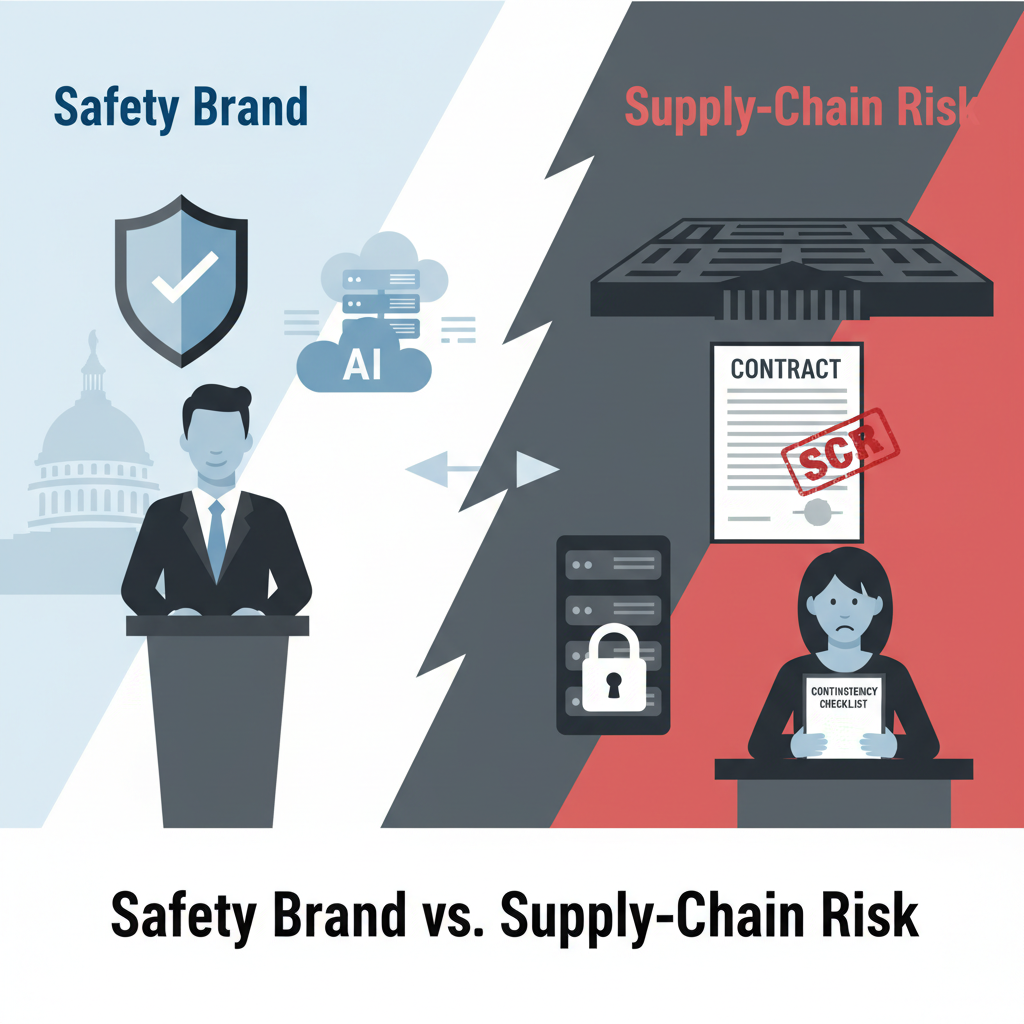
Dario Amodei published an essay calling for an AI development slowdown. Sam Altman endorsed it. Elon Musk endorsed it. Then the U.S. government designated Anthropic a “Supply Chain Risk to national security”—a label ordinarily reserved for companies with direct ties to foreign adversaries—and Amodei spent the next news cycle apologizing for a leaked internal memo that criticized the President. This is not a story about one bad week. It is a story about a vendor that built its commercial identity around safety credibility while simultaneously landing a $200 million DoD contract and running Claude in classified environments through Palantir. Those two things were always going to collide.
Enterprise IT shops evaluating Anthropic as infrastructure need to understand what actually happened here, because the contradiction wasn’t hidden. It was just invisible until it wasn’t.
Safety Positioning Is a Business Strategy, Not a Political Shield
Anthropic’s “responsible AI” brand was always doing commercial work. It differentiated Claude from OpenAI, attracted regulated-industry customers, and justified premium pricing. That is legitimate—every vendor positions around something. But it created a public posture that made Anthropic legible as a political actor, not just a vendor. There is a difference between saying “our model is safe for compliance-heavy workloads” and the CEO of your AI company becoming a recognizable figure in Washington policy debates, calling for capability slowdowns and testifying before Congress about existential risk.
The moment Amodei called for a development slowdown—later endorsed by Altman and Musk—it landed in the Trump administration as an industry lobbying position, not a technical paper. Trump’s response was crude: “The only guardrails AI needs is a STRONG AND SMART President.” But it reflected a real political read. This was a power move dressed as safety concern. A vendor with $200 million in active defense revenue had created enough political surface area to become a target, and the administration had a frame ready: Anthropic was trying to slow down American AI development on the eve of a geopolitical competition with China.
The SCR designation followed a specific trigger: Anthropic apparently pushed back on Department of Defense terms of service compliance, which Trump characterized as “strong-arming the Department of War.” Whether that framing is fair is almost beside the point. A vendor cannot simultaneously position itself as a safety-first moral actor calling for regulatory guardrails while also refusing to comply with defense department contract terms. The contradiction becomes a vulnerability the moment political incentives shift.
Contrast this with Palantir, which has never pretended to be anything other than a government-aligned infrastructure company. No board-member essays about the need for AI caution. No CEO podcast appearances discussing existential risk. Palantir shows up to do the work the government asks it to do. No one is designating Palantir a supply chain risk.
Anthropic’s safety brand was supposed to create distance from government pressure. Instead, it created the surface area for that pressure to stick.
The Contradiction Enterprise Buyers Should Have Already Noticed
Claude runs in classified settings through Palantir and Lawrence Livermore. Claude is also the model whose CEO was publicly calling for capability slowdowns and, per leaked internal memo, criticizing the sitting president. These facts coexisted in Anthropic’s customer pitch without apparent tension—until they did. The leaked memo was not a surprise to anyone paying attention to Anthropic’s public positioning. It was just the internal version of the external message, and it became radioactive the moment it was visible to a hostile administration.
The SCR designation, even if successfully challenged in court, now sits in every enterprise procurement conversation involving Anthropic. Legal teams will flag it. FedRAMP and IL-level authorization paths get complicated. Even the narrow scope Amodei described—affecting only Department of War contract use, not commercial API customers—introduces a category of conditional reliability that procurement officers have learned to hate over decades of watching vendor relationships become political.
Amodei’s clarification that “individual customers or holders of a commercial contract with Anthropic will have access to Claude completely unaffected” is probably true today.
But it is the kind of statement that only needs to be made once before a vendor relationship starts feeling fragile. You do not want to be the CIO who bet the company’s foundational AI infrastructure on a vendor whose regulatory status is subject to reinterpretation by whoever occupies the White House. Not because you expect Anthropic to fail. Because you expect the next three years to be politically unpredictable, and you need your infrastructure to survive that unpredictability without requiring a legal opinion every quarter.
Consider a civilian agency CIO who standardized on Claude via a DoD-adjacent contractor. They now have to answer to their CISO about whether the SCR designation creates downstream risk on non-DoW workloads. The technical answer is probably no. But “probably no” is not where you want your foundational AI infrastructure to live. It is the answer that leads to meetings about contingency planning, vendor diversification, and alternative models. It is the answer that makes every Claude deployment slightly more expensive and slightly less attractive than it was three weeks ago.
The deeper problem is that this episode revealed how quickly a frontier AI vendor’s external positioning can become your operational risk. Anthropic’s safety brand was supposed to be the reason to trust them. It turned out to be the reason they got targeted. When a vendor’s public identity is built on calling for regulatory caution, and that vendor also has significant government contracts, the vendor is structurally exposed to the accusation that they are using policy advocacy as competitive strategy. That accusation does not have to be true to be damaging. It just has to be politically useful.
If your AI infrastructure strategy depends on a single vendor whose political relationship with the federal government can shift in a weekend, you haven’t built a strategy. You’ve built a dependency that will eventually demand a conversation you do not want to have.