The permit ladder is designed to thin the herd
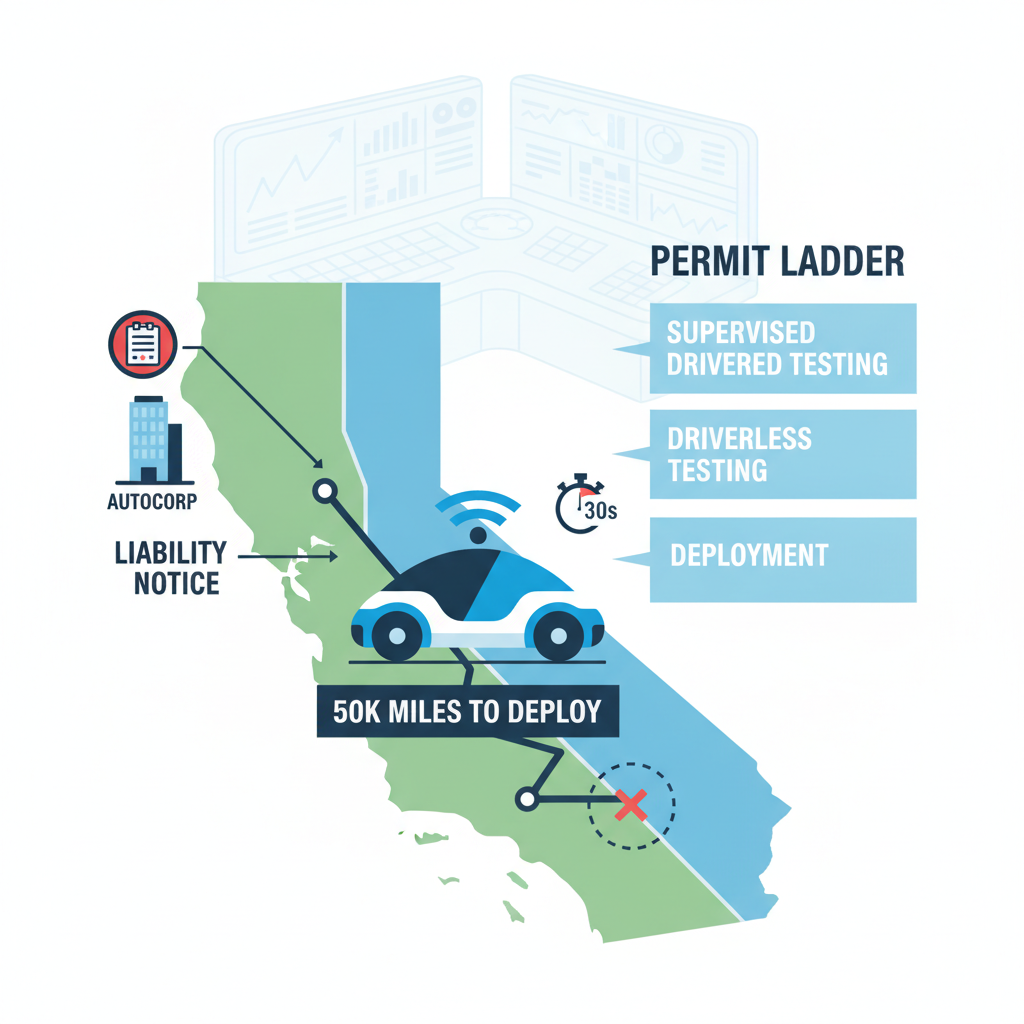
Somewhere in a Waymo operations center, someone now has a job that didn’t exist six months ago: responding to law enforcement noncompliance notices within a legally mandated window. That’s not a hypothetical. As of July 1, 2026, California law enforcement can issue traffic violation notices directly to AV manufacturers when their vehicles break the rules. No driver to ticket. No human to absorb the liability. The citation goes straight to the company. That single policy change—quiet as it was—restructures the entire risk calculus for autonomous vehicle deployment in the largest auto market in the country. This isn’t the DMV playing catch-up. It’s the state drawing a line between a technology experiment and a transportation business.
Most of the AV industry spent the last five years waiting for regulation. What they got instead was a framework designed to separate companies with actual operational discipline from those still running on venture capital and press releases.
The permit ladder is designed to thin the herd
California’s new regulatory structure creates three ascending permission tiers, each with its own permit and each substantially harder to earn than the last. Start with supervised driverless testing—a company can operate autonomous vehicles on public roads, but a human safety driver must remain in the vehicle and be able to take control. Move up to driverless testing without a human in the loop. Then, if you survive both phases, you can apply for a deployment permit that allows commercial operation at scale. The state isn’t handing out permission slips. It’s building a gauntlet.
The specific requirement that cuts deepest: to even apply for full deployment, a manufacturer must log 50,000 autonomous miles under a driverless testing permit first. Not on a closed test track. Not in a controlled environment. On California public roads, in real weather, real traffic, real edge cases. Waymo has been accumulating those kinds of miles for years—they crossed 20 million autonomous miles in 2024 and kept going. For a late-stage entrant that’s been doing closed-track demos and showing up to conferences with polished renders of future robotaxi fleets, 50,000 miles is a very different problem. It’s not a number you hit with a press release.
This is where the regulation actually works as intended.
The framework isn’t red tape for its own sake. It’s a structured proof-of-competence requirement that companies with genuine operational maturity will clear and companies playing at the space won’t. You can argue about whether the specific mileage threshold is 50,000 or 100,000. You can’t argue that companies need to demonstrate they can operate safely at scale without breaking things. The permit ladder forces that demonstration to happen in public, under scrutiny, before a company gets permission to run robotaxis through residential neighborhoods.
What’s revealing is how different companies have responded. Waymo and Cruise (before its recent stumble) already had most of those miles logged. For them, the new permit structure was less a barrier than a formalization of what they were already doing. For the dozen or so other companies with “Level 4 autonomous” on their pitch deck, the 50,000-mile requirement suddenly became a question they couldn’t answer: Do you actually have miles? On public roads? Or just in simulation?
Direct liability to the manufacturer changes everything downstream
The real teeth in California’s framework isn’t the mileage requirement. It’s the accountability mechanism. Under the old system, when an autonomous vehicle broke the law, the liability chain was murky. Driver? Company? Insurance carrier? The ambiguity was actually useful if you were trying to move fast and not worry too hard about compliance. California eliminated the ambiguity. The vehicle breaks the law, law enforcement issues a citation directly to the manufacturer. Not a human operator. The company.
That’s not just a procedural detail.
It means that when a Waymo robotaxi runs a red light in San Francisco, a police officer doesn’t write a ticket to a person. They write it to Waymo. That citation generates a paper trail that goes directly to the company’s legal and compliance team. The state tracks patterns of noncompliance. Accumulate enough citations and you lose your operating permit. No operating permit in California means no robotaxi business in California. No robotaxi business in California means your entire U.S. deployment strategy is already dead, because California is where the market is.
California is also requiring AV companies to respond to first responder calls within 30 seconds and comply with electronic geofencing directives from local emergency officials. These aren’t soft asks. If a fire department needs to clear a street and your autonomous vehicles won’t move out of the way because they’re stuck in a loop waiting for a sensor to resolve an ambiguity, that’s not a technical problem you get to debug in private. That’s a noncompliance notice. Repeat the pattern and you’re out of the state.
The consequence of losing operating rights in California isn’t a reputational ding. It’s a commercial death sentence.
Any company whose business model assumes U.S. scale—and every AV company’s business model does—can’t survive permanent exclusion from California. The state has 40 million people. It has the infrastructure, the regulatory apparatus, and the density of urban environments that robotaxis actually need to be profitable. You can operate in Phoenix or Austin or Las Vegas. You can’t build a transportation business without California. The regulatory framework California just put in place knows that. It’s using that leverage.
This is where you see the difference between companies that were serious about operations and companies that were serious about fundraising. The serious operators were already building compliance infrastructure. They already had legal teams that understood California traffic law. They already had operations centers designed to respond to incident reports. The 30-second first responder callback? Waymo probably already does that, or something close to it. For a company that’s been focused on perfecting the autonomous stack and assuming that regulatory and operational concerns would “figure themselves out,” that requirement is a complete rebuild of operational architecture.
What separates the players from the pretenders
The AV industry spent years making the argument that regulation would stifle innovation. The argument had a certain appeal. Regulation does create compliance costs. It does slow down deployment timelines. But California just tested that argument by writing rules serious enough to actually matter—and the serious operators didn’t blink.
That’s the tell.
Waymo and Cruise didn’t slow down because of the 50,000-mile requirement. They were already past it. They didn’t panic about noncompliance notices because they’ve been building compliance operations for years. They didn’t scramble to meet first responder response times because that’s already part of their operational model. For them, California’s regulatory framework didn’t stifle anything. It just formalized what they were already doing and cut off the people who weren’t.
The ones loudest about regulatory burden? Look at what they’re actually operating and where. The companies that have been making the most noise about California’s rules being “too restrictive” tend to be the ones with the fewest real-world miles logged, the most recent funding rounds, and the shiniest investor decks. They’re serious about attracting capital. They’re less serious about actually deploying robotaxis under conditions where things can go wrong and the company is responsible for fixing it.
This pattern shows up everywhere you look at infrastructure. Enterprise IT is full of it. The teams that complain loudest about security audits and compliance requirements are usually the teams least prepared to pass them. The companies that fought hardest against SOC 2 compliance turned out to be the ones cutting corners on access controls. The organizations that treated audit prep as a box-checking exercise rather than an operational discipline are the ones that eventually had a breach they couldn’t explain to a customer.
Compliance doesn’t kill good products. It just makes it harder to hide bad ones.
What’s worth watching now isn’t whether any single company passes the 50,000-mile threshold first or survives its first noncompliance notice intact. That’s tactical. What matters is whether other states treat California’s framework as a template or a warning. If Texas and Florida and New York look at what California did and decide to adopt something similar, the companies that built compliance operations in California can scale that work. The companies that tried to work around it will find they’re locked out of multiple markets at once. If other states stay loose and California stays strict, you get a fractured market where only the biggest operators can afford to maintain parallel operational models for different regulatory regimes.
Either way, the era of AV companies operating as if regulation was a problem to lobby away rather than a constraint to build into the product is ending. California made sure of that.