The Real Market Bet Is Specificity, Not Scale
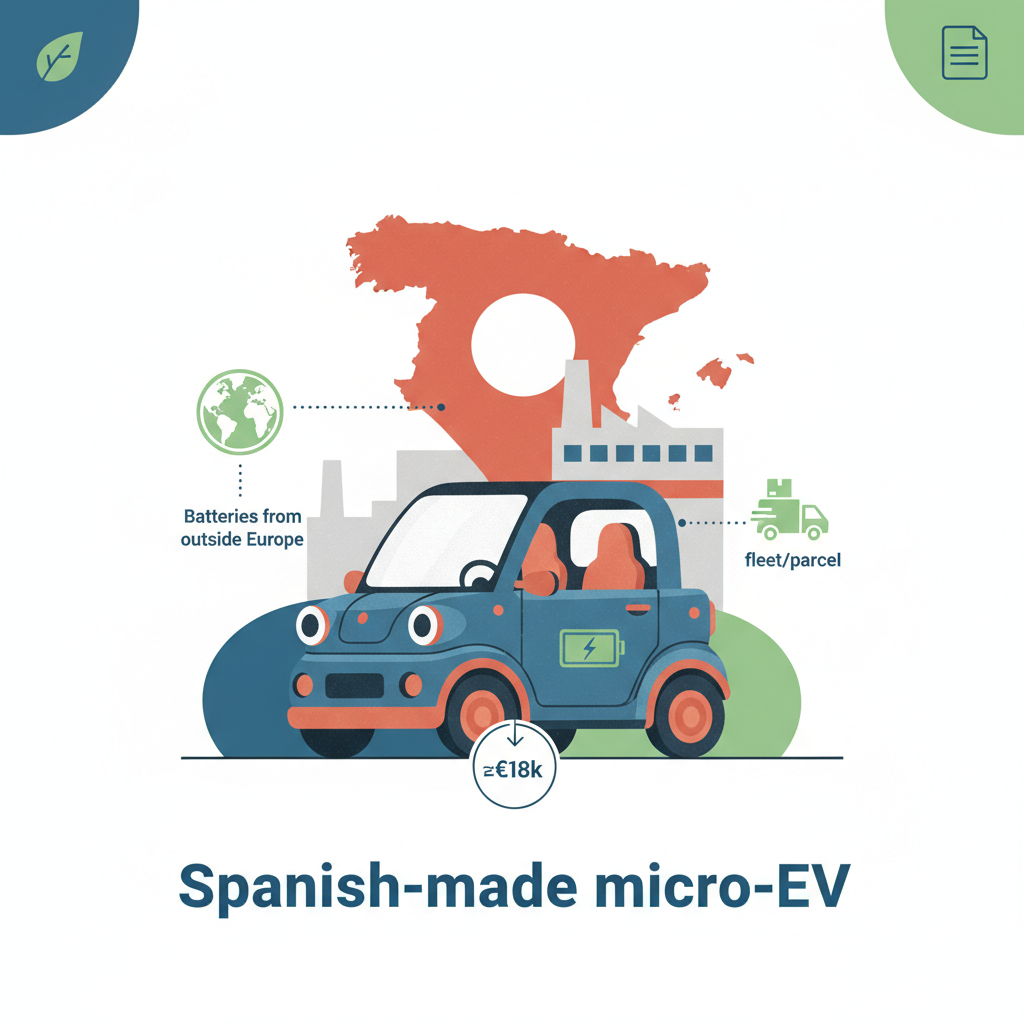
Smart, one of the most recognizable small-car brands in Europe, now builds its cars in China. The Italian microcars that once defined urban mobility have largely been displaced by competitively priced Chinese EVs. So when a 65-person Spanish startup opens the country’s first new car plant in over 30 years and announces it will sell a two-seat microcar for under €18,000, the instinct is to be skeptical. But Liux isn’t pretending it hasn’t noticed the competition. Its founders have already conceded that a fully sovereign European supply chain is unattainable — batteries come from outside Europe — and they’re saying so out loud. That honesty is actually the most interesting thing about the company, and it points to a strategy that’s more coherent than it first appears.
The “made in Europe” narrative has become the default move for any startup trying to position itself against Chinese EV manufacturers. It’s understandable. Chinese automakers have captured scale and cost structure that European producers can’t match through manufacturing discipline alone. The instinct is to retreat to what sounds like a moat: we’ll build it here, with European labor and European standards, and that will be worth a premium. The problem is that this story collapses the moment someone asks where the battery comes from.
Liux’s founders didn’t wait for that question.
They’ve been explicit that full supply chain sovereignty is unrealistic. Batteries, the single most expensive and technically complex component in an EV, are sourced outside Europe. There’s no secret domestic supply that will magically appear by 2027. This admission matters because it signals something that most European automotive startups still haven’t learned: pretending you can solve a structural problem through messaging is a competitive disadvantage. It creates brittle narratives that collapse under scrutiny, and in a sector where every announcement gets picked apart by automotive journalists and industry analysts, brittleness is expensive.
Smart’s journey to China is the clearest illustration of what “competing on cost” actually demands from a European microcar brand. Daimler held onto Smart for decades as a statement about urban mobility and brand prestige. The cars were engineered in Stuttgart, assembled in France, marketed across Europe as an icon of compact European design. By 2020, the economics had become untenable. The company shifted production to China, where Geely handles manufacturing, and what remained was a hollowed-out brand — still wearing the name, still available in Europe, but no longer the product it once was. The transition happened not because Chinese engineers were secretly better, but because the cost structure of European labor and regulation made the business model unsustainable at the price point the market demanded.
Liux is making a different bet.
Instead of claiming sovereignty it can’t achieve, the company is keeping sustainability as an operational north star while acknowledging the constraints. Production happens in Spain. Supply chain decisions are made with environmental impact as a decision criterion, not as an afterthought. The battery sourcing is transparent. This is a narrower strategy than “we’re building everything here,” but it’s also more durable because it doesn’t require anyone to believe something that isn’t true.
The Real Market Bet Is Specificity, Not Scale
The sub-€18,000 price point (before subsidies) is competitive but not disruptive. Liux isn’t trying to undercut Chinese manufacturers on unit economics — that’s a race the company would lose. Instead, it’s trying to be the credible alternative for a specific set of buyers and fleet operators for whom origin and sustainability credentials are actual decision factors, not marketing theater. This is a narrower market than the total addressable market for microcars, but it’s also one where margin structure might actually work.
Fleet partnerships are where this positioning becomes relevant in the short term. European cities and logistics operators are under genuine regulatory pressure to electrify their fleets. They also face increasing scrutiny on supply chain ethics and environmental impact. A two-seat urban delivery vehicle manufactured in Spain, with transparent battery sourcing and designed for a 10-year operational life, is a different product category than a Chinese EV sold on price alone. Whether it’s enough of a difference to command a meaningful price premium is the real question, and Liux’s founders are deliberately keeping the door open to fleet integrations and potential autonomous vehicle applications rather than trying to forecast consumer adoption curves.
This is the kind of optionality that makes a small company survivable.
Microlino, the Swiss two-seater launched around the same time, offers a useful comparison. The vehicle is design-forward, sustainability-adjacent, and explicitly not chasing volume. The company has been careful about where it sells, how it manufactures, and what story it tells about the product. It’s built a credible niche without pretending to be something it isn’t. Liux appears to be operating from the same playbook, except with the added complexity of a greenfield manufacturing facility and a 65-person team trying to scale.
The timeline is measured: Europe-wide homologation for 2026, with sales expected in H1 2027. This either signals discipline or reflects the actual difficulty of coordinating production across multiple Spanish facilities simultaneously. Probably both. A startup that promises production ramp-up in 18 months is usually either lying or about to discover why car manufacturing is capital-intensive and time-consuming. A startup that says 2027 and sticks to it is doing something closer to operational planning.
What makes this credible is that Liux’s founders have already demonstrated they understand the gap between what they’re selling and what Chinese manufacturers are selling. They’re not trying to win the same game with a smaller budget. They’re playing a different game in a smaller arena, and they’ve been honest about the constraints that define that arena.
Why Honesty About Constraints Actually Matters
European automotive is littered with startups that couldn’t tell the difference between the fight they were picking and the fight they could actually win. Fisker talked about luxury and technology and ran into the reality that capital-intensive manufacturing doesn’t care about design philosophy. Arrival promised to revolutionize the supply chain and discovered that revolutionary supply chains are also revolutionary money sinks. Canoo built prototypes and investors and couldn’t figure out which one actually mattered. The pattern is consistent: founders with a vision but without a clear-eyed assessment of what they were actually competing against.
Liux’s founders know what they’re not winning on. They can’t match Chinese manufacturers on scale, cost structure, or supply chain efficiency. They won’t have the R&D budget of legacy OEMs. They can’t promise that their supply chain is fully sovereign because it isn’t. What they can promise is a specific product for a specific market, manufactured with specific operational constraints that are actually enforced rather than claimed. That’s a narrower bet than most automotive startups make, which is probably why it might actually work.
The companies worth watching in the European EV space right now aren’t the ones promising full sovereignty or trying to match Chinese manufacturers on unit economics. Those races are already decided. They’re the ones that have figured out what they’re actually selling and to whom. Liux is selling a considered object made by a small team in Spain, with sustainability as a real operational constraint rather than a badge. Whether that’s enough of a market is genuinely unknown. But the founders already know they can’t win the fight they’re not picking, and in a sector littered with startups that couldn’t tell the difference, that’s not nothing.