The thesis was the position
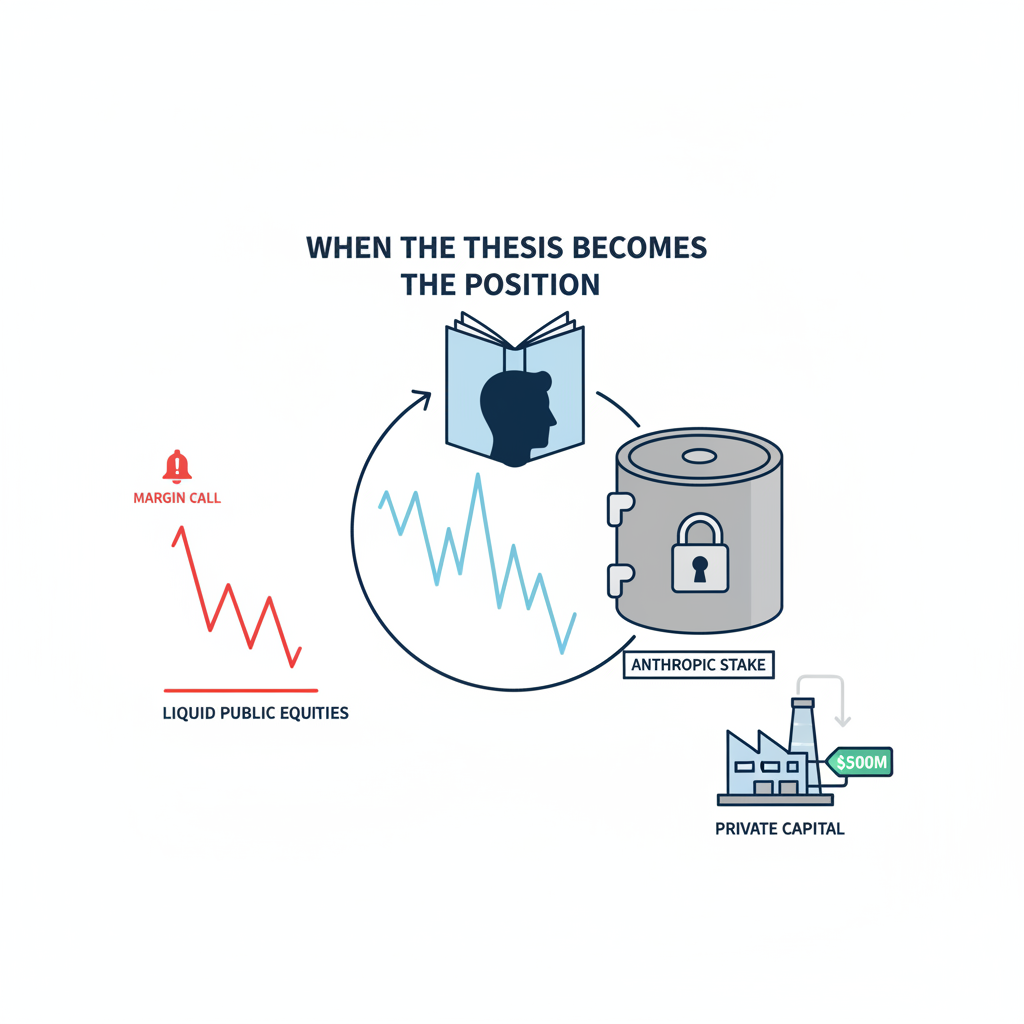
Leopold Aschenbrenner didn’t just write the document that convinced a generation of investors AI was the trade of the decade — he ran a fund named after it. That fund, Situational Awareness, reportedly hit +120% YTD by late June 2026. Then it blew up. The public equity portfolio was effectively wiped out by margin calls, and the fund’s positive headline return exists almost entirely because of an unrealized gain in Anthropic — a private position that couldn’t be sold to cover anything. The Bank of America CEO called the unwind “a warning shot for leveraged markets.” That framing is too polite. This wasn’t a leverage accident. This was a closed loop collapsing: the analyst becomes the fund manager, the thesis becomes the portfolio, and the exit becomes impossible.
The AI investment thesis has always had a self-referential quality to it. The people making the most confident predictions about AGI timelines are also the people running the largest bets on those predictions arriving. When the predictions hold, the bets print money. When they don’t, the bets blow up — but the people holding them are usually the last to adjust the underlying thesis. Aschenbrenner’s meltdown isn’t a cautionary tale about position sizing. It’s evidence that the ecosystem has become so tightly wound around a single intellectual narrative that the people closest to it can no longer think their way out.
The thesis was the position
Aschenbrenner’s original Situational Awareness essays framed AGI arrival as near-certain and near-term. That was analysis. Once he started running a fund on it, it stopped being analysis and became a bet that couldn’t be unwound without repudiating the worldview behind it. The fund’s reported +80% YTD return before the blow-up was structurally misleading in a way that matters. The gain was almost entirely an unrealized mark on an Anthropic stake — illiquid, unsellable without triggering a crisis, impossible to use as collateral without inviting the margin desk to ask hard questions. The leveraged public equity book underneath that number was, per analyst tracking, effectively zeroed out by mid-June. Two completely different asset positions, presented as a single return number.
This is the AI trade’s core epistemological problem.
The people with the strongest conviction about AGI timelines are also the people most incentivized to hold that conviction past the point of rationality. A fund manager who built their entire brand on “AGI is coming in 2027” cannot, without destroying their credibility and their capital base, pivot to “actually, we were wrong about the timeline.” The thesis becomes unfalsifiable because the people defending it have too much personal and professional capital locked into its truth. Aschenbrenner had written the intellectual case for the trade. He was running the fund on it. The thesis and the position had become the same thing.
When margin calls came, there was no optionality. The liquid book got wiped because it had to be — it was the only thing that could be liquidated. The Anthropic stake, the thing that actually made the fund look good, couldn’t be touched. A real +80% return means you have optionality: you can take some money off, rebalance, adjust conviction. A +80% return that’s two-thirds illiquid private equity and one-third wiped public equities means you have none. You’re locked in.
The $500M move is what actually matters
Within days of the meltdown, Situational Awareness committed $500 million into Source Foundry, a stealth chip manufacturing tools startup. This wasn’t a chastened fund pulling back. It was doubling down — just in a different asset class, one further from public markets where margin desks can force liquidity.
The timing is instructive.
A fund that had just blown up on leverage in public equities immediately moved to private venture capital in a domain where returns are 7-10 year horizons minimum. Chip tooling doesn’t have a secondary market. It doesn’t trade on margin. You can’t get a margin call at 2am because the valuation moved against you. Source Foundry is a thesis preservation move dressed as a pivot.
The logic is internally consistent if you believe the original Situational Awareness thesis is intact. The problem wasn’t the view — AGI timelines, AI capital intensity, the criticality of semiconductor infrastructure. The problem was the vehicle. Public markets can test your conviction in real time. Margin desks have no patience for theses that don’t compound quarter over quarter. Private venture capital, by contrast, is designed for people who want to hold a position through multiple years of negative or uncertain returns while the underlying thesis plays out.
But that logic is exactly what got the fund into trouble in the first place.
The move signals something to other AI-focused funds watching from the sidelines. Not “be more careful.” Not “position size more conservatively.” The signal is: move further from price discovery. Move into vehicles where conviction can’t be tested by a margin desk. If you’re going to bet on an AGI narrative that hasn’t had to face real market feedback in three years, at least structure the bet so you can’t be forced to liquidate it at the worst possible moment.
That’s not a hedge fund story anymore.
Enterprise infrastructure budgets are already being set based on AI roadmaps that trace back, however indirectly, to the same intellectual lineage Aschenbrenner represents. Cloud infrastructure teams are being asked to reserve capacity for workloads that don’t exist yet, based on timelines that depend on AGI arriving on schedule. Chip manufacturers are signing long-term supply agreements. Venture funds are writing checks into compute infrastructure startups. All of this capital allocation is downstream from a relatively small number of people who built a conviction about AGI timelines and then monetized it.
If the people closest to that thesis are now structuring their exposure to be insulated from market feedback, that’s a problem that goes well beyond one fund’s leverage blow-up. That’s a signal about where the AI capital cycle is actually headed — further into private vehicles, longer time horizons, and deeper insulation from the market mechanisms that usually force bad theses to decompress.