UK Social Media Ban Under-16s: What Parents Need to Know
UK Social Media Ban Under-16s: What Parents Need to Know
A few years ago, British parents raising alarms about children’s online safety were told by their own government there was nothing to be done. Today, that same government is drafting one of the most sweeping social media restrictions in the world.
I’ve watched this issue evolve from dismissed parental paranoia to front-page policy debate. And honestly? The speed of this shift tells you everything about how serious the problem has become.
Here’s the thing — children under 16 in the UK are routinely exposed to harmful algorithms, contact from adult strangers, disappearing messages, and high-risk content. With little structural protection in place. Parents know it. Teachers know it. And now, finally, the government seems to know it too.
This post breaks down exactly what the proposed UK social media ban covers, which platforms are affected, what critics and child safety experts are saying, and what you can do right now to protect your children — whether the ban passes or not.
What Is the UK’s Proposed Social Media Ban for Under-16s?
Prime Minister Keir Starmer’s government is actively weighing a ban on social media for children under 16. But here’s what makes this particularly dramatic: when Labour won in 2024, they explicitly stated they had no plans to restrict social media for children.
So what changed?
Growing public consensus that more must be done to protect children online, accelerated by Australia’s under-16 ban. Australia went first — and suddenly the UK government found itself under enormous pressure to follow suit.
The Department for Science, Innovation and Technology conducted a national consultation titled “Growing Up in the Online World.” And look, consultations are usually bureaucratic theatre. But this one actually mattered. Downing Street has signalled the government’s action needs to be a “gamechanger” — and according to sources close to the PM, “nothing was off the table.”
In January 2026, a joint statement signed by 42 child protection charities, online safety groups, academics, and bereaved families was published. These aren’t fringe activists. We’re talking mainstream organisations who’ve spent years watching children harmed by platforms that prioritise engagement over safety.
Parents like Daisy Greenwell — who spent years advocating before the government listened — are finally seeing their concerns taken seriously. That shift from dismissal to action? It’s been a long time coming.
Which Social Media Apps Will Be Banned or Restricted?
This is where it gets specific. And complicated.
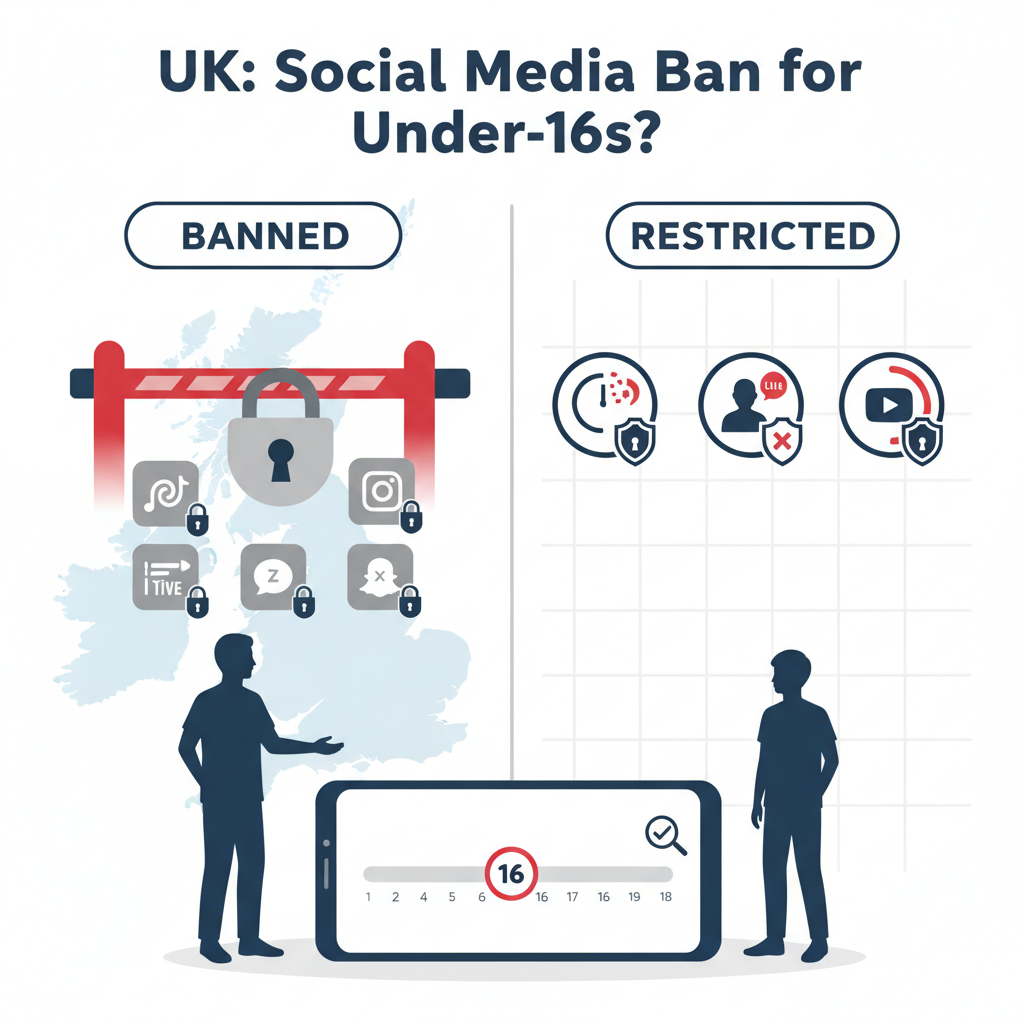
The government is proposing a two-tier system. “High-risk” platforms face an outright ban for under-16s. “Safer” platforms face significant restrictions rather than full bans. It’s similar to how films and video games have different ratings reflecting the risk they pose to children — social media platforms have different levels of risk too.
The confirmed apps on the banned list include:
- TikTok
- YouTube
- Snapchat
- X (formerly Twitter)
But even on “safer” apps that might not be banned outright, specific features would be restricted:
- Disappearing messages (which make it impossible for parents or authorities to review conversations)
- Chats with adult strangers
- Livestreaming (which has been exploited for real-time abuse)
In my experience covering online safety issues, it’s these features — not just the platforms themselves — that create the most risk. A 15-year-old losing access to TikTok is one thing. But losing the ability to livestream to strangers or receive disappearing messages from adults? That’s actually where the danger lives.
The two-tier framework makes sense in theory. But it also opens up a can of worms. Which platforms are “high-risk” and which are “safe”? Who decides? And what happens when a platform challenges that classification in court?
How Would the Ban Actually Work? Enforcement and Age Verification
This is where things get messy.
Because here’s the central question nobody has a great answer for: how do platforms actually verify a user is under 16?
The UK Parliament has been exploring age assurance technology — basically, systems that can confirm someone’s age without requiring them to hand over sensitive documents. But honestly? The technology isn’t there yet. Not reliably. Not at scale.
Right now, the digital age of consent sits at 13. The proposed ban would raise the effective threshold to 16. That’s a significant jump — and it means millions of teenagers who currently have legal access would suddenly be locked out.
Platform accountability versus parental responsibility is the other big debate. Should TikTok be fined millions if a 15-year-old slips through? Or should parents be expected to monitor their children’s devices? The government seems to be leaning toward platform accountability — which makes sense, given that parents can’t realistically police every app and workaround.
But critics fear that banning some platforms but not others could trigger legal challenges. If Instagram is banned but another visually-focused platform isn’t, what’s the legal justification? It’s complicated.
And then there’s the elephant in the room: VPNs and workarounds. Tech-savvy teenagers already know how to bypass geographic restrictions. Australia is attempting enforcement as a model, but early reports suggest it’s… not going great. Kids are finding ways around it within hours of restrictions going live.
The Case FOR the Ban — Why Supporters Say It’s Necessary
Look, I understand why this proposal has momentum.
Widespread public opinion in the UK has shifted dramatically toward supporting greater restrictions. Parents who were dismissed as overprotective just a few years ago are now being vindicated. And the role of bereaved families — parents who lost children to online harms — in driving political momentum cannot be overstated.
The Molly Rose Foundation and similar organisations represent families who’ve experienced the absolute worst-case scenarios. When they speak, politicians listen. Because these aren’t hypothetical risks. These are children who died.
Harmful algorithms are the structural risk everyone’s finally acknowledging. It’s not just about stumbling across bad content. It’s about platforms that actively push harmful content to vulnerable children because it drives engagement. The algorithm doesn’t care if a 14-year-old is spiralling into depression. It cares about watch time.
The specific risks supporters point to include adult stranger contact (predators actively use these platforms to groom children), disappearing messages (which eliminate evidence and accountability), and livestreaming exploitation (which can happen in real-time before anyone can intervene).
The National Education Union launched a public billboard campaign in London calling for an under-16 ban. Teachers see the impact daily — distracted students, cyberbullying, mental health crises. They’re not just concerned. They’re desperate for something to change.
And you know what? After years of watching platforms promise to do better while doing nothing meaningful, I get why people want the nuclear option.
The Case AGAINST the Ban — Expert Warnings and Unintended Consequences
But here’s where it gets really interesting.
The same 42 organisations that want children protected oppose a blanket ban. Let that sink in. Child protection charities, bereaved families, online safety experts — they’re warning that a blanket ban could have “serious unintended consequences that could put children at greater risk.”
Their full statement reads: “Though well-intentioned, blanket bans on social media would fail to deliver the improvement in children’s safety and wellbeing that they so urgently need.”
Why would child safety experts oppose a ban designed to protect children?
Because they’re thinking about vulnerable groups who rely on these platforms for survival. LGBTQ+ children who can’t safely come out at home or school use social media to find community, support, and identity affirmation. Neurodiverse children who struggle with in-person social connections find acceptance in online spaces. Children in abusive homes who need access to Childline and trusted mental health resources.
A blanket ban doesn’t distinguish between a 15-year-old scrolling TikTok for dance videos and a 15-year-old reaching out to a suicide prevention helpline. It cuts off both.
And here’s the kicker — a ban offers limited protection from toxic algorithms. Because the underlying infrastructure remains unchanged. The platforms don’t become safer. They just become off-limits. Which means when kids inevitably find workarounds (and they will), they’re accessing the same dangerous systems without any adult awareness or oversight.
There’s also the risk of driving children to less regulated, darker corners of the internet. When mainstream platforms are banned, kids don’t just stop using social media. They migrate to platforms with even fewer protections, less moderation, and more extreme content. We’ve seen this pattern before with other types of online restrictions.
What This Means for Your Family Right Now
Whether the ban passes or not, you don’t have to wait for government action to protect your children.
Start with honest conversations. Not lectures. Not scare tactics. Actual dialogue about what they’re seeing online, who they’re talking to, and how certain content makes them feel. I’ve found that kids are remarkably honest when they don’t feel judged.
Use built-in parental controls and privacy settings. Every major platform has them — most parents just don’t know they exist or how to activate them. Spend an hour learning your child’s most-used apps. It’s worth it.
Consider age-appropriate alternatives. Not every platform carries the same risk. A 14-year-old on a heavily moderated creative platform is different from a 14-year-old on an anything-goes social network.
Model healthy digital behaviour yourself. Kids notice when parents are glued to their phones at dinner. They notice when you doom-scroll instead of being present. Your relationship with technology sets the template.
Know the warning signs of online harm:
- Sudden withdrawal from family and friends
- Secretive behaviour around devices
- Changes in sleep patterns or mood
- Reluctance to discuss online activities
- New “friends” they’ve never mentioned before
And look — I’m not saying any of this is easy. Parenting in the digital age is genuinely harder than previous generations had it. But waiting for the government to solve this problem isn’t a strategy.
What Happens Next? Timeline and Political Reality
The consultation has closed. The government is reviewing responses. But turning policy proposals into actual law takes time — and political will.
The Online Safety Act already exists, but it doesn’t go far enough according to most child safety advocates. This proposed ban would require new legislation, parliamentary debate, and likely legal challenges from tech companies with very deep pockets.
Australia’s experience suggests implementation will be messy. Even with political consensus, the practical challenges of enforcement, age verification, and platform compliance are significant. And that’s before you factor in the inevitable workarounds teenagers will develop within days.
My best guess? We’ll see some form of restrictions pass, but probably not the full blanket ban supporters want. More likely: enhanced age verification requirements, stricter platform accountability, and targeted restrictions on the highest-risk features.
The tech companies will fight it. They always do. But public opinion has shifted enough that politicians can’t ignore this issue anymore.
The Bigger Picture: What We’re Really Debating
This isn’t really about banning apps.
It’s about who’s responsible for protecting children in digital spaces. Is it parents? Platforms? Government? And when those three groups disagree about the right approach, who gets final say?
It’s about balancing protection with freedom. At what age should children be trusted to navigate complex online environments? Is 16 the right number? Why not 15 or 17?
And it’s about acknowledging that social media platforms were never designed with children’s wellbeing in mind. They were designed to maximise engagement, monetise attention, and create addictive behaviour patterns. Child safety was an afterthought — if it was thought about at all.
The UK’s proposed ban is an attempt to reset that equation. Whether it succeeds or fails, it represents a fundamental shift in how we think about children’s relationship with technology.
Because honestly? The status quo isn’t working. Every parent knows it. Every teacher sees it. And finally, the government is doing something about it.
Whether that something is the right thing remains to be seen.
Ready to take control of your family’s digital wellbeing? You don’t have to navigate these challenges alone. Contact our experts for personalised guidance on protecting your children online while fostering healthy technology habits that last a lifetime.