What Is the Role of Memory in an Agentic AI System: A Deep Dive into AI’s Cognitive Architecture.
What Is the Role of Memory in an Agentic AI System: A Deep Dive into AI’s Cognitive Architecture
Estimated reading time: 9 minutes
Key Takeaways
- Memory acts as the backbone of agentic AI, enabling continuous learning, adaptation, and autonomous decision-making.
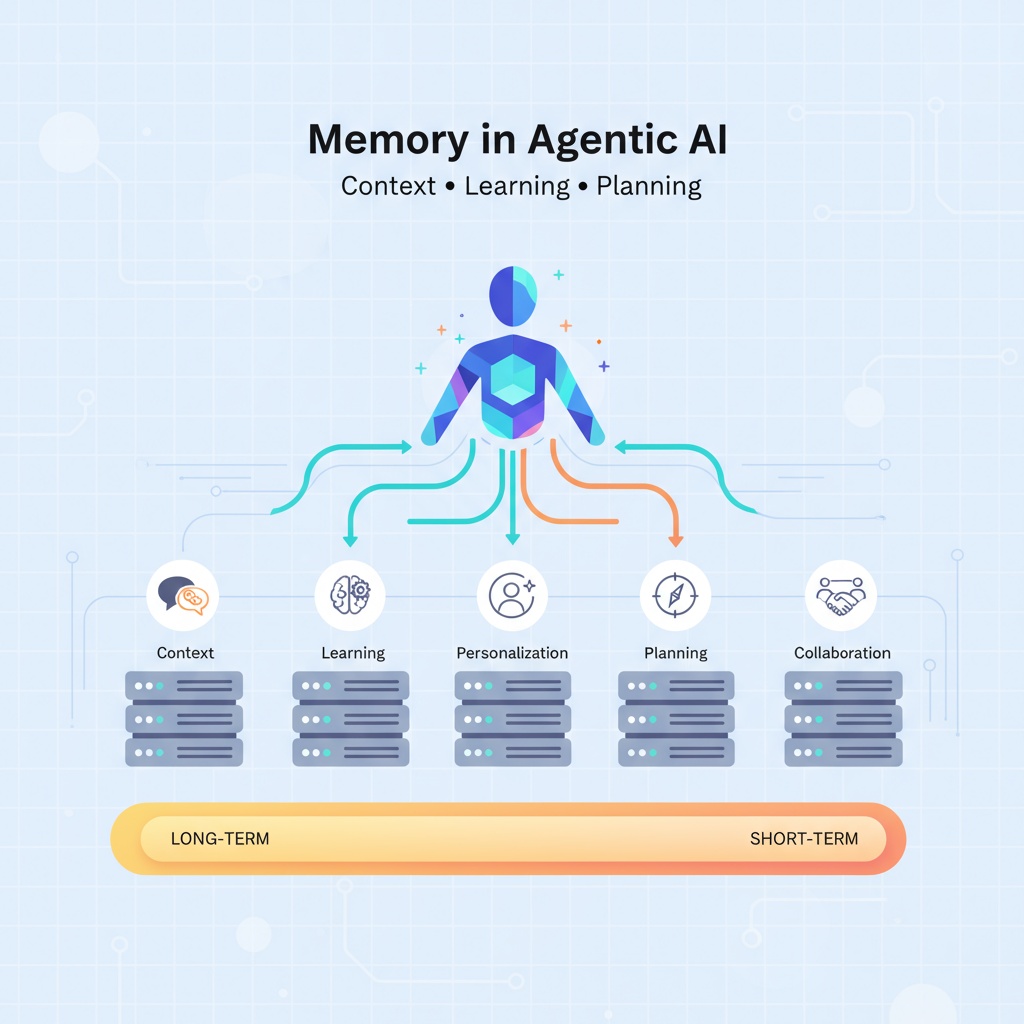
- Different memory types work together to preserve context, capture experience, personalize interactions, plan actions, and foster collaboration.
- Effective memory design improves performance across tasks and domains, from simple interactions to complex workflows.
- Architectural challenges include scaling, obsolescence management, and seamless integration across memory layers.
- The future points toward more human-like cognition, better knowledge transfer, and collaborative AI systems that augment human capabilities.
Table of contents
Memory in agentic AI systems acts as the connective tissue that links experiences, enabling continuous learning and evolution. While traditional AI often relies on stateless prompts, agentic architectures leverage memory to plan, adapt, and act with purpose. This deep dive pulls from research across industry and academia to illuminate how memory shapes intelligent behavior.
The Foundation of Agentic AI Memory
At its core, memory in agentic AI systems functions as the bridge between isolated experiences and ongoing learning. The right memory architecture supports persistent context, knowledge accumulation, and informed decision-making over time.
Essential Functions of Memory in Agentic AI
1. Context Retention
Memory enables AI agents to maintain awareness of ongoing tasks and conversations. As highlighted by Data Science Dojo, this ability to retain context is crucial for maintaining coherent interactions and operations across multiple sessions. Imagine trying to have a meaningful conversation with someone who forgets everything you said just moments ago – that’s what AI would be like without effective memory systems.
2. Experiential Learning
One of the most powerful aspects of memory in agentic AI is its ability to learn from experience. According to Factr.me, AI systems use their memory to:
- Record previous interactions
- Store user feedback
- Track outcomes of different actions
- Build upon past knowledge to improve future performance
3. Personalization Capabilities
Memory architecture enables AI to remember user preferences and historical interactions, leading to increasingly personalized experiences. As reported by Bhavishya Pandit’s research, this allows AI systems to:
- Tailor recommendations to individual users
- Adapt communication styles
- Remember specific user needs and preferences
- Provide contextually relevant responses
4. Strategic Planning
Data Science Dojo’s research emphasizes how memory enables AI agents to engage in complex, multi-step planning. This includes:
- Breaking down large tasks into manageable steps
- Tracking progress toward goals
- Adjusting strategies based on changing conditions
- Maintaining focus on long-term objectives
5. Collaborative Intelligence
Memory systems support knowledge sharing among multiple AI agents, fostering collaborative intelligence. This capability is particularly crucial in complex environments where multiple AI systems need to work together seamlessly. Collaborative intelligence plays a key role in coordinated problem-solving.
Types of Memory in Agentic AI Systems
Understanding the different types of memory in agentic AI helps us appreciate its sophisticated architecture:
Short-term (Working) Memory
- Maintains immediate context and recent interactions
- Processes current tasks and conversations
- Enables coherent responses in real-time
Long-term Memory
- Stores persistent knowledge and historical data
- Maintains user information across sessions
- Builds a knowledge base for future reference
Episodic Memory
- Records specific events and their context
- Enables learning from particular experiences
- Supports pattern recognition and prediction
Semantic Memory
- Stores factual knowledge and rules
- Maintains structured information about various domains
- Enables understanding of concepts and relationships
Procedural Memory
- Remembers how to perform specific tasks
- Stores action-oriented knowledge
- Enables efficient problem-solving
Architectural Considerations and Challenges
According to Algomox’s comprehensive research, implementing effective memory systems in agentic AI presents several challenges:
Memory Management
- Scaling to handle growing datasets
- Ensuring fast and relevant information retrieval
- Managing knowledge obsolescence
- Balancing storage capacity with processing speed
Knowledge Transfer
- Enabling cross-domain learning
- Adapting knowledge to new scenarios
- Maintaining consistency across different contexts
Integration Challenges
- Combining different types of memory effectively
- Ensuring smooth information flow between memory systems
- Maintaining data integrity and accessibility
Overview and guidance on best practices can be found in the Principles Building AI Agents PDF.
The Future of Agentic AI Memory
As AI development accelerates, memory systems are expected to play an increasingly crucial role in creating more capable agents. Future directions include:
- Enhanced memory architectures that more closely mirror human cognitive processes
- Improved integration between different types of memory systems
- More efficient knowledge transfer and generalization capabilities
- Better solutions for managing and scaling memory resources
The future may feature a collaborative model where AI handles routine tasks while humans focus on strategy, creativity, and complex problem-solving. Effective context engineering for AI agents will be pivotal in enabling smoother human-AI collaboration.
Conclusion
Memory in agentic AI systems is more than data storage—it’s the backbone that enables learning, adaptation, and autonomous operation. By architecting robust memory systems, we can unlock AI that not only processes information but understands, reasons, and collaborates in more human-like ways. The ongoing exploration of memory architectures, cross-domain transfer, and memory-efficient design will shape the next era of intelligent, autonomous systems.
Whether you’re a developer, researcher, or simply curious about AI’s evolution, understanding memory’s role in agentic AI provides essential insights into building more capable and responsible artificial systems for the future. For broader context and ongoing discussions, you can explore related resources such as Best AI Agents 2025 Guide.
Frequently Asked Questions
Is memory the only factor that determines agentic AI autonomy?
No. While memory is crucial for context, learning, and planning, autonomy also depends on algorithms, reasoning capabilities, safety controls, and goal alignment with human values.
How does memory impact AI safety and reliability?
Memory can improve reliability by maintaining consistent behavior across sessions, but it also introduces risks if memory stores sensitive data or propagates biased patterns. Proper governance, data minimization, and auditing are essential.
What are practical next steps to improve memory in AI systems?
Focus on clear memory scoping, efficient retrieval, robust obsolescence handling, cross-domain transfer mechanisms, and transparent logging of memory usage to support debugging and safety reviews.
Where can I learn more about memory architectures for agentic AI?
Explore industry and academic resources on memory-augmented AI, including the references cited above, and consider following the latest publications at relevant conferences and journals. Principles Building AI Agents PDF offers foundational concepts.
}