The Ultimate Guide to Patterns for Building AI Agents: Key Insights from Leading Books and Resources
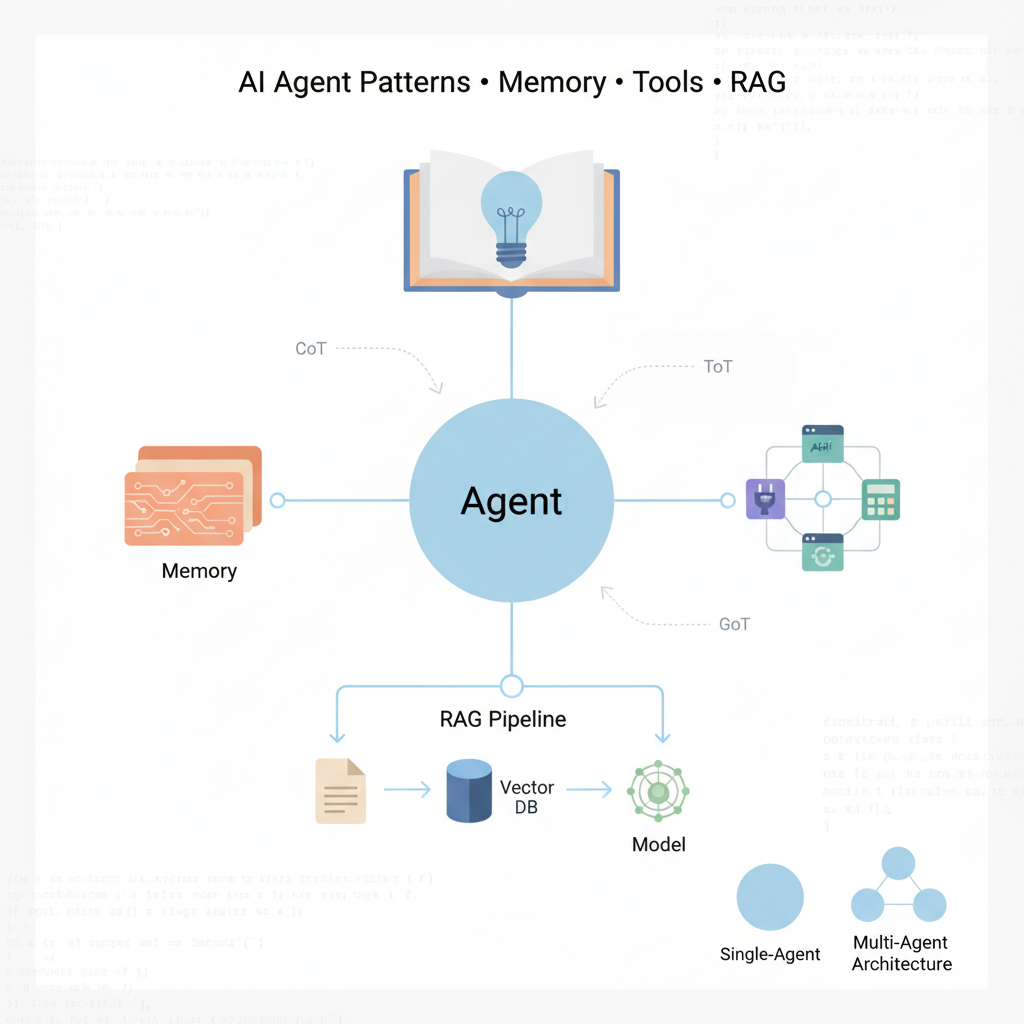
The Ultimate Guide to Patterns for Building AI Agents: Key Insights from Leading Books and Resources
Estimated reading time: 7 minutes
Key Takeaways
- The Model, Tools, and Instructions form the three fundamental components of an AI agent, providing the core decision-making, world interaction, and safety guidelines. Source
- Single-Agent Systems offer simplicity and easier debugging for task execution; a guided overview discusses their advantages.
- Multi-Agent Systems distribute work across coordinated agents, organized as Manager-centralized or Decentralized architectures. Source
- Memory Management, including working memory for short-term operations and hierarchical/long-term memory for context recall, is critical to agent performance. Source
- Tool Integration relies on clear interfaces, robust connections, and domain-specific actions via databases and APIs. Source
- RAG (Retrieval-Augmented Generation) enables querying external data sources for up-to-date information; highlighted in The Practical Guide to Build AI Agents. Source
- CoT (Chain-of-Thought), ToT (Tree-of-Thought), and GoT (Graph-of-Thought) represent advanced reasoning patterns; GoT is linked to networked reasoning. Source
- Start Small with single-agent workflows before expanding to multi-agent orchestration. Source
- Guardrails include input filtering, tool-call monitoring, and human-in-the-loop interventions. Source
- Real-World Applications span Healthcare, Finance, Retail, Education, and Enterprise sectors. Healthcare, Finance
- Essential Tools & Frameworks include LangGraph, AutoGen, CrewAI, and OpenAI Agents SDK; See OpenAI Agents SDK for orchestration capabilities.
- Recommended Reading includes OpenAI, O’Reilly, Sam Bhagwat, Manning, and the Fundamentals of Building AI Agents resource.
Table of contents
In the rapidly evolving world of artificial intelligence, understanding how to build effective AI agents has become increasingly crucial. Today, we’ll dive deep into the essential patterns, architectures, and best practices for building AI agents, drawing insights from the most authoritative books and resources in the field.
The Foundation: What Makes an AI Agent?
- The Model: The large language model (LLM) or reasoning engine that powers decisions
- Tools: External APIs or functions that allow the agent to interact with the world
- Instructions: Clear operational guidelines including goals, guardrails, and safety checks source
The Art of Agent Orchestration
- Single-Agent Systems — These systems operate with one agent cycling through instructions and tools to complete tasks in a loop. According to multiple sources, including O’Reilly’s comprehensive guide, single-agent systems are preferred for their simplicity and ease of debugging. source
- Multi-Agent Systems — For more complex tasks, multi-agent systems distribute work across multiple coordinated agents. These can be organized in two main ways:
- Manager-centralized: A central agent delegates work to others
- Decentralized: Agents operate as peers, passing tasks between themselves as needed source
The Building Blocks: Essential Architectural Components
Memory Management
A crucial aspect of AI agent architecture is memory implementation. According to the “Fundamentals of Building AI Agents,” agents require both:
- Working memory for short-term operations
- Hierarchical/long-term memory for context tracking and recall
Tool Integration
Real-world agents rely heavily on robust tool chains. The O’Reilly guide emphasizes the importance of:
- Designing clear tool interfaces
- Connecting tools effectively
- Implementing domain-specific actions through databases and APIs source
Retrieval-Augmented Generation (RAG)
Modern AI agents often incorporate RAG systems, allowing them to query external data sources and knowledge bases for up-to-date information. This capability is particularly emphasized in The Practical Guide to Build AI Agents. source
Advanced Reasoning Patterns
Several sophisticated reasoning patterns have emerged as standard practices:
- Chain-of-Thought (CoT) — This pattern enables agents to explicitly reason through intermediate steps, making their decision-making process more transparent and reliable.
- Tree-of-Thought (ToT) — This approach involves branching planning and exploring alternatives, particularly useful for complex problem-solving scenarios.
- Graph-of-Thought (GoT) — For the most complex workflows, networked reasoning allows agents to handle interconnected tasks efficiently. source
Implementation Best Practices
Based on extensive research from multiple sources, here are the key best practices for implementing AI agents:
- Start Small — Begin with single-agent workflows before evolving to multi-agent orchestration as complexity grows. source
- Ensure Composability — Design agents modularly to allow for easy reuse and recombination in new workflows.
- Build Strong Guardrails — Implement robust safety measures including:
- Input filtering
- Tool call monitoring
- Human-in-the-loop interventions
- Regular Evaluation — Establish clear checkpoints and feedback mechanisms before scaling to more autonomous behaviors.
Real-World Applications
AI agents are currently being deployed across numerous sectors:
Healthcare
- Data interpretation
- Patient workflow automation source
Finance
- Risk analysis
- Customer service automation source
Retail
- Personalized recommendation systems
- Inventory management
Education
- Personalized tutoring
- Content generation
Enterprise
- Process orchestration
- Knowledge extraction
Essential Tools and Frameworks
Several frameworks and SDKs have emerged as industry standards for building AI agents:
– LangGraph
– AutoGen
– CrewAI
– OpenAI Agents SDK
These tools provide flexible, protocol-driven multi-agent orchestration and code-driven workflow management capabilities. Source
Recommended Reading
- “A Practical Guide to Building Agents” by OpenAI
- “Building Applications with AI Agents” (O’Reilly)
- “Principles of Building AI Agents” by Sam Bhagwat
- “AI Agents in Action” (Manning)
- “Fundamentals of Building AI Agents” source
Conclusion
Building effective AI agents requires a careful balance of structured design, clear orchestration patterns, and robust safety mechanisms. As the field continues to evolve, these patterns and practices will undoubtedly refine further, but the fundamental principles outlined here provide a solid foundation for anyone looking to develop AI agents for real-world applications.
Whether you’re building a simple single-agent system or a complex multi-agent orchestration, understanding these patterns and best practices is crucial for success in the rapidly evolving landscape of AI agent development. source
Frequently Asked Questions
What are the core components of an AI agent?
The Model, Tools, and Instructions form the three fundamental components that power decisions, enable world interaction, and enforce safety checks. Source
What are the main orchestration patterns?
Single-Agent Systems and Multi-Agent Systems are the two primary patterns. Single-Agent emphasizes simplicity and debugging ease, while Multi-Agent distributes tasks among coordinated agents, with Manager-centralized or Decentralized configurations. Source
What are the essential architectural building blocks?
Memory Management (working memory and long-term memory), Tool Integration, and Retrieval-Augmented Generation (RAG) are core components in modern AI agent architectures. Source