Understanding Minimax: The Algorithmic Backbone of Game AI
Understanding Minimax: The Algorithmic Backbone of Game AI
Estimated reading time: 9 minutes
The minimax algorithm stands as one of artificial intelligence’s most fundamental and fascinating strategies, powering the decision-making processes in countless games and competitive scenarios. From the classic games of chess and tic-tac-toe to modern AI applications, this remarkable algorithm continues to shape how machines make strategic decisions in competitive environments.
Key Takeaways
- The minimax algorithm is a recursive decision-making strategy designed for two-player, zero-sum games, constructing a game tree to evaluate moves.
- It alternates between maximizing and minimizing moves, propagating values back to choose the best guaranteed outcome.
- Optimization techniques like Alpha-Beta Pruning and Iterative Deepening greatly improve efficiency and depth of search.
- Minimax provides the foundation for evaluating functions and AI agent design in games and beyond.
- Its main limitation is exponential growth with depth, which necessitates practical depth limits and heuristic methods.
Table of contents
The minimax algorithm stands as one of artificial intelligence’s most fundamental and fascinating strategies, powering the decision-making processes in countless games and competitive scenarios. From the classic games of chess and tic-tac-toe to modern AI applications, this remarkable algorithm continues to shape how machines make strategic decisions in competitive environments.
The Essence of Minimax: A Strategic Dance of Maximizing and Minimizing
At its core, the minimax algorithm is a recursive decision-making strategy designed for two-player, zero-sum games. Picture a chess match where one player consistently tries to maximize their advantage while the other attempts to minimize their opponent’s gains. This constant push and pull between maximizing and minimizing moves gives the algorithm its name.
How Does Minimax Work?
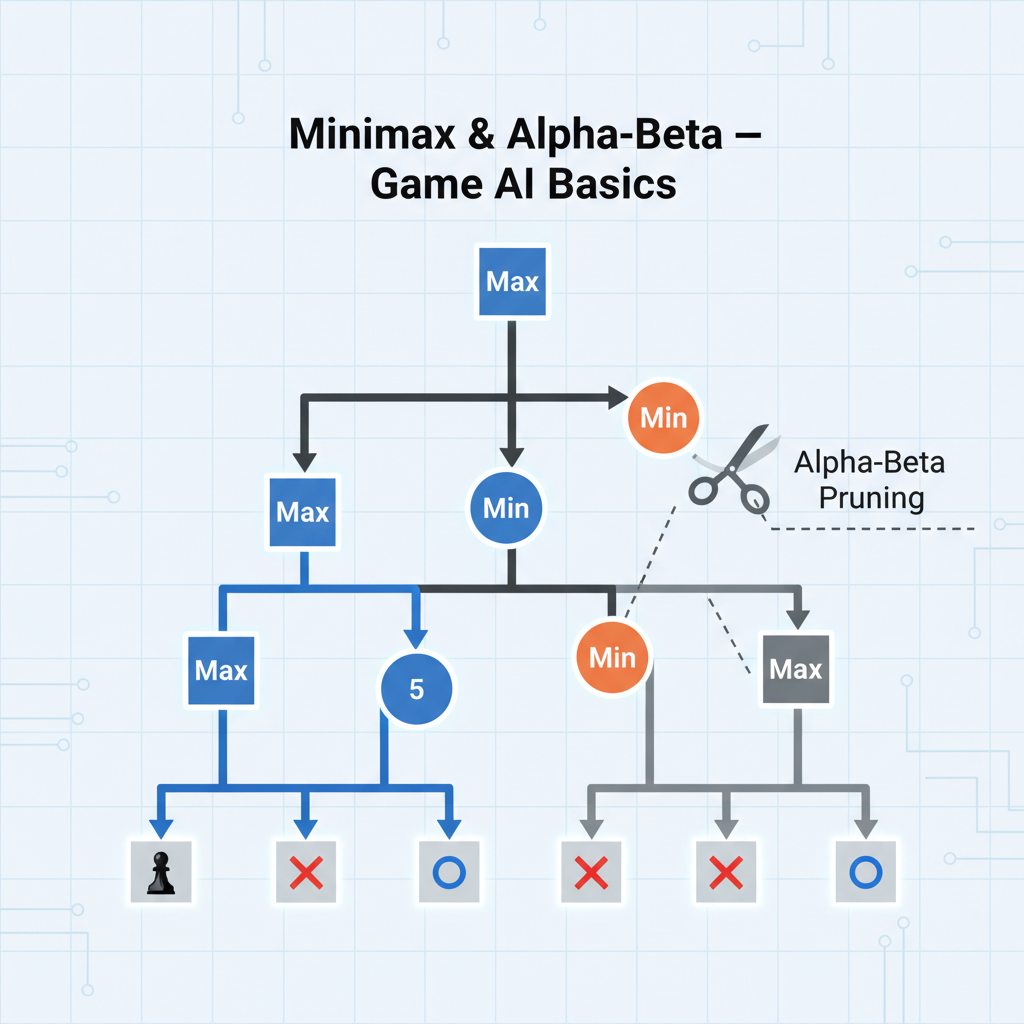
The algorithm operates by constructing a comprehensive game tree, methodically evaluating all possible moves and countermoves. Think of it as a massive decision tree where each branch represents a potential move, and each node represents a game state. Here’s how it unfolds:
- Tree Construction
The algorithm begins by building a game tree from the current position. Each level of the tree alternates between the maximizing player’s moves and the minimizing player’s responses. This process continues until it reaches either a game-ending position or a predetermined depth limit. - Value Assignment
At the terminal nodes (end positions), the algorithm assigns specific values:
– A high positive value or infinity for a win by the maximizing player
– A high negative value or negative infinity for a win by the minimizing player
– Zero for a drawFor non-terminal positions, it employs evaluation functions to estimate the favorability of each position. In chess, for example, this might involve calculating material advantage or positional strength. For deeper understanding of AI evaluation functions and practical AI agent design, you can refer to this PDF which dives into principles of building AI agents including evaluation methodologies.
- Value Propagation
The algorithm then works backward from the terminal nodes, propagating values up the tree according to simple rules:
– At maximizing nodes, select the highest value among children
– At minimizing nodes, select the lowest value among childrenThis process continues until reaching the root node, where the algorithm selects the move leading to the best guaranteed outcome.
A Practical Example: Tic-Tac-Toe
Consider a game of tic-tac-toe where X (maximizer) must choose their next move. The algorithm examines all possible moves and their subsequent game states. If X can force a win, the algorithm will identify and select that path. If no winning path exists, it aims for a draw, avoiding any moves that could lead to a loss.
The Mathematical Foundation
Minimax operates on ordinal outcomes, ranking strategies by their worst-case scenarios rather than expected values. It utilizes the mathematical principle that max(a,b) = -min(-a,-b), which enables a simplified version called negamax. With infinite computational resources, minimax can solve for perfect play, though practical limitations usually necessitate depth restrictions.
Applications Beyond Gaming
While most famous for its role in game AI, minimax’s applications extend beyond the gaming world:
– Strategic decision-making in competitive business scenarios
– Resource allocation in zero-sum situations
– AI training and development
– Foundation for more advanced game-playing algorithms
For more on how AI agents are developed and the foundational principles behind their architectures, check out this PDF which provides comprehensive insights into modern AI agent design.
Limitations and Modern Optimizations
The primary challenge with minimax lies in its scalability. The computational complexity grows exponentially with depth, expressed as O(b^d), where b is the branching factor (average number of moves available), and d is the depth of search.
To address this limitation, several optimizations have been developed:
- Alpha-Beta Pruning
This enhancement dramatically improves efficiency by eliminating branches that cannot influence the final decision. It can reduce the effective branching factor by up to half, enabling deeper searches without additional computational cost. For practical details on algorithmic optimizations including alpha-beta pruning and iterative deepening, the blog at this blog which elaborates on techniques to optimize AI systems and decision making. - Iterative Deepening
Instead of searching to a fixed depth, the algorithm gradually increases search depth, ensuring the best move is found within time constraints. - Advanced Heuristics
Modern implementations employ sophisticated evaluation functions and pattern recognition to better assess non-terminal positions. More about heuristic methods and AI strategies can be explored in this book which covers various strategic patterns used in AI agent development.
The Future of Minimax
While newer AI techniques like neural networks and reinforcement learning have emerged, minimax remains relevant and continues to evolve. Its principles inform modern AI development, and its mathematical foundations contribute to our understanding of strategic decision-making.
The minimax algorithm’s elegance lies in its simplicity and effectiveness. It demonstrates how fundamental mathematical principles can create sophisticated decision-making systems, making it a cornerstone of artificial intelligence and game theory.
Whether you’re developing game AI, studying computer science, or simply interested in how machines make decisions, understanding minimax provides valuable insights into the logical foundations of artificial intelligence. For a broader perspective on how AI agents are shaping the future, including applications in the workforce and digital assistants, visit this site.
As AI continues to advance, the principles behind minimax remain as relevant as ever, informing new generations of algorithms and decision-making systems.
Frequently Asked Questions
What is minimax?
The minimax algorithm is a recursive decision-making strategy designed for two-player, zero-sum games. It builds a comprehensive game tree and uses alternating maximizer and minimizer nodes to determine the best move.
What is Alpha-Beta Pruning?
Alpha-Beta Pruning is a optimization technique that eliminates branches of the game tree that cannot affect the final decision, reducing the search space and speeding up the algorithm.
What are practical optimizations?
Practically, minimax uses techniques like Alpha-Beta Pruning, Iterative Deepening, and Advanced Heuristics to improve efficiency and enable deeper searches within time constraints.
}