Essential Guide to Automation Governance: Aligning AI and IT for Strategic Success
Essential Guide to Automation Governance: Aligning AI and IT for Strategic Success
Estimated reading time: 9 minutes
Key Takeaways
- Automation governance is a structured framework of policies, processes, roles, and tools that organizations use to oversee, control, and scale automated processes.
- Automation governance ensures that your automation initiatives align with business strategy while managing risk, maintaining compliance, and building sustainable programs that actually deliver value over time.
- Automation governance connects with AI governance and IT governance at the intersection of these two disciplines.
- AI governance focuses on institutionalizing policies that ensure AI systems are trustworthy, fair, and compliant with regulations.
- IT governance aligns technology investments and operations with broader business goals.
- The core building blocks of governance include policies and procedures for deployment, risk management strategies, compliance considerations, and governance models.
Table of contents
- What is Automation Governance?
- The Connection Between Automation Governance and AI Governance
- Key Components of Effective Automation Governance
- Role of IT Governance in Automation Governance
- Challenges in Automation Governance
- Best Practices for Automation Governance
- Case Studies and Real-World Examples
- Future Trends in Automation and AI Governance
- Conclusion
- Call to Action
Automation is reshaping how businesses operate at an unprecedented pace. From simple task automation to sophisticated AI-powered systems, organizations are racing to digitize processes and gain competitive advantages. But here’s the thing—this rapid transformation brings new risks and complexities that can quickly spiral out of control without proper oversight.
Read more about business process automation
So how can organizations harness automation safely while driving innovation? The answer lies in automation governance.
Automation governance is essentially a structured framework of policies, processes, roles, and tools that organizations use to oversee, control, and scale automated processes. It ensures that your automation initiatives align with business strategy while managing risk, maintaining compliance, and building sustainable programs that actually deliver value over time.
And let me be clear—this isn’t just another corporate buzzword. In today’s landscape of hyperautomation, where organizations are deploying hundreds or even thousands of automated processes, governance has become critical. Without it, you’re looking at security gaps, interoperability failures, compliance nightmares, and automation initiatives that collapse under their own weight.
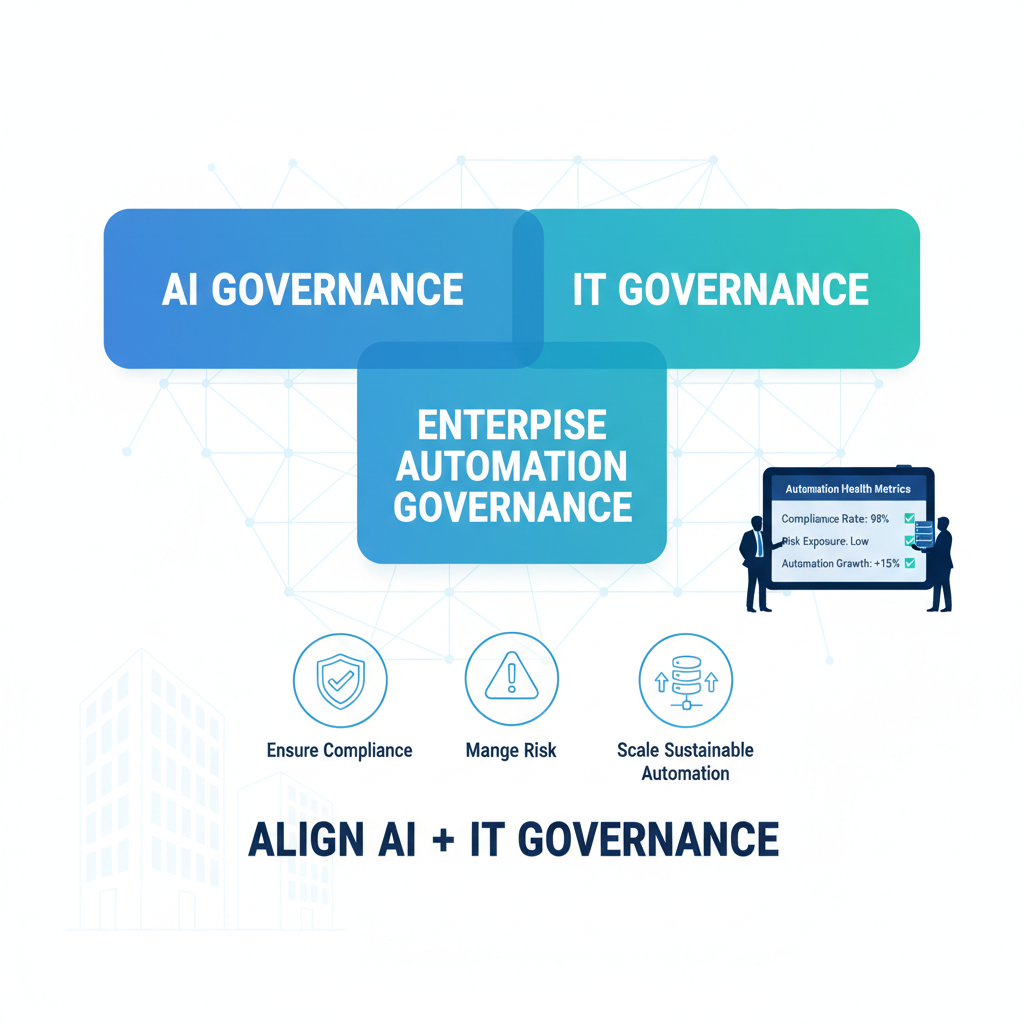
What makes automation governance particularly interesting is how it connects with two other crucial disciplines: AI governance and IT governance. AI governance focuses on institutionalizing policies that ensure AI systems are trustworthy, fair, and compliant with regulations. IT governance, meanwhile, aligns technology investments and operations with broader business goals. Automation governance sits at the intersection of these two, creating a comprehensive approach to managing modern digital operations.
https://optro.ai/blog/getting-started-with-automation-governance
https://turbotic.com/resources/blog/automation-governance-framework
https://docs.aws.amazon.com/wellarchitected/latest/devops-guidance/automated-governance.html
https://www.ibm.com/think/insights/automated-ai-governance
So, what exactly is automation governance and how does it work in practice? Let’s dig deeper.
What is Automation Governance?
Think of automation governance as the blueprint for building and maintaining a city of automated systems—each bot or script is like a building that needs proper planning, construction, and maintenance. You wouldn’t let anyone construct a skyscraper without permits, inspections, and safety standards, right? The same principle applies to automation.
At its core, automation governance provides a blueprint for managing automated systems across their entire lifecycle. We’re talking about everything from simple bots and scripts to enterprise-wide hyperautomation initiatives. It sets clear objectives, establishes standards, and defines lifecycle stages including ideation, assessment, development, testing, deployment, and ongoing maintenance.
The real purpose here is enabling organizations to innovate rapidly without sacrificing the discipline, security, quality, and compliance that keep businesses running smoothly. This becomes especially critical when you consider the democratization of automation—more people across organizations now have access to automation tools, which means they’re potentially accessing sensitive data or creating automations without full technical expertise.
Read more about no-code and low-code automation tools
Why can’t we simply let teams automate freely? Well, that’s like asking why we need building codes. Sure, you might get some impressive structures quickly, but you’ll also get dangerous failures, inconsistent quality, and systems that don’t work together. Poor automation governance introduces risks like security vulnerabilities, compliance violations, failed deployments, and ultimately, automation programs that become too costly and chaotic to sustain.
https://optro.ai/blog/getting-started-with-automation-governance
https://turbotic.com/resources/blog/automation-governance-framework
https://docs.aws.amazon.com/wellarchitected/latest/devops-guidance/automated-governance.html
Since AI is an integral part of many automation initiatives today, how does AI governance fit into this picture?
The Connection Between Automation Governance and AI Governance
With AI powering a growing portion of automation, how do we ensure that AI-driven decisions are trustworthy and compliant? That’s where AI governance comes in.
AI governance establishes safety standards and continuous monitoring frameworks to ensure AI systems remain trustworthy throughout their operational life. We’re talking about monitoring for accuracy, fairness, and explainability—all the qualities that make AI systems reliable and defensible. This becomes especially crucial in regulated sectors like finance and healthcare, where AI decisions can have significant consequences and regulatory scrutiny is intense.
Learn more about building AI agents (PDF guide)
Here’s what’s interesting: automation governance frameworks naturally extend to address AI-specific challenges. They integrate AI lifecycles into broader automation management, automate the collection of evidence for audits, and enforce enterprise-wide consistency that prevents technical debt from accumulating. It’s not about creating separate governance systems—it’s about ensuring your automation governance framework is sophisticated enough to handle AI’s unique requirements.
The technical implementation often involves what we call “automated governance processes.” These are systems that automatically collect and verify compliance data using specialized tools and open platforms. Instead of manual checks and spreadsheets, you get scalable monitoring and risk management that can keep pace with your AI deployments.
IBM’s Cloud Pak for Data provides a practical example of this in action. Regulated firms use it to automate AI compliance processes, demonstrating how governance can scale across complex organizations while maintaining the rigor that regulators demand.
https://www.ibm.com/think/insights/automated-ai-governance
Understanding how AI fits within automation governance sets the stage for building a robust governance framework. But what are the actual building blocks?
Key Components of Effective Automation Governance
What are the building blocks that make automation governance practical and effective? Let’s break down the essential components.
Policies and Procedures for Deployment
Every solid governance framework starts with an automation charter. This document defines your organization’s vision, principles, and standards for automation. It should detail the complete lifecycle—from ideation through maintenance—and establish clear procedures for each phase.
Documentation might sound boring, but it’s absolutely critical for business continuity and repeatability. When key people leave or processes need to scale, that documentation becomes your lifeline. It ensures that automations can be maintained, updated, and replicated without starting from scratch each time.
Read our automation governance checklist and guide
Risk Management Strategies
Risk management in automation governance involves multiple layers of control. You need user and bot access restrictions that follow the principle of least privilege—giving systems and people only the access they absolutely need. Segregation of duties is crucial too, separating the people who create automations from those who deploy them to production.
Continuous monitoring catches issues before they become disasters. Interoperability checks ensure your automations work together rather than creating conflicts. And prioritization based on business impact helps you focus governance resources where they matter most—on the automations that drive significant value or carry substantial risk.
Compliance and Regulatory Considerations
Smart organizations don’t reinvent the wheel. Automation governance should leverage existing IT controls wherever possible, supplementing them with new policies specifically designed for automation security and quality. The goal is ensuring alignment with regulatory requirements without creating unnecessary bureaucracy.
This means understanding which regulations apply to your automated processes—whether that’s GDPR for data handling, SOX for financial controls, HIPAA for healthcare data, or industry-specific requirements. Your governance framework should make compliance easier, not harder.
Governance Models
Organizations typically evolve through different governance models as they mature. Early-stage automation programs often use a centralized model with a single Center of Excellence (COE) handling both governance and infrastructure. This makes sense when you’re still figuring things out and need tight control.
As organizations mature, they often move to a hub-and-spoke or federated model. Central governance provides oversight and standards, but individual business units gain autonomy to operate within those guardrails. Eventually, some organizations reach a decentralized model with multiple COEs operating independently—but this only works when governance maturity is high across the organization.
How should your organization structure governance? It depends on your maturity level, organizational culture, and automation scale. The key is balancing central control with team innovation—too much control stifles creativity, while too little creates chaos.
https://optro.ai/blog/getting-started-with-automation-governance
https://turbotic.com/resources/blog/automation-governance-framework
https://docs.aws.amazon.com/wellarchitected/latest/devops-guidance/automated-governance.html
Role of IT Governance in Automation Governance
Now that we’ve covered the core framework elements, it’s important to see how IT governance supports and enhances automation governance.
Role of IT Governance in Automation Governance
IT governance establishes objectives for aligning IT strategy with business goals while managing resources, risk, and performance. It’s the foundation that automation governance builds upon, providing established processes and controls that can be extended to cover automation-specific needs.
The support IT governance provides is multifaceted. First, it offers foundational controls and processes that automation initiatives can leverage rather than creating from scratch. Why reinvent identity management, change control, or security protocols when they already exist?
Second, IT governance enables cross-functional integration. Effective automation governance requires involving IT, audit, HR, finance, and other departments in governance practices. This ensures broad accountability and prevents automation from becoming an isolated initiative that doesn’t align with organizational objectives.
Third, IT governance provides scalability through automated controls and policies. As automation programs grow, manual governance becomes impossible. Automated policies and controls maintain the balance between agility and accountability, allowing rapid deployment without sacrificing oversight.
The relationship between IT governance and automation governance is symbiotic. IT governance provides the foundation, while automation governance extends it to address the specific challenges of managing automated systems and AI.
https://optro.ai/blog/getting-started-with-automation-governance
https://docs.aws.amazon.com/wellarchitected/latest/devops-guidance/automated-governance.html
While IT governance provides a sturdy foundation, organizations still face hurdles implementing automation governance effectively.
Challenges in Automation Governance
Why do many organizations struggle with automation governance despite its clear benefits? Let’s be honest about the obstacles.
The rapid pace of automation often outstrips existing control frameworks. Organizations that spent years developing IT governance suddenly find those frameworks inadequate for the speed and scale of modern automation. By the time you’ve documented one wave of automations, three more waves have already deployed.
Democratized automation creates another challenge. When citizen developers and business users can create automations using low-code or no-code tools, they’re often operating with sensitive data without full expertise in security, compliance, or best practices. This isn’t a criticism of these users—they’re solving real business problems—but it does create governance gaps.
Interoperability issues multiply as organizations use multiple automation tools and platforms. You might have RPA bots from one vendor, API integrations from another, and AI models from a third. Getting all these systems to work together while maintaining consistent governance is genuinely difficult.
Perhaps the biggest challenge is balancing centralized oversight with innovation autonomy. Business units need freedom to innovate and respond quickly to opportunities. But without some central oversight, you end up with duplicated efforts, inconsistent standards, and automations that can’t scale beyond their original department.
Risks of Poor Governance
The consequences of inadequate governance are serious. Failed automation deployments waste time and money while eroding confidence in automation programs. Compliance breaches can result in fines, legal action, and reputational damage. Security vulnerabilities in automated processes create entry points for attacks.
AI-specific risks amplify these concerns. Unmonitored AI models can develop bias that leads to discriminatory outcomes. Inaccurate models make poor decisions that affect customers and operations. Lack of explainability makes it impossible to defend AI decisions to regulators or customers, creating legal and reputational exposure.
The cumulative effect of poor governance is automation programs that become unsustainable—too costly, too risky, and too chaotic to continue.
https://optro.ai/blog/getting-started-with-automation-governance
https://www.ibm.com/think/insights/automated-ai-governance
Best Practices for Automation Governance
Implementing these best practices helps organizations build reliable, scalable, and compliant automation governance. None of this is rocket science, but it does require commitment and follow-through.
Develop an Automation Charter
Start by creating a comprehensive governance document that establishes clear objectives for your automation program. This charter should identify leadership roles, including executive sponsorship and COE responsibilities. Without executive backing, governance initiatives struggle to get the resources and authority they need.
Define specific KPIs that measure governance effectiveness—not just automation ROI, but governance metrics like compliance rates, security incident frequency, and automation lifecycle times. And don’t forget change management. Your charter should include training programs that help people understand and follow governance processes.
Read our automation governance checklist and guide
Prioritize High-ROI Automations
Not all automations are created equal. Focus governance resources on automations with measurable business impact first. This means selecting appropriate technologies and tools that provide centralized control capabilities—things like feed management, access controls, and CI/CD pipelines that make governance practical rather than theoretical.
Tools like UiPath Automation Ops exemplify this approach, providing centralized control without stifling innovation. You get visibility into what automations exist, who’s creating them, and whether they’re following standards—all without creating bottlenecks that slow everything down.
https://www.uipath.com/product/automation-ops
Align with Business Goals
Cross-functional collaboration isn’t optional. IT, business units, and compliance teams need to work together from the start. This “shift-left” approach catches potential issues early when they’re easier and cheaper to fix.
Automated policy enforcement ensures consistency across the organization. Instead of relying on people to remember and follow rules, you build those rules into the automation platform itself. This doesn’t eliminate human judgment—it just removes the burden of remembering every standard and procedure.
Institutionalize AI Trust
For AI-powered automation, continuous monitoring is essential. You need to track fairness, accuracy, and explainability throughout the AI lifecycle, not just at deployment. Open platforms and automated governance tools make this monitoring scalable, allowing you to oversee hundreds or thousands of AI models without exponentially increasing your governance team.
Learn more about context engineering for AI agents
https://www.ibm.com/think/insights/automated-ai-governance
IBM’s approach to automated AI governance demonstrates how this works in practice. By automating evidence collection and compliance verification, organizations can maintain rigorous AI governance without drowning in manual processes.
https://optro.ai/blog/getting-started-with-automation-governance
https://www.uipath.com/product/automation-ops
https://www.kenwayconsulting.com/blog/understanding-automated-data-governance/
https://www.ibm.com/think/insights/automated-ai-governance
Case Studies and Real-World Examples
Forward-thinking organizations using centralized COE models have successfully scaled automation initiatives while maintaining governance rigor. These companies deliver resilience and measurable ROI by establishing clear governance charters that define how automation happens across the enterprise. The centralized approach works particularly well in early stages, providing the control needed to build a foundation of successful automations.
IBM’s Cloud Pak for Data offers a concrete example of governance at scale. Regulated industries like finance and healthcare use it to automate AI compliance processes across their organizations. Instead of manual compliance checks that can’t keep pace with AI deployment speeds, these firms automate evidence collection, policy enforcement, and audit trails. This demonstrates how automation governance and AI governance can work together in highly regulated environments where mistakes carry serious consequences.
https://www.ibm.com/think/insights/automated-ai-governance
https://www.uipath.com/product/automation-ops
UiPath Automation Ops provides another real-world example of governance in action. Organizations use it to enable centralized controls like code reviews and policy enforcement while maintaining operational flexibility. The platform doesn’t restrict what people can do—it provides visibility and control that optimize automation investments without creating bureaucratic bottlenecks.
https://optro.ai/blog/getting-started-with-automation-governance
https://www.ibm.com/think/insights/automated-ai-governance
As technology evolves, so do governance frameworks—what trends should we watch for next?
Future Trends in Automation and AI Governance
The automation of governance itself is accelerating. We’re seeing configurable workflows that adapt governance processes to different automation types, continuous AI model monitoring that catches issues in real-time, and scalability improvements that let governance keep pace with automation growth. Essentially, we’re using automation to govern automation—which makes perfect sense when you think about it.
Open governance platforms are gaining traction, enabling global regulatory compliance and enterprise-wide transparency. These platforms provide standardized approaches to governance that work across different tools, technologies, and organizational boundaries. They’re particularly valuable for multinational organizations navigating different regulatory regimes.
Governance structures themselves are evolving. As organizational maturity increases, we’re seeing more federated and decentralized COE models. Organizations that started with centralized governance are pushing decision-making closer to business units while maintaining oversight and standards. This evolution reflects growing confidence in governance processes and automation maturity across the organization.
The integration of governance with hyperautomation and DevOps is another significant trend. Modern DevOps practices emphasize automated controls that balance speed with risk mitigation. This “shift-left” security approach builds governance into development processes rather than treating it as a deployment gate. The result is faster, safer automation delivery.
Finally, we should anticipate proactive regulatory standards for AI. Governments and industry bodies are developing frameworks for AI governance, and organizations need governance systems adaptive enough to accommodate new requirements. The organizations that build flexible, comprehensive governance frameworks now will find regulatory compliance much easier as standards evolve.
https://optro.ai/blog/getting-started-with-automation-governance
https://docs.aws.amazon.com/wellarchitected/latest/devops-guidance/automated-governance.html
https://www.ibm.com/think/insights/automated-ai-governance
Conclusion
Automation governance is no longer optional—it’s essential for sustainable digital transformation. Organizations racing to automate without governance are building on sand, creating systems that will eventually collapse under their own complexity.
We’ve covered a lot of ground here. We defined automation governance as a structured framework for overseeing automated processes throughout their lifecycle. We explored its connections to AI governance, which ensures AI systems remain trustworthy and compliant, and IT governance, which aligns technology with business objectives. We examined the core components of effective governance, including policies, risk management, compliance considerations, and organizational models.
We also acknowledged the real challenges organizations face—rapid change, democratized automation, interoperability issues, and the tension between control and innovation. But we’ve also outlined practical best practices: developing automation charters, prioritizing high-ROI initiatives, aligning with business goals, and institutionalizing AI trust through continuous monitoring.
Strong automation governance aligns automation initiatives with business goals while managing risk and ensuring compliance. It’s the difference between automation programs that deliver sustained value and those that become expensive, chaotic failures. As automation and AI continue transforming business operations, governance becomes the foundation that makes transformation sustainable.
Call to Action
Is your organization ready to govern automation effectively? Now’s the time to find out.
Start by reviewing your current automation practices. Do you have a governance charter that defines objectives, roles, and standards? Have you established a COE model appropriate for your organizational maturity? Are your automation initiatives aligned with broader IT governance and business goals?
If you’re starting from scratch, leverage available resources. Automation lifecycle guides can help you understand the stages where governance adds value. Platforms like UiPath Automation Ops and IBM Cloud Pak for Data provide the tools to implement governance at scale, making oversight practical rather than burdensome.
Focus on building your governance charter first. Define what success looks like, identify who’s responsible for what, and establish the processes that will guide automation from ideation through maintenance. Then prioritize high-impact initiatives—automations that deliver clear business value while meeting compliance requirements and managing risk appropriately.
The organizations that invest in automation governance now will be the ones still benefiting from automation in five years. Those that skip governance will likely be dealing with the expensive cleanup from automation gone wrong. The choice is yours.
https://optro.ai/blog/getting-started-with-automation-governance
}