What the Academy Actually Said — The New Rules Explained
What the Academy Actually Said — The New Rules Explained
Look, I’ve been covering the Oscars for over a decade, and I can’t remember the last time a rule change made this many waves outside the industry bubble. On Friday, May 1, 2026, the Academy of Motion Picture Arts and Sciences dropped what amounts to a bombshell for anyone paying attention to where Hollywood’s headed.
The rules apply to submissions for the 99th Academy Awards ceremony — you know, the one scheduled for March 2027. And honestly? They’re more specific than I expected.
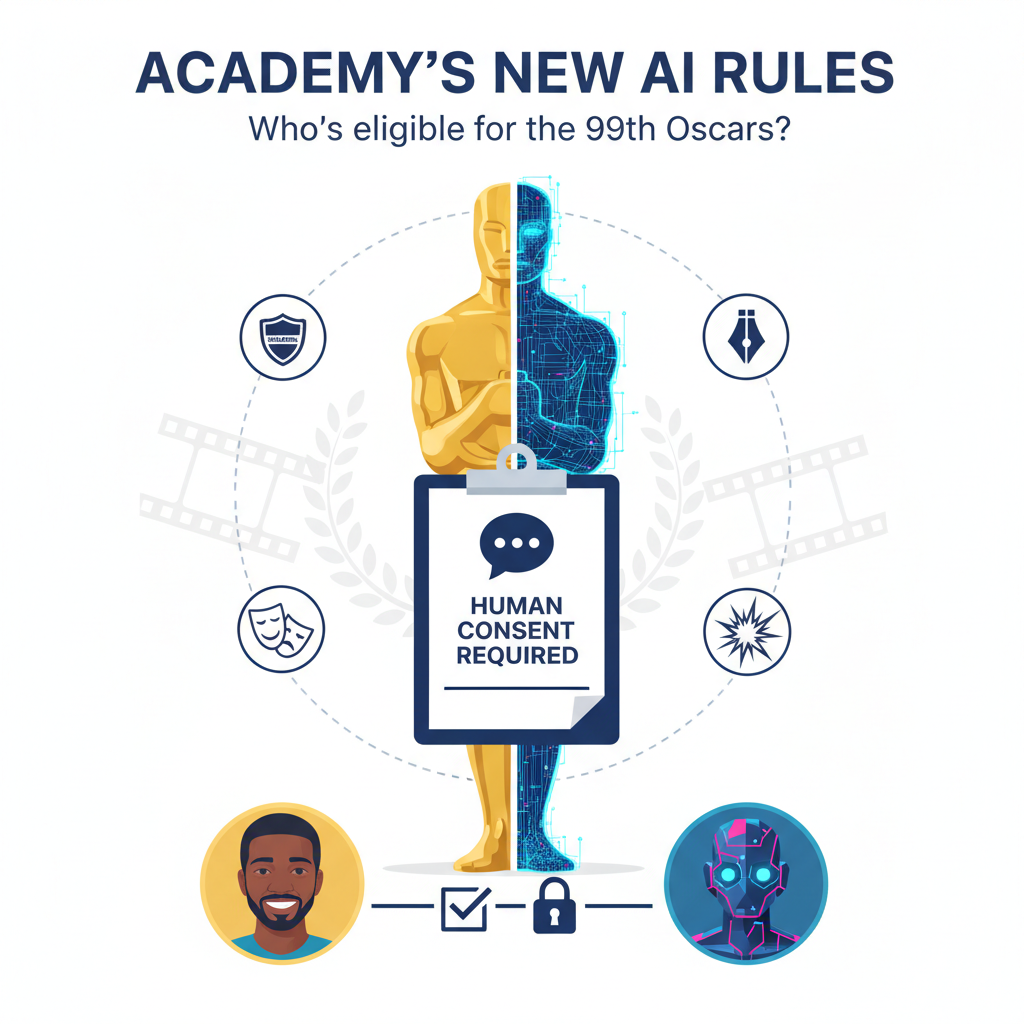
Here’s what the Academy actually said, and I’m quoting directly from their official statement here: “Only roles credited in the film’s legal billing and demonstrably performed by humans with their consent will be considered eligible.” That’s the acting rule. Clean. Direct. No wiggle room.
On the writing side, screenplays “must be human-authored” to qualify for consideration. Period.
Now, before you panic if you’re a filmmaker who’s been using AI tools — and let’s be real, who hasn’t at this point? — the Academy was careful to clarify something important. You can still use AI in production. The ban isn’t about AI as a tool. It’s about AI as the creator or performer.
Think of it this way: Using AI to enhance visual effects? Totally fine. Using AI to generate your lead actor from scratch? That’s where the Academy draws the line.
The rules span six key categories, according to reporting from The Wrap, though the Academy’s been a bit cagey about spelling out every single detail. What we know for certain is that both acting and writing categories are explicitly covered — and that consent clause is doing some heavy lifting in ways I’ll get into later.
Let me break down what this looks like in practice, because the devil’s always in the details:
Scenario A: You’re a director who uses AI-powered visual effects to de-age your lead actor by 20 years, but the performance itself comes from a real human being who signed off on everything. You’re golden. That film’s eligible.
Scenario B: A studio submits a film featuring a fully synthetic AI actress — someone (or something) that never existed as a flesh-and-blood person. Under these new rules, that performance can’t be nominated. Full stop.
Scenario C: Here’s where it gets murky. What if you co-wrote your screenplay with ChatGPT? You did 60% of the work, AI did 40%. Is that eligible? The Academy hasn’t given us crystal-clear guidance on collaborative authorship yet, but based on the “must be human-authored” language, I’d bet money that’s going to be a problem. The safer interpretation — and the one most industry lawyers are probably advising — is that AI can assist but can’t co-author.
What strikes me most about these rules is how defensive they are. The Academy isn’t trying to lead the industry into some brave new future. They’re drawing a line in the sand, saying: this far, no further. At least not yet.
The Tilly Norwood Controversy — The Case That Changed Everything
You want to know why the Academy moved this fast? Two words: Tilly Norwood.
If you haven’t heard of her — and honestly, depending on when you’re reading this, you might not have — Tilly Norwood is Hollywood’s first fully AI-generated “actress.” And I’m putting that word in quotes because, well, can you really call something an actress if it was never born?
Norwood’s debut wasn’t some quiet tech demo at a film festival. Her producer went loud with it, publicly boasting about interest from studio executives. That’s according to Reuters reporting, and the timing here matters. Studio interest meant this wasn’t just a novelty or a proof-of-concept. This was a potential business model.
And that’s when SAG-AFTRA — the Screen Actors Guild and the American Federation of Television and Radio Artists, basically the union that represents every working actor you’ve ever heard of — raised the alarm. They didn’t just express concern. They went formal with it.
I’ve covered labor disputes in Hollywood before, and when SAG-AFTRA moves that quickly, you know something’s hit a nerve. These are the same folks who fought tooth and nail during the 2023 strikes over AI protections. Seeing a synthetic performer getting genuine studio attention? That’s their worst-case scenario playing out in real time.
Who Is Tilly Norwood? Hollywood’s First AI Actress Controversy
Here’s what made Norwood different from, say, a CGI character in a Pixar movie. She wasn’t presented as a cartoon or an obvious digital creation. The pitch was that she could play human roles — dramatic roles — in live-action films. She could theoretically compete for parts against real actors.
And look, I get the technological fascination. The uncanny valley has been shrinking for years. But there’s a massive difference between being impressed by the tech and thinking it should compete for the industry’s highest honors.
The backlash wasn’t just from actors, either. Filmmakers started asking questions. If an AI can be nominated for Best Actress, what does that say about the craft? About the years of training, the emotional vulnerability, the lived experience that actors bring to their performances?
Under the Academy’s new rules, Tilly Norwood — or any synthetic performer like her — is explicitly ineligible for an Oscar. Reuters confirmed this directly in their coverage of the rule change. The Academy looked at the Norwood situation and said: nope, this isn’t what we’re about.
Why SAG-AFTRA Sounded the Alarm
SAG-AFTRA’s response wasn’t just about protecting jobs, though that’s obviously part of it. It was about protecting the fundamental nature of performance itself.
Think about what acting actually is. It’s interpretation. It’s bringing your own history, your own emotional truth, to someone else’s words. An AI doesn’t have a history. It doesn’t have trauma or joy or any of the messy human stuff that makes a performance resonate.
The union also raised concerns about consent and likeness rights — issues that go way beyond just Oscar eligibility. If studios can create synthetic performers, what stops them from creating digital versions of real actors without permission? What stops them from replacing aging stars with AI versions that never age, never demand raises, never say no to projects?
These are existential questions for the industry, and the Norwood case forced everyone to confront them years earlier than they probably wanted to.
Which Oscar Categories Are Affected — A Full Breakdown
So you’re probably wondering: okay, which awards are actually covered by these new rules? The Wrap confirmed that six key categories are explicitly addressed, though the Academy’s official documentation gets specific about some and leaves others a bit more open to interpretation.
Let me walk you through what we know for certain — and what’s still a bit fuzzy.
Acting Categories: All Four Are Covered
Every single acting category now requires that the performance be “demonstrably performed by humans with their consent.” That’s Best Actor, Best Actress, Best Supporting Actor, and Best Supporting Actress.
The consent part is huge, by the way. This isn’t just about blocking fully synthetic AI actors. It’s also about protecting real actors from having their likenesses used without permission.
Imagine this scenario: A studio takes footage of a deceased actor — or even a living one who didn’t consent to a particular project — and uses AI to generate a “new” performance. Under these rules, that’s ineligible. Even if the source material came from a real human, the lack of consent for this specific performance disqualifies it.
Can you still use AI tools in the production of an acting performance? Absolutely. If an actor does motion capture and AI enhances the final rendering, that’s fine. The key is that the core performance — the creative choices, the emotional beats, the interpretation — comes from a human being who agreed to do the work.
Writing Categories: Human Authorship Required
Both Best Original Screenplay and Best Adapted Screenplay fall under the “must be human-authored” requirement. This one’s trickier than it sounds.
Writers have been using software tools forever. Spell-checkers, grammar tools, even story structure software — none of that’s new. But generative AI that can write dialogue, create plot points, develop character arcs? That’s a different animal.
The Academy hasn’t released detailed guidance on where the line is, which honestly makes sense because they probably don’t know yet. Technology’s moving faster than policy can keep up.
My read on this — and I’ve talked to a few screenwriters about it — is that AI can be used as a research tool or a brainstorming assistant, but the actual creative authorship needs to be demonstrably human. If you’re using ChatGPT to generate entire scenes that make it into your final script, you’re probably in dangerous territory.
What About Other Categories?
Here’s where things get interesting. The Academy has been explicit about acting and writing, but what about Best Original Score? Best Cinematography? Best Visual Effects?
Visual Effects is particularly fascinating because AI’s already deeply embedded in that workflow. Every major VFX house uses machine learning tools for everything from rotoscoping to texture generation. But those tools assist human artists — they don’t replace them.
I suspect the Academy is being intentionally vague about these categories because they don’t want to stifle innovation in areas where AI can genuinely enhance human creativity without replacing it. But that’s just speculation on my part.
Best Original Score is another gray area. If an AI composes a film score, is that eligible? What if a human composer uses AI to generate melodic ideas and then arranges and orchestrates them? The Academy hasn’t said, and I imagine we’ll get clarification as specific cases come up.
The Eligibility Matrix
Let me lay this out in a way that’s actually useful if you’re trying to figure out where your project stands:
Best Actor/Actress: Performance must come from a real human who consented to the role. AI can enhance production (de-aging, environment replacement, etc.) but can’t generate the performance itself. Verdict: Human performance required, AI production tools allowed.
Best Supporting Actor/Actress: Same rules as lead acting categories. No synthetic performers, consent required for any likeness use. Verdict: Human performance required, AI production tools allowed.
Best Original Screenplay: Must be human-authored. AI can’t be credited as co-writer or primary author. Verdict: Human authorship required, AI assistance unclear but risky.
Best Adapted Screenplay: Same as original screenplay — human authorship required. Adapting AI-generated source material might be okay, but the screenplay itself needs a human author. Verdict: Human authorship required.
Best International Feature Film: Subject to all the above rules plus new submission pathways (more on this in the next section). Verdict: Human creative control required, but new qualification routes available.
Beyond AI — The Other Major Rule Changes for the 99th Oscars
Look, I know everyone’s focused on the AI stuff — and rightfully so — but the Academy made other significant changes that are getting buried in the coverage. And honestly? Some of them might be even more impactful for working filmmakers.
The International Feature Film Revolution
This is the biggest structural change to the Best International Feature Film category since its inception in the 1950s. I’m not exaggerating. This fundamentally alters how films can qualify.
Here’s how it used to work: Each participating country could submit one film. That’s it. One film per country, chosen by that country’s film commission or equivalent body. If your film wasn’t selected by your country, tough luck — it didn’t matter how good it was or how well it played at festivals.
The new rule — and this is huge — creates a dual pathway. Films can still qualify through the traditional country submission process. But now they can also qualify by winning the top award at one of six designated film festivals.
The Wrap reported this as the most significant change since the category’s creation, and I completely agree. This opens up the competition in ways that could be transformative.
Think about what this means practically. A film from a country with limited government support for cinema — or worse, a government that actively censors certain types of films — now has another route to Oscar consideration. Win at Cannes, Berlin, Venice, or one of the other designated festivals, and you’re in.
It also rewards the films that are actually making waves in the international film community rather than just the ones that happen to have good relationships with their national film boards.
I’ve seen incredible films over the years that never had a shot at the Oscar because they weren’t their country’s official selection. Some of them went on to win major festival prizes but couldn’t compete for the Academy Award. That changes now.
Multiple Nominations in a Single Acting Category
This one’s more technical, but it matters. The Academy now permits actors to receive more than one nomination within the same category in a single year.
Previously, if you gave two amazing performances in the same year — both worthy of Best Actor consideration — the Academy would only nominate you once. You’d have to choose which performance to campaign for, or the votes would split and you might not get nominated at all.
That always seemed arbitrary to me. If an actor delivers two nomination-worthy performances in a single year, why shouldn’t both be recognized?
This probably won’t happen often — it requires an actor to have two major releases in the same eligibility window, both strong enough to generate Oscar buzz. But when it does happen, the Academy won’t artificially limit recognition anymore.
What These Changes Signal About the Academy’s Direction
Here’s what’s interesting to me about these rule changes taken together. The Academy is simultaneously protecting traditional human artistry (the AI rules) while opening up new pathways for recognition (the international film changes and multiple nominations rule).
They’re not being purely conservative or purely progressive. They’re trying to preserve what they see as the essential human core of filmmaking while adapting to a changing global film landscape.
Whether that balance holds remains to be seen. Technology isn’t going to stop advancing just because the Academy drew some lines in the sand. And the international film community is only going to become more interconnected and less defined by national borders.
But for now, these are the rules we’re working with for the 99th Academy Awards in March 2027.
What This Means for Filmmakers — Navigating the New Landscape
Okay, so you’re a filmmaker trying to figure out what all this means for your work. Maybe you’re in development on a project right now. Maybe you’re already in post-production. Or maybe you’re just trying to understand where the industry’s headed so you can plan accordingly.
Let me be straight with you: these rules create both clarity and confusion, often in the same breath.
The Good News: You Can Still Use AI Tools
First, the reassuring part. The Academy isn’t banning AI from filmmaking. They’re banning AI from taking credit for creative authorship and performance.
That means all the AI tools that have become standard in modern production workflows are still fair game. Color grading assistance? Fine. AI-powered editing tools that can sort through hours of footage? No problem. Visual effects that use machine learning? Absolutely.
In my experience covering film technology, this is actually the right line to draw. AI is incredibly powerful as a tool that amplifies human creativity. It’s when it tries to replace human creativity that things get ethically murky.
If you’re using AI to handle the tedious, time-consuming parts of production so you can focus more energy on the creative decisions — that’s still encouraged. That’s still eligible for Oscar consideration.
The Documentation Challenge
Here’s something I haven’t seen enough people talking about: How do you prove your film is compliant with these rules?
For acting