The AI Copyright Crisis — What’s Actually Happening?
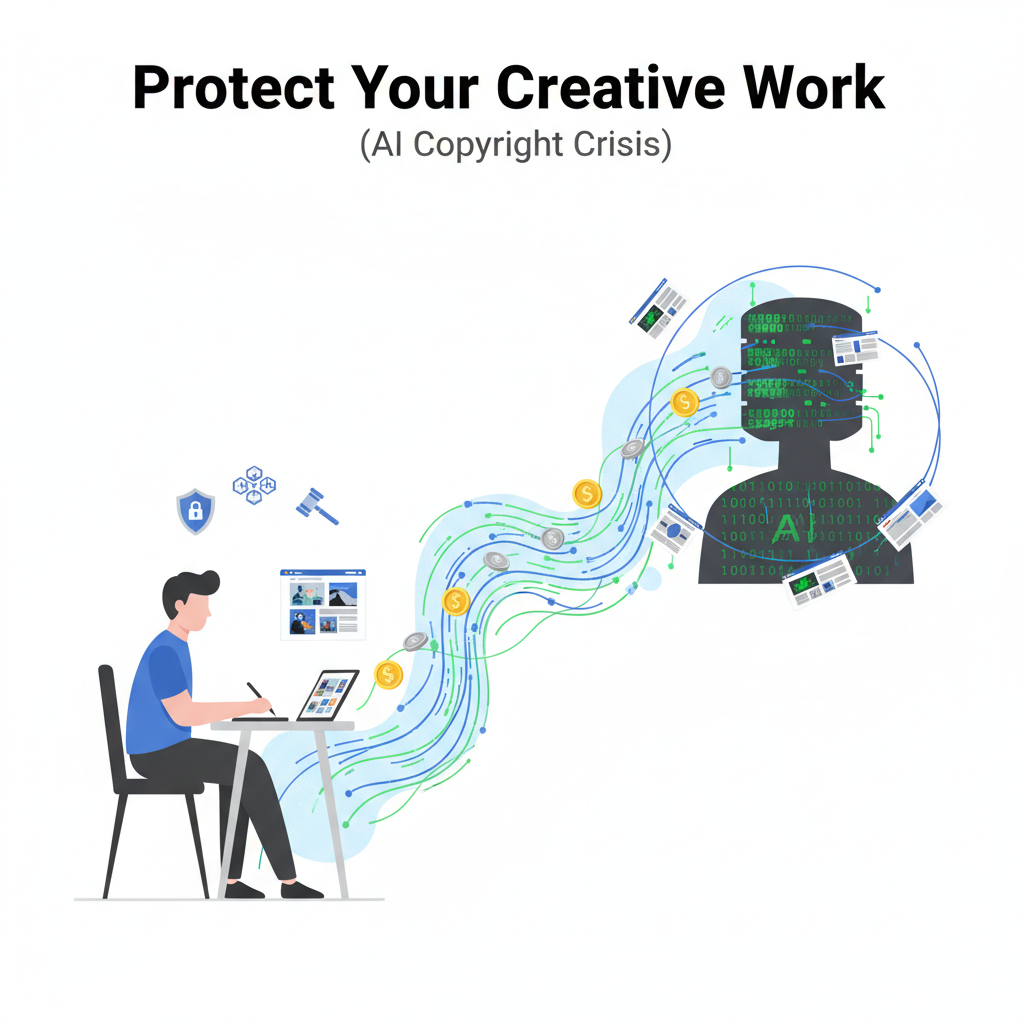
Billions of dollars are being made from your creative work — and you may never see a cent.
I know that sounds dramatic. But here’s the thing — it’s happening right now, at a scale that’s honestly kind of terrifying. Major AI companies are training their models on copyrighted material scraped from the internet, and creators are waking up to find their life’s work powering someone else’s billion-dollar business.
Look, I’ve been watching this unfold for the past couple years, and the situation has gone from “interesting legal question” to “full-blown crisis” faster than anyone expected. From Anthropic’s lawsuit over pirated books to AI image generators scraping artists’ portfolios without permission, we’re in the middle of an intellectual property war that’s going to reshape how creative work gets valued and protected.
So what can you actually do about it? And what does the law even say right now? Let’s break it down — no legal jargon, just the stuff you need to know to protect yourself.
The AI Copyright Crisis — What’s Actually Happening?
The lawsuits are piling up. And I mean really piling up.
In August 2024, three authors filed a class-action lawsuit against Anthropic — you know, the company behind Claude AI that’s raised more than $7 billion in the past year [Source]. Their claim? That Claude was trained on pirated copies of their books, scraped from shady websites without permission or payment. The authors alleged that Anthropic “made a mockery of its lofty goals” by using stolen content to build a commercial product [Source].
But Anthropic isn’t alone. OpenAI faced similar lawsuits earlier. Visual artists filed a massive class-action against Stable Diffusion, Midjourney, and Dreamup [Source]. The pattern is clear — AI companies moved fast, scraped everything they could find, and figured they’d deal with the legal consequences later.
Here’s what keeps me up at night about this: it’s not just about individual lawsuits. It’s about the fundamental economics of creative work. When an AI can generate images in the style of a living artist, or write prose that mimics an author’s voice, what happens to the market for human creators? You can’t compete with free and instant.
The cases are being filed in San Francisco federal court, one after another [Source]. And while the legal system grinds slowly, AI companies keep training bigger models on more data. The stakes here go way beyond courtroom drama — we’re talking about whether creative professionals can earn a living in the age of generative AI.
What the Law Actually Says About AI and Copyright
Okay, so here’s where things get complicated. And honestly? The law hasn’t caught up to the technology.
First question everyone asks: can AI-generated content be copyrighted? In the United States and many other countries, the answer is generally no [Source]. Why? Because copyright law requires a human author. An AI can’t hold a copyright any more than a camera or a paintbrush can. The tool doesn’t own the output.
Deep AI actually spells this out explicitly in their terms of service — all content created through their platform is “free of copyright” [Source]. Which sounds great for users until you realize it also means you can’t protect AI-generated work as your own.
But — and this is crucial — there’s a massive difference between AI output and the training data used to create it. Just because the AI’s creations aren’t copyrighted doesn’t mean the company had the right to use copyrighted material for training. That’s the whole fight.
AI companies lean heavily on “fair use” arguments. They claim that training on copyrighted material is transformative, that it’s not copying but learning patterns. Courts are still figuring out whether that holds water. In my experience watching these cases, judges are skeptical — especially when the AI can reproduce styles or content eerily similar to the original.
The EU is moving faster than the U.S. on this. The EU AI Act includes transparency requirements for AI training data [Source]. Companies will have to disclose what they trained on. The European Commission is even releasing mandatory templates for public disclosure [Source]. That’s a big deal — it shifts from “scrape first, ask questions never” to actual accountability.
And look, there’s already precedent being set. The Anthropic settlement referenced in 2026 projections suggests that liability is heading in one clear direction: toward requiring licenses and compensation [Source].
How AI Companies Are Exploiting the Legal Gray Zone
Let me explain how the scraping actually works — because understanding the mechanism helps you protect yourself.
AI art generators don’t “steal” images in the traditional sense. They analyze millions of images, learning patterns, styles, color relationships, compositions. Then they generate new images based on those learned patterns. Sounds innocent, right? Except those millions of training images were usually taken without permission.
The style theft problem is particularly insidious. An AI can study your distinctive artistic style — the thing that took you years to develop, the signature that makes your work recognizable — and replicate it. It doesn’t need to copy your exact pieces. It learns what makes your work yours and can produce unlimited variations.
I’ve talked to illustrators who’ve found their styles mimicked by AI tools they never authorized. It’s not just frustrating — it’s economically devastating. Why would someone commission you when they can generate “art in your style” for free?
SY Lee from Story Protocol put it bluntly: not compensating creators is “suicidal” for AI in the long run [Source]. He’s right. “Without great human-created data, AI models are not going to be able to train themselves and improve themselves” [Source]. AI companies need creators. They just haven’t wanted to pay for what they need.
Here’s something businesses need to understand: using AI tools trained on unlicensed data exposes you to legal risk [Source]. If you’re generating commercial content with these tools, you’re potentially building your business on a foundation of copyright infringement. And there’s currently a lack of “accessibility to foundation models trained on only licensed data” [Source].
That’s changing, though. Which brings us to the solutions.
Startups Fighting Back — Ethical AI and Creator Protection Tools
Not everyone in the AI space is playing fast and loose with copyright. Some companies are actually trying to do this right.
Bria AI is building generative AI exclusively on licensed sources. They’ve partnered with Getty Images, Alamy, and Envato — major content libraries where creators have already agreed to licensing terms [Source]. Getty Images’ SVP Peter Orlowsky said the company is “excited to be part of this initiative” that makes AI “more accessible and safer to use” [Source]. Finally, someone gets it.
Bria offers a “foundry” on Nvidia Picasso where businesses can access AI trained only on licensed content. It’s not free. But it’s legal. And if you’re running a business, that peace of mind is worth paying for.
Then there’s Story Protocol, which takes a completely different approach. They raised $80 million at a $2.25 billion valuation, backed by Andreessen Horowitz [Source]. Their idea? Make copyright programmable using blockchain technology.
Here’s how it works: you register your IP on Story Protocol’s blockchain. You set the licensing terms — who can use it, for what, at what price. When someone uses your work (including AI companies), the system automatically tracks it and processes payment. It’s like putting a smart contract on your creative work.
Is blockchain the answer to everything? No. But for IP tracking and automated licensing, it actually makes sense. The transparency is built in. The record is permanent. And creators maintain control.
Now for the defensive tools. Glaze, developed by the University of Chicago, is a free app that disrupts AI’s ability to read and mimic your artwork [Source]. You run your images through Glaze before posting them online, and it adds imperceptible changes that confuse AI training algorithms. To humans, your art looks the same. To AI, it’s garbled.
Nightshade goes further — it’s a “poisoning” tool that corrupts AI training when scraped art is used. Some artists love it. Others worry about the ethics of poisoning data pools. But honestly? When AI companies are taking your work without permission, fighting back doesn’t seem unreasonable.
There’s also a growing “Certified Human” movement. C2PA standards are emerging to verify that content was created by humans, not AI. Some platforms are starting to badge human-created work. It’s early days, but it could become a meaningful market differentiator.
What Creators Can Do Right Now to Protect Their Work
Alright, enough theory. What do you actually do about this?
First: register your copyright. In the U.S., you technically have copyright the moment you create something, but registration gives you way more legal options if you need to sue. It costs like $65 per work through the U.S. Copyright Office. Do it before you publish anything significant.
Second: apply for a Creative Commons license. This doesn’t prevent AI scraping, but it establishes clear terms for how your work can be used. If someone violates those terms, you have clearer grounds for legal action.
Third: use Glaze or Nightshade before posting art online. It takes a few minutes per image. Is it perfect protection? No. But it’s free and it makes your work significantly harder to train on. Download Glaze, run your portfolio through it, then upload the protected versions.
Fourth: register on Story Protocol. Create a blockchain record of your IP with clear licensing terms. Even if AI companies don’t respect it today, you’re building a paper trail that proves you asserted your rights.
Fifth: audit the AI tools you’re using. If you’re using generative AI for work, check whether it was trained on licensed data. Bria AI and similar ethical alternatives exist. They cost more than free tools, but they won’t expose you to lawsuits.
Sixth: watermark strategically. Not the old-school visible watermarks — those are easy to crop out. Use invisible metadata and digital watermarking tools that embed ownership information in the file itself.
Seventh: join the class-actions if you qualify. If your work was scraped by Stable Diffusion, Midjourney, or other AI companies, there are active lawsuits you might be able to join. Check with IP attorneys who specialize in these cases.
Eighth: advocate for better laws. Contact your representatives. Support organizations pushing for AI transparency requirements and creator compensation. The EU AI Act shows that regulation is possible — we need similar frameworks in other countries.
Look, I’m not going to pretend these steps guarantee complete protection. The technology is moving faster than the law. AI companies have billions of dollars and armies of lawyers. But doing nothing guarantees you’ll get steamrolled.
The creative economy is at a crossroads. Either we establish norms and laws that respect creators’ rights, or we watch generative AI hollow out creative professions. I’ve seen industries transform before — sometimes for the better, sometimes not. This one’s still up for grabs.
What happens next depends partly on courts and legislators. But it also depends on creators standing up for their work, using available tools, and refusing to accept that billion-dollar AI companies can just take whatever they want.
Your work has value. Don’t let anyone — human or AI — convince you otherwise.
Ready to take your creative work protection to the next level? Contact our experts for personalized guidance on navigating AI copyright issues and implementing the right protection strategies for your specific situation.