AI Accuracy in 2026: What the Research Really Shows
AI Accuracy in 2026: What the Research Really Shows
Imagine trusting a tool that gets the answer wrong 1 in 5 times — and you’d never know which time that was.
That’s not a hypothetical scenario. It’s where we are with AI in 2026.
Look, I’ve watched AI tools get embedded into everything from hiring decisions to healthcare guidance to the research papers students are writing. And honestly? The gap between how people think AI works and what the actual data shows is kind of terrifying. We’re talking about measurable inaccuracies, demographic biases, and inconsistencies that most users never see — or even think to look for.
Here’s the thing: I’m not anti-AI. Not even close. But after digging through the latest research from WSU, MIT, and leading AI organizations, I’ve realized we need to have a much more honest conversation about where these tools actually stand right now.
So let’s talk numbers. Real data. And what you can actually do to use AI more safely — whether you’re a marketer, an employer, a student, or just someone trying to get accurate information in 2026.
How Accurate Is AI Really in 2026? The Numbers Behind the Hype
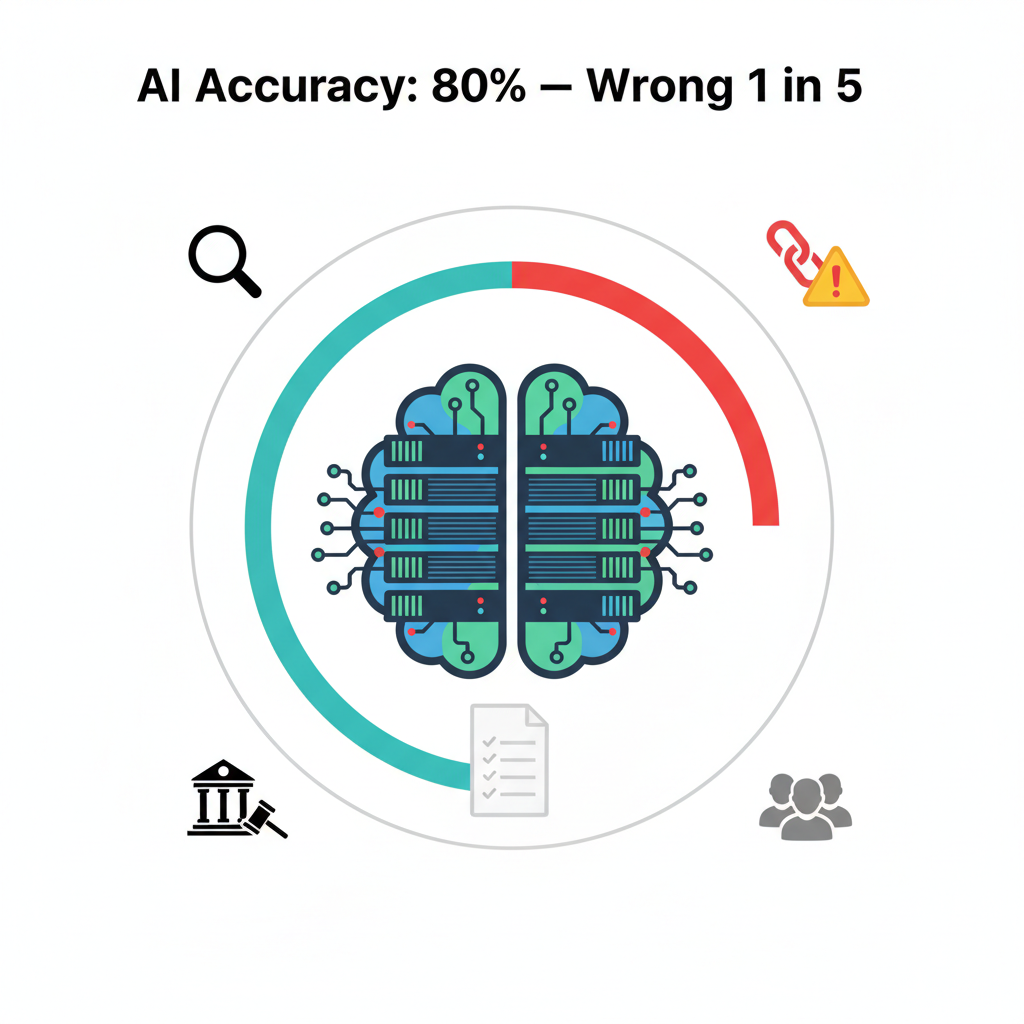
ChatGPT answered correctly 76.5% of the time in 2024 testing, according to a Washington State University study. When they repeated the experiment in 2025, that number jumped to 80%.
Sounds pretty good, right?
But here’s what that actually means: one in every five answers could be wrong. And you won’t necessarily know which one.
The researchers literally called it a “D grade” — and I think that framing is important. Because 80% accuracy sounds impressive until you apply it to contexts where accuracy actually matters. A doctor with an 80% accuracy rate would lose their license. A financial advisor at 80% would face serious liability. Yet we’re casually plugging these tools into decision-making processes across industries.
I’ve seen this play out in real scenarios. A student uses ChatGPT to research a paper and cites a completely fabricated statistic. A small business owner relies on AI-generated market data that’s six months outdated (because the model’s training cutoff was last year). A marketing team builds an entire campaign around consumer insights that turn out to be… well, wrong.
And accuracy isn’t even consistent. The WSU study shows it shifting between model versions, between different prompts, between contexts. You can ask the same question three different ways and get three different answers — with varying levels of correctness.
What does “accuracy” even mean in AI testing? The researchers measured factual correctness — did the AI provide information that matched verified sources? But that doesn’t capture contextual appropriateness, nuance, or whether the answer actually helps the person asking.
Think about it this way: if you ask 100 questions and get 20 wrong answers scattered randomly throughout, how do you know which ones to trust? You don’t. That’s the problem.
AI Bias Is Not Hypothetical — It’s Documented and Costly
Okay, so accuracy is one issue. But bias? That’s where things get really concerning.
In 2026, researchers benchmarked 14 leading large language models across six bias categories: gender, race, age, disability, socioeconomic status, and sexual orientation. They used 66 carefully designed evaluation questions to test how these models responded.
The results? Even the most advanced AI systems perpetuate harmful stereotypes when they’re trained on unbalanced data.
And this isn’t just an academic concern — there are real legal and financial consequences. One company recently settled an age discrimination case for $365,000 that was linked to algorithmic hiring tools. The AI they used to screen resumes systematically disadvantaged older candidates. Not because anyone programmed it to be ageist, but because the training data reflected existing biases in hiring patterns.
Here’s what keeps me up at night: Gartner forecasts that by 2025, generative AI will produce 10% of all generated data. Think about what that means. Biased outputs don’t just affect individual decisions — they scale rapidly. That AI-generated content becomes training data for future AI models, creating a feedback loop that can amplify bias over time.
I’ve talked to HR professionals who’ve seen this firsthand. Resume screening tools that downrank candidates based on zip codes (which correlate with race and socioeconomic status). AI image generators that default to specific racial or gender representations when you type “CEO” versus “nurse.” Loan approval algorithms that disadvantage certain demographics in ways that are incredibly difficult to detect or challenge.
A separate study comparing three different generative AI tools found that all of them reproduced social biases related to age, gender, and emotion representation. All of them. These aren’t outliers or poorly designed systems — this is the current state of the technology.
Real Cost of AI Bias: One hiring algorithm. One lawsuit. $365,000 settlement.
And that’s just one case we know about. How many biased decisions happen every day that never make it to court?
Vulnerable Users Are Hit Hardest — What the MIT Research Found
Here’s where the equity dimension gets really stark.
MIT research from 2026 found that AI chatbots provide less accurate information to vulnerable users. Not the same level of inaccuracy across the board — actually worse performance for people who might need reliable information most.
Think about who that includes. Elderly users trying to understand healthcare options. Non-native language speakers navigating customer service. People with disabilities seeking accessibility information. Individuals in financial distress looking for benefits eligibility guidance.
AI doesn’t fail equally. And that’s the part of the accuracy debate most people are missing.
I’ve seen this play out in user testing sessions. An elderly person asks an AI chatbot about medication interactions and gets vague, less detailed responses compared to what a younger user receives for the same question. A non-native English speaker gets lower-quality AI customer service responses — shorter, less helpful, sometimes missing key information entirely.
Why does this happen? It likely connects back to the bias data we talked about earlier. If certain demographics are underrepresented in training data, the AI has less “experience” understanding their needs, their language patterns, their contexts. The model hasn’t learned to serve them as well.
This compounds existing social inequalities rather than democratizing access to knowledge. We were promised AI would level the playing field — give everyone access to information and assistance previously available only to those who could afford human experts. But if the AI works better for already-privileged users, we’re just automating inequality.
The disability and socioeconomic status categories from the AIMultiple bias study are particularly relevant here. These are exactly the populations the MIT research identified as receiving less accurate information.
Why AI Gets It Wrong — The Root Causes of Inaccuracy and Bias
So why do these problems exist? Understanding the root causes actually helps you use AI more effectively.
First, there’s training data imbalance. AI reflects the data it learned from — period. If that data is skewed, incomplete, or biased, the outputs will be too. You can’t train a model on text that’s predominantly written by one demographic and expect it to understand all demographics equally well.
Then there’s demographic underrepresentation. Gaps in training data coverage for certain groups lead to lower accuracy for those groups. It’s not mysterious — it’s actually pretty straightforward. The AI has seen fewer examples, so it performs worse.
But here’s something interesting: model drift. The WSU study shows accuracy changing between years (76.5% to 80%), which suggests these models aren’t static or consistently reliable. They’re updated, retrained, modified — and each change can shift performance in ways that aren’t always predictable.
I’ve also noticed prompt sensitivity in my own testing. Accuracy varies based on how you phrase questions. Ask the same thing three different ways and you might get three different answers with three different accuracy levels. That makes it really hard to know whether you’re getting reliable information or not.
There’s also a feedback loop risk that worries me. Remember that Gartner forecast about 10% of all data being AI-generated? That means AI may increasingly train on its own outputs. If those outputs contain biases or inaccuracies, they get baked into the next generation of models. It’s like making a photocopy of a photocopy — the quality degrades.
And don’t forget lack of real-time knowledge. Most models have training cutoffs, making them unreliable for current events or recent data. I’ve seen AI confidently cite studies that don’t exist, give outdated regulatory information, or miss major developments that happened after their training period ended.
AI can also hallucinate — just make things up — with complete confidence. It’ll cite a nonexistent research paper, invent statistics, or create plausible-sounding but entirely false information. And it presents these hallucinations with the same confident tone it uses for accurate information.
What You Can Actually Do About It
Look, I’m not saying don’t use AI. I use it regularly. But I use it differently now that I understand these limitations.
Here’s what I’ve learned works:
Verify everything that matters. Treat AI outputs as first drafts or starting points, not final answers. If a decision has real consequences — hiring, medical, financial, legal — verify the information through authoritative sources. Every time.
Test for bias in your specific use case. If you’re using AI for hiring, test it with diverse candidate profiles. If it’s for customer service, test across different user demographics. You can’t fix what you don’t measure.
Use multiple sources. Don’t rely on a single AI tool for important information. Cross-reference between different models, and between AI and traditional sources. When answers diverge, that’s your signal to dig deeper.
Be explicit about context. The more context you provide in your prompts, the better the output tends to be. Don’t ask “Is this medication safe?” Ask “Is this medication safe for a 70-year-old with high blood pressure and diabetes?”
Stay current on model updates. That 76.5% to 80% accuracy jump happened in just one year. Models change. Performance changes. What was true about ChatGPT-4 might not be true about the version you’re using today.
Document AI-assisted decisions. If you’re using AI in professional contexts, document when and how you used it. This creates accountability and helps you audit for bias or errors later.
Advocate for transparency. Ask vendors about their AI accuracy rates, bias testing, and demographic performance. If they can’t or won’t answer, that tells you something important.
The Bottom Line
AI in 2026 is powerful but imperfect. It’s 80% accurate on average — which means it’s wrong 20% of the time. It carries measurable biases across gender, race, age, disability, socioeconomic status, and sexual orientation. And it performs worse for vulnerable users who often need reliable information most.
These aren’t hypothetical problems. They’re documented, measured, and already causing real harm — from discrimination lawsuits to misinformation to compounded social inequalities.
But here’s what I actually believe: understanding these limitations makes you a more effective AI user. You can get value from these tools while protecting yourself and others from their shortcomings. You just need to go in with your eyes open.
The research is clear. The question is what we do with that information.
Ready to implement AI responsibly in your organization? Contact our experts for personalized guidance on accuracy testing, bias auditing, and building AI systems that actually serve all your users equally.