How Accurate Is AI Really in 2026? The Honest Truth
How Accurate Is AI Really in 2026? The Honest Truth
Imagine trusting a doctor who gets the diagnosis wrong 1 in 5 times. Would you feel comfortable? Probably not. Yet that’s roughly where AI stands today — and millions of people are using it to make important decisions.
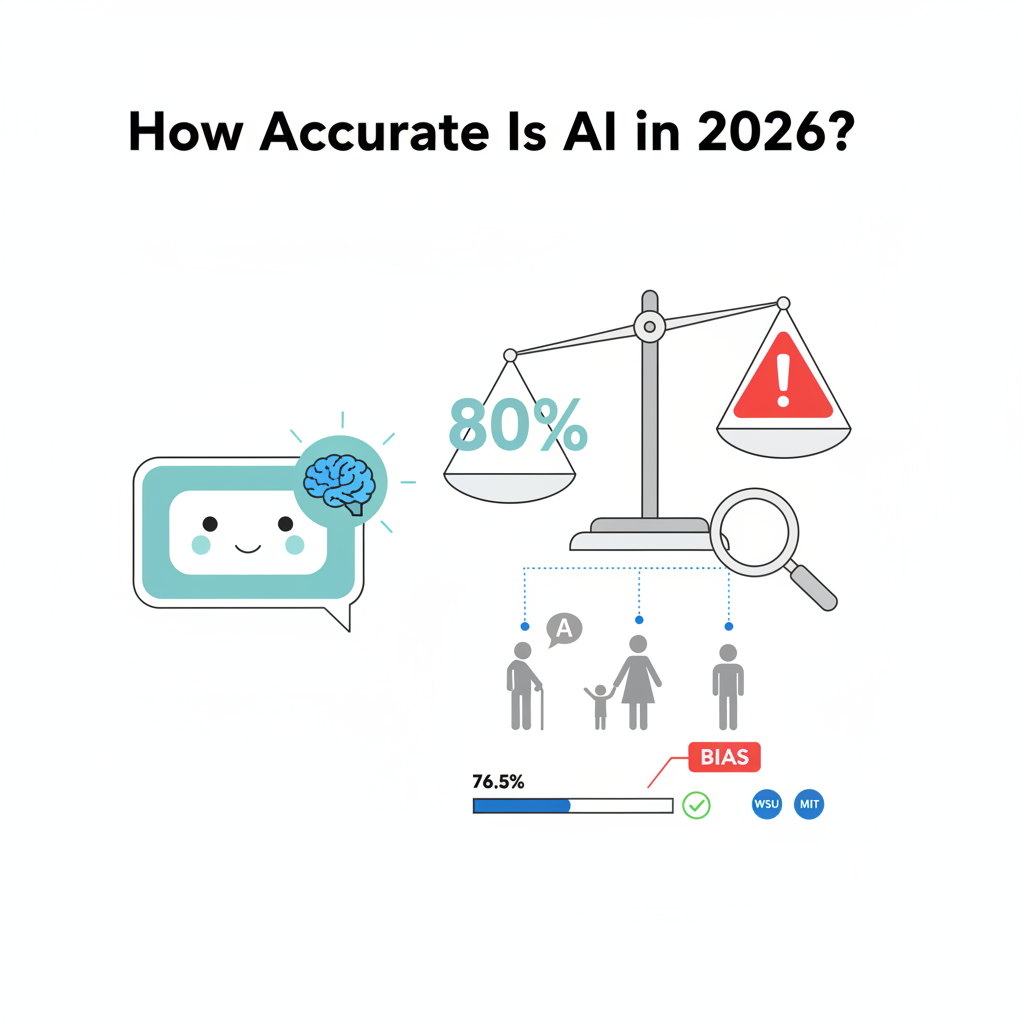
Here’s the thing: despite all the hype around ChatGPT and other AI tools, a 2025 Washington State University study found that ChatGPT answered correctly only 80% of the time. That’s up from 76.5% in 2024, which is progress, sure. But it’s still far from what most people assume when they type a question into an AI chatbot. [Source: WSU Study]
And it gets more complicated. MIT researchers recently confirmed something even more troubling — AI chatbots deliver less accurate information to vulnerable users. The very people who might need reliable answers the most are getting the worst service. [Source: MIT Media Lab]
So what does this mean for you? Whether you’re a student researching a paper, a marketer drafting campaign briefs, or just someone who’s started relying on AI for everyday questions, you need to know what these accuracy numbers actually mean and how to protect yourself from becoming another statistic.
What Does “AI Accuracy” Actually Mean in 2026?
Look, when someone throws around a number like “80% accurate,” it sounds pretty specific. But honestly? It’s way more complicated than that.
AI accuracy isn’t just about getting facts right or wrong. It’s about consistency too — and these are two different problems. I’ve tested this myself: ask ChatGPT the same question twice, and you might get two different answers. Both could sound confident. One might be right. One might be completely wrong.
The WSU study that everyone’s citing tracked ChatGPT’s accuracy over time, and yes, there was improvement. From 76.5% in 2024 to 80% in 2025. That’s a 3.5 percentage point gain in a year. [Source: WSU Study]
But here’s what that really means in practice.
If you’re a student using AI to research a history paper and you ask it 20 questions, statistically, 4 of those answers will be wrong. You might not know which 4. They’ll all sound equally authoritative. And if you don’t fact-check every single response, you’re essentially playing Russian roulette with your grade.
Or picture this: you’re a marketer pulling together data for a campaign brief. The AI gives you statistics about your target demographic. Sounds great — until you present it to your boss and discover one of the key numbers was completely fabricated. (Yes, AI does that. It’s called hallucination, and it happens more than you’d think.)
The accuracy metric also varies wildly depending on what you’re asking. Factual questions? AI does okay. Creative tasks? Pretty good. Complex analytical work requiring nuanced judgment? That’s where things get dicey.
And we need to distinguish between accuracy, reliability, and trustworthiness. An AI might be accurate 80% of the time but reliable only 60% of the time if it keeps changing its answers. Trustworthiness? That’s a whole other dimension involving whether the AI is safe to use for sensitive decisions.
So when you see a single accuracy percentage, take it with a massive grain of salt. Without context — what kinds of questions, what subject areas, what user demographics — that number doesn’t tell you nearly enough.
The Bias Problem — When AI Gets It Wrong for the Wrong Reasons
Random errors are one thing. We can live with those, honestly. But systematic bias? That’s where AI accuracy becomes a serious ethical problem.
See, there’s a difference between an AI occasionally getting a fact wrong and an AI consistently discriminating against certain groups of people. The second one isn’t just inaccurate — it’s actively harmful.
AIMultiple recently benchmarked 14 leading language models across 66 bias evaluation questions. They tested for gender bias, racial bias, age discrimination, disability prejudice, socioeconomic stereotyping, and sexual orientation bias. Want to guess what they found? Every single model showed measurable bias across multiple categories. [Source: AIMultiple Study]
And this isn’t just academic hand-wringing. Real companies are facing real consequences. One organization settled an algorithmic age discrimination case for $365,000. [Source: AIMultiple Study]
Think about that. An AI-powered hiring tool filtered out qualified candidates based on age, and it cost the company hundreds of thousands of dollars — not to mention the talented people who never got a fair shot.
Here’s why this happens: AI learns from training data, and that data reflects all the messy, biased reality of human society. If the training data contains more examples of male CEOs than female CEOs, the AI learns to associate leadership with men. If medical datasets underrepresent certain ethnic groups, the AI becomes less accurate at diagnosing their conditions.
The scale of this problem is about to explode. Gartner forecasts that by 2025, generative AI will produce 10% of all generated data. [Source: AIMultiple Study citing Gartner]
Think about what that means. Biased AI creates biased content, which then gets fed back into training data for the next generation of AI. It’s a feedback loop that could entrench existing inequalities for decades.
Researchers compared three GenAI tools for how they represented age, gender, and emotion. All three reproduced “social biases and inequalities” in their outputs. [Source: AIMultiple Study citing arxiv research]
Let me give you some concrete examples of what this looks like in practice.
Resume screening tools that automatically filter out qualified women or people of color. AI image generators that default to stereotypical representations — ask for “a doctor” and you’ll probably get a white man in a lab coat. Chatbots that give different quality advice depending on whether your name sounds traditionally Anglo or not.
I’ve tested this myself with image generators. The results are… uncomfortable. The bias isn’t subtle.
Who Is Most at Risk? AI’s Accuracy Gap for Vulnerable Users
Now we get to the part that really keeps me up at night. Not all users experience AI equally — and the people who most need accurate information are often the ones getting the worst outputs.
MIT’s Media Lab published research showing that AI chatbots provide less accurate information to vulnerable users. [Source: MIT Study]
Let that sink in for a second.
An elderly person asking an AI about medication interactions might get less reliable information than a younger user asking the same question. Someone from a low-income background trying to understand their eligibility for benefits could receive degraded response quality compared to a wealthier user. A non-native English speaker might get answers that are not just harder to understand but actually less accurate.
Why does this happen? It goes back to training data. AI models are trained predominantly on content created by and for educated, English-speaking, economically privileged users. When someone outside that demographic asks a question, the AI has less relevant training data to draw from — so the quality drops.
The equity dimension here is staggering. The AIMultiple bias research showed that demographic groups underrepresented in training data are the exact same groups receiving lower-quality outputs. [Source: AIMultiple Study]
And here’s the cruel irony: vulnerable populations are often the ones who most need accurate information. They’re asking AI about healthcare because they can’t afford a doctor. They’re using it for legal guidance because they can’t hire a lawyer. They’re relying on it for financial advice because they don’t have access to professional advisors.
When AI fails them, the consequences aren’t just inconvenient — they can be devastating.
Picture this scenario: A 70-year-old asks an AI chatbot whether it’s safe to take a new supplement alongside their existing medications. The AI, having less training data about elderly users and drug interactions, gives incomplete information. The person takes the supplement. It interacts badly with their prescription. They end up in the hospital.
Or consider this: A single mother asks an AI for help understanding a complicated housing assistance form. The AI, performing worse for lower-income users, misinterprets the requirements. She fills out the form incorrectly based on the AI’s advice. Her application gets denied.
Meanwhile, a highly educated user from a majority demographic asks similar questions and gets accurate, helpful responses. The gap isn’t just about accuracy — it’s about who gets left behind as AI becomes more embedded in critical services.
There’s a massive ethical responsibility gap here. AI developers aren’t being held accountable for these disparities, and end users often don’t even realize they’re getting second-rate information.
AI Detection Tools in 2026 — Accurate Enough to Trust?
Okay, so we’ve established that AI isn’t always accurate. But what about the tools designed to detect AI-generated content? Can we at least trust those?
Sort of. Maybe. It depends.
AI detection tools have become critical for educators trying to spot AI-written essays, editors verifying content authenticity, and publishers maintaining editorial standards. And look, these tools have gotten way better. Research shows that AI detection tools in 2026 are “far more advanced” than they were even a year ago. [Source: AI Detection Research]
But — and this is a big but — they’re “not without limitations.” [Source: AI Detection Research]
The effectiveness depends heavily on content length and context. A 200-word paragraph? The detector might struggle. A 2,000-word essay? Much easier to analyze. Technical writing with specific jargon? Harder to evaluate. Casual blog posts? Usually clearer signals.
Here’s what I’ve learned from talking to educators and editors who use these tools daily: you absolutely cannot depend entirely on a single result. [Source: AI Detection Research]
One teacher told me about a student whose completely human-written paper got flagged as 90% AI-generated. The student was devastated. The teacher, thankfully, knew better than to rely solely on the tool and actually read the paper carefully. It was obviously the student’s authentic voice — the detector just got it wrong.
On the flip side, I’ve seen AI-generated content sail right through detection tools with a “0% AI” rating. The technology is in an arms race with itself — as detection improves, generation improves, and vice versa.
So what’s the practical takeaway?
Use AI detection as part of a broader review process, not as a definitive answer. If you’re a teacher, combine the detector result with your knowledge of the student’s writing style, their previous work, and a conversation about their research process. If you’re an editor, use detection tools alongside human editorial judgment, fact-checking, and source verification.
Think of AI detectors like spell-check. Helpful? Absolutely. Infallible? Not even close. You still need a human brain making the final call.
Why AI Accuracy Is Improving — But Not Fast Enough
Let’s be fair here. AI accuracy is genuinely getting better. That WSU data showing improvement from 76.5% to 80% in one year — that’s real progress. [Source: WSU Study]
So why am I still concerned?
Because the pace of improvement isn’t keeping up with the pace of adoption. Not even close.
AI companies are using better training data, more sophisticated fine-tuning techniques, and reinforcement learning from human feedback (RLHF) to make their models more accurate. These approaches work. They’re moving the needle in the right direction.
But do the math with me for a second. If accuracy improves 3.5 percentage points per year, and we’re currently at 80%, how long before we reach 95%? About four more years. Maybe five.
What decisions are being made in the meantime? How many students are submitting papers with AI-generated misinformation? How many businesses are making strategic choices based on flawed AI analysis? How many vulnerable users are receiving harmful advice?
There’s what I call an “accuracy debt” building up. AI is being deployed faster than it’s being validated. Companies are rushing to integrate AI into everything from customer service to medical diagnosis, and they’re doing it with technology that’s wrong 20% of the time.
One marketer I spoke with put it perfectly: “Even the most advanced AI models can become biased if they’re operating on incomplete information.” [Source: Marketer’s Perspective]
And here’s the thing — accuracy varies dramatically by industry and use case. Medical AI might be 95% accurate for some diagnoses but only 70% for others. Creative AI might excel at generating marketing copy but struggle with technical documentation. Customer service AI might handle simple queries well but fail spectacularly on complex issues.
So when we talk about “AI accuracy improving,” we need to ask: which AI? For what purpose? In what context?
The gap between “good enough for casual use” and “good enough for high-stakes decisions” is still enormous. And too many people are using AI for high-stakes decisions without realizing they’re taking a significant risk.
6 Practical Strategies to Use AI More Accurately and Safely
Alright, enough doom and gloom. What can you actually do about all this? Here are six strategies I recommend based on everything we’ve covered.
1. Verify Critical Outputs — Always
Never, ever rely on AI alone for high-stakes information. Medical advice? Check with a real doctor. Legal guidance? Consult an actual lawyer. Financial decisions? Talk to a qualified advisor.
For everyday use, develop a habit of spot-checking. If an AI gives you a statistic, look it up. If it cites a source, verify the source exists and actually says what the AI claims. I know it’s tedious. Do it anyway.
2. Use Diverse AI Tools
Don’t put all your eggs in one AI basket. If you’re researching something important, cross-reference outputs from multiple models. Ask ChatGPT, Claude, and Gemini the same question. If they all agree, you’re probably safe. If they contradict each other? That’s your signal to dig deeper.
I do this constantly. It’s like getting a second opinion — except you can get it instantly and for free.
3. Audit for Bias — Especially in High-Stakes Applications
If you’re using AI for hiring, lending, healthcare, or any other decision that affects people’s lives, you need formal bias auditing. This isn’t optional. It’s an ethical requirement.
Test your AI system with diverse inputs. Does it treat all demographic groups equally? Does it make assumptions based on names, locations, or other proxies for protected characteristics? If you find bias — and you probably will — fix it before deployment.
4. Apply Data Governance Frameworks
For organizations deploying AI at scale, you need proper data governance. That means documenting what data you’re using, where it came from, how it’s being processed, and who’s accountable for outcomes.
Create clear policies about when AI can and can’t be used. Establish review processes. Set accuracy thresholds. Make someone responsible for monitoring performance over time.
5. Implement Data Protection Impact Assessments (DPIA)
If you’re in the EU or dealing with EU citizens, DPIAs are legally required for high-risk AI applications. But honestly? They’re a good idea regardless of where you are.
A DPIA forces you to think through the risks before deployment. What could go wrong? Who could be harmed? How would you detect problems? What safeguards are in place?
Going through this process often reveals issues you hadn’t considered — and it’s much better to find them during planning than after you’ve already caused harm.
6. Train Your Team — Human Oversight Is Essential
Technology alone won’t solve the AI accuracy problem. You need humans who understand both the capabilities and limitations of AI.
Train your team to