Building AI Agents: A Comprehensive Guide to Creating Autonomous AI Systems
Building AI Agents: A Comprehensive Guide to Creating Autonomous AI Systems
Estimated reading time: 12 minutes
Key Takeaways
- AI agents integrate reasoning, decision-making, and action to operate beyond simple chat
- The three pillars of AI agents are Model, Tools, and Instructions
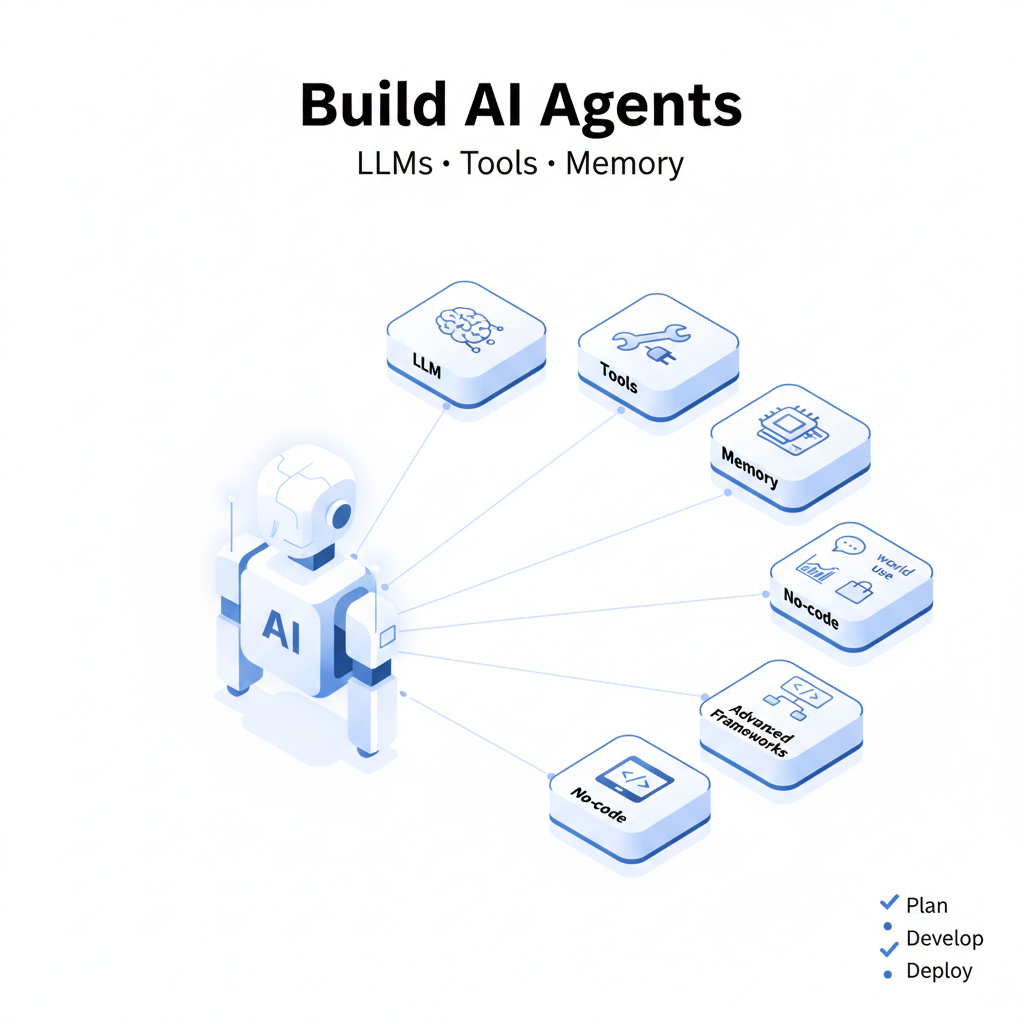
- Five essential components: Brain (LLM), Prompt, Memory, Knowledge, and Tools
- No-code to advanced development approaches unlock broad access to building agents
Table of contents
- Understanding AI Agents: More Than Just Chatbots
- The Three Pillars of AI Agent Architecture
- The Five Essential Components of Modern AI Agents
- Building Approaches: From No-Code to Advanced Development
- Real-World Applications: Where AI Agents Shine
- Planning for Success: Essential Considerations
- Getting Started: Essential Prerequisites
- The Future of AI Agents
- Conclusion
- Frequently Asked Questions
Introduction paragraph with emphasis and bold text. The world of artificial intelligence is evolving rapidly, and at its forefront is the development of AI agents – autonomous systems that can think, decide, and act independently. Building AI agents has become a crucial skill in today’s tech landscape, as these intelligent systems revolutionize how we automate tasks and solve complex problems. Let’s dive deep into what AI agents are, how to build them, and why they’re transforming the future of automation.
Understanding AI Agents: More Than Just Chatbots
AI agents are sophisticated systems powered by large language models (LLMs) that go beyond simple chat interactions. Unlike traditional chatbots that merely respond to queries, AI agents can independently reason, make decisions, and take actions using external tools and APIs to accomplish specific tasks. This autonomous capability makes them powerful allies in various business and technical applications. Learn more.
The Three Pillars of AI Agent Architecture
Every successful AI agent stands on three fundamental components:
- The Model: At the heart of every AI agent lies its brain – the Large Language Model (LLM). This sophisticated neural network powers the agent’s reasoning and decision-making capabilities. Source.
- Tools: These are the external functions and APIs that allow the agent to interact with the world and take meaningful actions.
- Instructions: Clear guidelines and guardrails that define the agent’s behavior and operational boundaries.
The Five Essential Components of Modern AI Agents
To build a truly effective AI agent, you need to understand and implement five crucial elements:
- The Brain (LLM): The cognitive center that processes information and makes decisions Source
- The Prompt: The initial instructions and context that guide the agent’s behavior Source
- Memory: The system that allows the agent to retain and recall information Source
- Knowledge: The database of information the agent can access and use Source
- Tools: The practical implements the agent uses to execute tasks
Building Approaches: From No-Code to Advanced Development
The exciting news is that building AI agents is becoming increasingly accessible, with multiple approaches available:
- No-Code Solutions with Google Cloud Vertex AI
- Framework-Based Development with Microsoft
- The OpenAI Approach: Starting Strong
Real-World Applications: Where AI Agents Shine
AI agents are already making waves in various sectors:
- Business Process Automation
- Customer Support and Service
- Creative Content Generation
- Workflow Management
- Media Production
Planning for Success: Essential Considerations
Before building your AI agent, consider these crucial factors:
- Problem Definition
- What specific challenge will your agent address?
- What are the expected outcomes? Source
- Functional Requirements
- Will the agent operate independently or require human oversight?
- What tools will it need access to? Source
- Operational Boundaries
- What are the agent’s limitations?
- What safety measures need to be in place?
- Personality and Interface
- How should the agent communicate?
- What tone and style best suit its purpose?
- Performance Metrics
- How will you measure success?
- What KPIs matter most?
Getting Started: Essential Prerequisites
Before diving into AI agent development, ensure you have:
- A solid understanding of generative AI fundamentals
- Knowledge of basic AI agent principles
- A properly configured development environment
- Access to necessary cloud infrastructure or local development tools
The Future of AI Agents
As AI technology continues to evolve, we’re seeing increasingly sophisticated agent architectures emerge. Multi-agent systems, where specialized agents work together under a main coordinator, represent the next frontier in AI agent development. These systems can handle complex tasks by breaking them down into manageable components, each handled by a specialized agent. Source
Conclusion
Building AI agents represents one of the most exciting frontiers in artificial intelligence. Whether you’re using no-code platforms or diving deep into framework-based development, the key to success lies in understanding the fundamental components and carefully planning your implementation. As the technology continues to evolve, the possibilities for AI agents are virtually limitless, making this an exciting time to begin building your own autonomous AI systems. ROI guide.
Frequently Asked Questions
What are the three pillars of AI Agent Architecture?
The three pillars are the Model, Tools, and Instructions that guide the agent’s reasoning, actions, and boundaries.
What are the five essential components of modern AI agents?
They are The Brain (LLM), The Prompt, Memory, Knowledge, and Tools.
What are common building approaches?
No-code and framework-based development options include Google Vertex AI, Microsoft, and OpenAI approaches.
}