Prompt Engineering: The Art and Science Behind Effective AI Communication
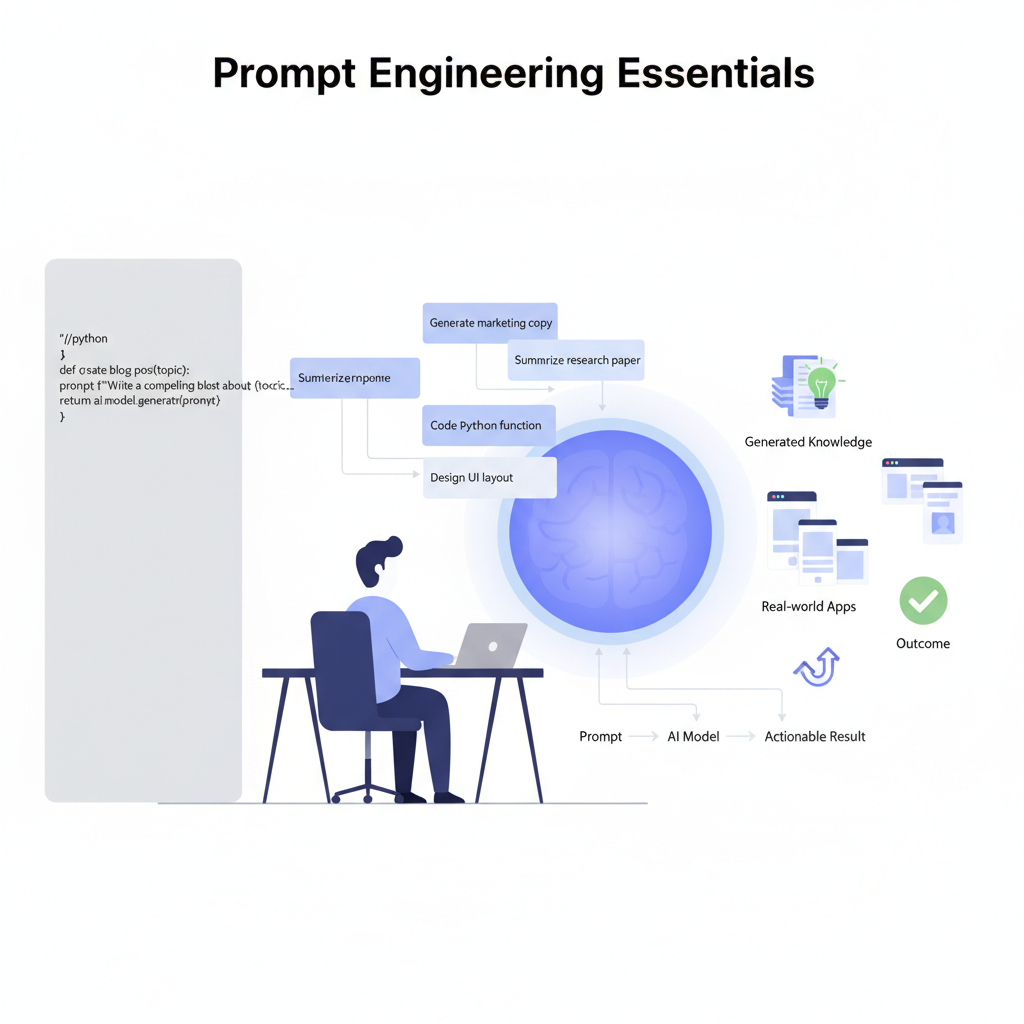
Prompt Engineering: The Art and Science Behind Effective AI Communication
Estimated reading time: 6 minutes
Key Takeaways
- Prompt engineering bridges human intent and AI capabilities by crafting and refining input prompts to guide AI models toward producing high-quality, desired outputs.
- Well-engineered prompts improve user experience by delivering coherent and accurate responses on the first attempt, reducing the trial-and-error process.
- Prompts should balance specificity and context to generate accurate, relevant results.
- Generated Knowledge Prompting is a powerful technique that helps ensure the model has a solid foundation of relevant knowledge before generating its response.
- Prompts can be designed to be domain-neutral, enabling rapid reuse across different enterprise applications.
Table of contents
In the rapidly evolving landscape of artificial intelligence, a new discipline has emerged that’s reshaping how we interact with AI systems: prompt engineering. This cutting-edge field is revolutionizing the way we communicate with AI models, particularly large language models (LLMs) like GPT-4, by focusing on the precise design, structure, and refinement of input prompts to achieve optimal results.
Understanding Prompt Engineering: The Foundation
At its core, prompt engineering represents the bridge between human intent and AI capabilities. According to Stanford University, it’s the process of crafting and refining input prompts to guide AI models toward producing high-quality, desired outputs.
The foundation of prompt engineering lies in creating natural language instructions that effectively communicate tasks to AI systems. These prompts can take various forms, from simple queries to complex commands incorporating detailed context and historical conversation data. The ultimate goal, as highlighted by Oracle, is to provide AI models with the perfect balance of specificity and context to generate accurate, relevant, and useful responses.
The Power of Well-Engineered Prompts
The impact of effective prompt engineering extends far beyond simple query-and-response interactions. According to AWS, well-engineered prompts significantly enhance user experience by enabling AI systems to deliver coherent and accurate responses on the first attempt. This eliminates the frustrating trial-and-error process often associated with AI interactions and helps mitigate potential biases present in the training data.
One of the most powerful aspects of prompt engineering is its flexibility and scalability. Organizations can create domain-neutral instructions that highlight logical patterns, allowing for rapid prompt reuse across different enterprise applications. For instance, a prompt designed to identify inefficiencies in one business process can be easily adapted for use across various departments and scenarios.
Advanced Techniques in Prompt Engineering
The field has evolved to include sophisticated techniques that push the boundaries of AI interaction. One particularly powerful approach is Generated Knowledge Prompting. This technique, as described by AWS, involves a two-step process where the AI model first generates relevant facts needed for a task before proceeding with the primary prompt. This method often results in higher-quality outputs by ensuring the model has a solid foundation of relevant knowledge before generating its response.
Professional Applications and Implementation
In the professional sphere, prompt engineering has become an indispensable tool for AI engineers developing complex services. According to Coursera, its applications range from powering sophisticated chatbots for customer service to generating legal contracts and beyond. Moreover, proper prompt engineering helps protect against prompt injection attacks, ensuring the security and reliability of AI systems.
Organizations typically implement prompt engineering at two distinct levels, as noted by Oracle. First, it serves as a specialized skill set where professionals continuously refine input prompts to optimize results. Second, it functions as an integrated component of AI workflows through automated, scalable base prompts embedded within applications. embedded within applications.
The Distinction from Traditional Programming
One crucial aspect that sets prompt engineering apart from conventional programming is its approach to problem-solving. While traditional programming relies on strict code formats and precise rules, prompt engineering embraces a more flexible, natural language-based methodology. This distinction, as highlighted by Oracle, allows for faster iteration and experimentation, though it may not always achieve the exact repeatability of traditional coding methods.
Looking to the Future
The rising importance of prompt engineering has led to the emergence of specialized roles within major technology companies and enterprises. Organizations now actively seek prompt engineers, recognizing that effective prompt design directly impacts the success of their AI investments and overall system performance.
As artificial intelligence continues to evolve and integrate more deeply into our daily lives, the role of prompt engineering will only grow in significance. It represents not just a technical skill but a fundamental shift in how we approach human-AI interaction, making it possible to harness the full potential of AI technologies in more intuitive and effective ways.
The field of prompt engineering stands as a testament to the evolving nature of technology work, where success lies not just in understanding computer systems, but in mastering the nuanced art of communication between humans and artificial intelligence. As we move forward, this discipline will undoubtedly continue to shape the future of AI interactions, making technology more accessible, efficient, and valuable for users across all sectors. Principles for Building AI Agents (PDF)
Frequently Asked Questions
What is prompt engineering?
Prompt engineering is the process of crafting and refining input prompts to guide AI models toward producing high-quality, desired outputs. Source
Why is prompt engineering important?
It improves user experience by delivering coherent and accurate responses on the first attempt, reducing the trial-and-error process. This is supported by industry references such as AWS and Oracle’s work on AI workflows.
}