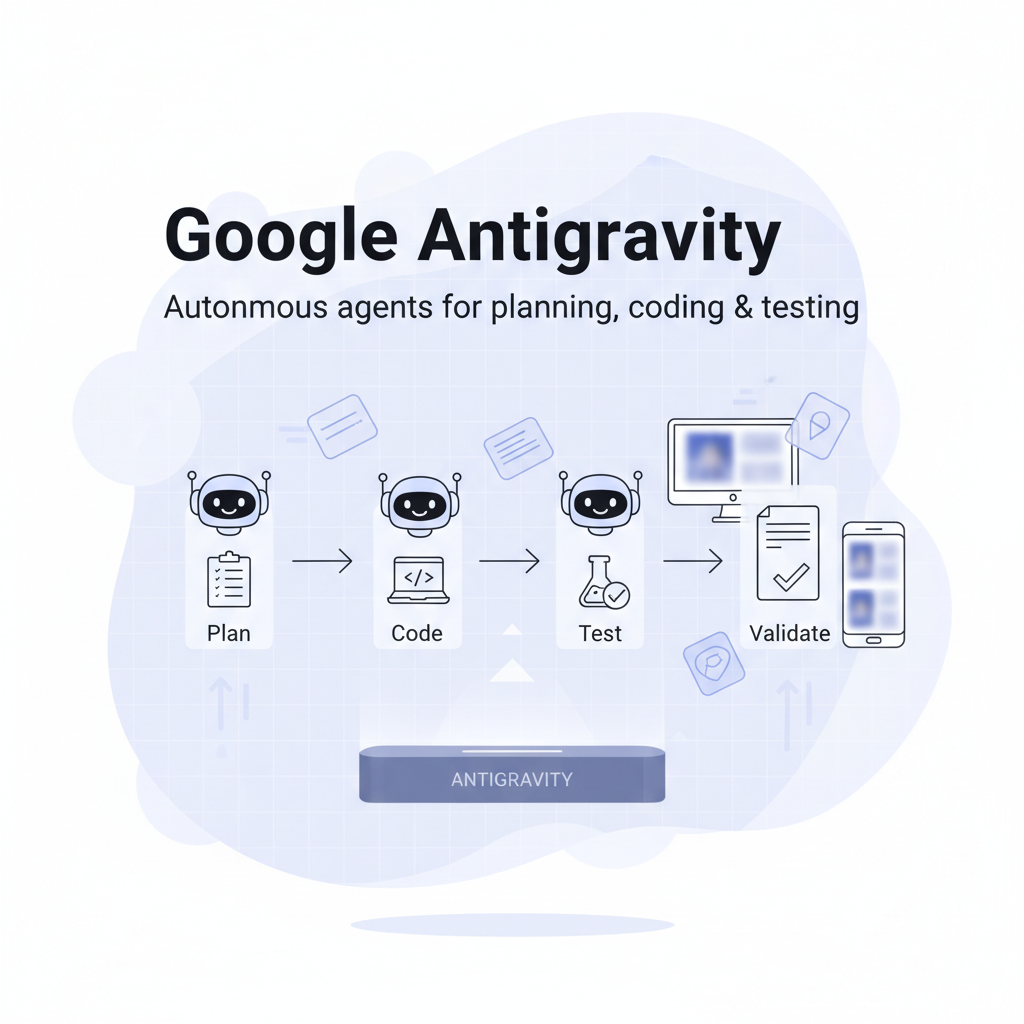
Google Antigravity: The Revolutionary AI Development Platform That’s Changing How We Code
Estimated reading time: 6 minutes
Key Takeaways
- AI-driven development with autonomous agents planning, coding, testing, and validating tasks with minimal human input.
- Agent-first architecture prioritizes capable AI entities over traditional chatbots or code completion.
- Transparency and trust via artifacts like plans, screenshots, code diffs, and test logs.
Table of contents
- A New Era of AI-Driven Development
- The Platform’s Core Components
- Building Trust Through Transparency
- Flexible Control and Oversight
- Powered by Advanced AI Models
- Real-World Applications
- Getting Started with Antigravity
- Early Reception and Limitations
- The Future of Software Development
- For developers and organizations
In a groundbreaking development that’s sending ripples through the software development community, Google has unveiled Antigravity – an innovative AI development platform that’s fundamentally transforming how software is created. This cutting-edge platform harnesses autonomous agents to plan, code, test, and validate software tasks with minimal human intervention, marking a significant leap forward in the evolution of AI-assisted development.
A New Era of AI-Driven Development
Google Antigravity isn’t just another coding assistant – it’s a complete paradigm shift in software development. At its core, the platform introduces an agent-first architecture that prioritizes AI entities capable of autonomous action over conventional chatbot or code-completion models. These agents can work independently or in parallel, tackling multiple development tasks simultaneously and dramatically increasing productivity.
The Platform’s Core Components
- Agent Manager
The heart of the platform is its Agent Manager, serving as a central hub where developers can dispatch, monitor, and review the work of multiple AI agents. This comprehensive control center ensures that developers maintain oversight while allowing agents to work autonomously. https://anilbohra.me/effective-context-engineering-ai-agents - Code Editor
The platform includes a standard code interface where agents can directly contribute, comment, and modify code. This familiar environment helps developers seamlessly integrate Antigravity into their existing workflow. https://anilbohra.me/best-ai-agents-2025-guide - Automated Chrome Browser
Perhaps one of the most innovative features is the automated Chrome browser interface. Agents can interact with the browser just like human users – clicking, scrolling, inputting data, and capturing outputs. This capability enables autonomous application validation and UI testing, previously manual tasks that required significant developer time. https://anilbohra.me/chatgpt-atlas-revolutionary-browser
Building Trust Through Transparency
One of Antigravity’s most impressive features is its sophisticated artifact system. When agents complete tasks, they generate comprehensive “artifacts” – including plans, screenshots, code diffs, and test logs – as proof of their work. This system effectively bridges the trust gap between human developers and AI agents, allowing for efficient verification of outcomes. https://anilbohra.me/principles-building-ai-agents-pdf
Flexible Control and Oversight
Understanding that different organizations have varying needs for human oversight, Antigravity offers customizable approval controls. Users can set their preferred level of human oversight, ranging from full automation to step-by-step approval. By default, agents make intelligent decisions about which actions require developer attention, but these settings can be tailored to specific requirements.
Powered by Advanced AI Models
The platform leverages Google’s latest Gemini suite of AI models:
– Gemini 3 handles advanced reasoning, planning, and coding
– Gemini 2.5 focuses on browser control
– The Nano Banana model enables sophisticated image editing and generation
These models work in concert to deliver a comprehensive development experience that can handle complex software tasks from start to finish.
Real-World Applications
Antigravity’s capabilities extend across various use cases:
Complete Workflow Automation
The platform can handle end-to-end software tasks, from initial planning to final validation. For example, it can independently plan, implement, and test a complete flight tracker application while maintaining full visibility through logs and artifacts. https://anilbohra.me/https-anilbohra-me-workflow-automation-small-business/
Parallel Task Processing
Multiple agents can work simultaneously in the same workspace, allowing for increased throughput on various tasks such as bug fixes, code reviews, and UI improvements.
Comprehensive Testing and Validation
Through its browser control capabilities, agents can simulate user actions, complete forms, navigate applications, and verify behavior through screenshots and logs.
Getting Started with Antigravity
The platform is available for Mac, Windows, and Linux users. Setup involves:
1. Downloading the platform
2. Installing necessary browser extensions
3. Launching the Agent Manager
4. Creating and dispatching agent workflows https://anilbohra.me/open-ai-agent-kit
Early Reception and Limitations
While Antigravity represents a significant advancement in AI-powered development, early user feedback has highlighted some areas for improvement. Users have reported occasional challenges with edge-case behaviors and agent transparency. Google is actively working to refine these aspects based on user feedback.
The Future of Software Development
Google Antigravity represents more than just a new development tool – it’s a glimpse into the future of software development. By functioning as a semi-autonomous “junior developer” capable of handling multiple tasks while maintaining transparency and user control, it’s setting new standards for AI-assisted development. https://anilbohra.me/future-of-work-ai-agents
The platform’s ability to balance autonomous operation with human oversight, coupled with its comprehensive artifact system for validation, addresses many of the traditional concerns about AI in software development. As Google continues to refine and enhance the platform based on user feedback, Antigravity appears poised to revolutionize how we approach software development in the years to come.
For developers and organizations looking to enhance their development capabilities, Antigravity offers a powerful new tool that combines the efficiency of AI automation with the necessary controls and transparency for professional software development. As the platform continues to evolve, it may well become an indispensable part of the modern developer’s toolkit.
Frequently Asked Questions
What is Google Antigravity?
Google Antigravity is an AI development platform with an agent-first architecture that enables autonomous planning, coding, testing, and validation of software tasks with minimal human intervention.
What are the platform’s core components?
The platform’s core components include the Agent Manager, the Code Editor, and the Automated Chrome Browser, which together support autonomous development workflows.
How does Antigravity build trust?
It uses an artifact system that generates plans, screenshots, code diffs, and test logs as proof of work, bridging trust between humans and AI agents.
What models power Antigravity?
It leverages Google’s Gemini suite: Gemini 3 for advanced reasoning, Gemini 2.5 for browser control, and the Nano Banana model for image editing and generation.