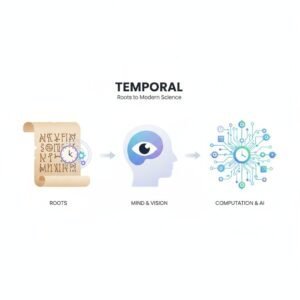
Understanding Temporal: From Ancient Origins to Modern Science
Estimated reading time: 12 minutes
Key Takeaways
- Temporal encompasses more than time—it spans biology, language, philosophy, and digital intelligence.
- Key examples include: Time-Related Context, worldly implications, and mortality concepts, all of which shape how we think about time and existence.
- The Temporal Lobe integrates memory, language, and emotion; understanding it helps explain human cognition and how AI contexts are modeled (linked here).
- Temporal vision connects perception to timing, motion detection, and latency; its study informs AI vision systems and agent toolkits.
- Linguistic markers show how tense and aspect encode time across languages, with AI language models leveraging these patterns (linked here).
Table of contents
- The Origins and Basic Understanding
- The Many Faces of Temporal
- The Temporal Lobe: A Marvel of Human Anatomy
- Temporal Vision: The Science of Time-Based Visual Processing
- Linguistic Applications
- Related Concepts and Terms
- Modern Implications and Future Applications
- Conclusion
- Frequently Asked Questions
Understanding temporal opens a lens onto how time shapes our world—from ancient philosophy to the neurons in our brains, and to the AI systems we build today.
The Origins and Basic Understanding
Derived from the Latin word temporalis, temporal fundamentally means “of time.” This ancient root has evolved into several nuanced meanings that we use today. According to Webster’s Dictionary, the word serves as a bridge between our understanding of time, worldly matters, and even specific anatomical structures.
The Many Faces of Temporal
- Time-Related Context — The most straightforward use of temporal relates to time itself. When we speak of temporal sequences or temporal relationships, we’re discussing matters that exist within the framework of time. This usage is crucial in scientific contexts. This concept of time-based processing is somewhat related to studies seen in areas like temporal vision, where timing and perception are essential (https://anilbohra.me/principles-building-ai-agents-pdf).
- Worldly or Secular Meaning — One of the most interesting applications of temporal relates to worldly matters. In religious contexts, temporal concerns are often contrasted with spiritual or eternal matters. For instance, when we speak of “temporal power,” we’re referring to civil authority as opposed to religious authority.
- The Concept of Mortality — Temporal also carries connotations of mortality and impermanence. As noted in religious texts, particularly in 2 Corinthians 4:18, “the things which are seen are temporal, but the things which are not seen are eternal.” This usage emphasizes the transient nature of physical existence compared to spiritual matters.
The Temporal Lobe: A Marvel of Human Anatomy
In neuroscience, the temporal lobe has emerged as one of the most fascinating areas of study. Located beneath the lateral fissure on both cerebral hemispheres, this remarkable structure plays crucial roles in:
- – Sensory processing, especially auditory information
- – Language comprehension
- – Memory storage
- – Emotional processing
- – Object recognition
According to the Cleveland Clinic, damage to the temporal lobe can result in significant impairments to memory, language processing, and emotional regulation. This underscores its vital importance in daily functioning. More about memory and language processing in AI systems can be linked to concepts discussed in AI agents architectures (https://anilbohra.me/principles-building-ai-agents-pdf). Also, this neuroanatomy parallels how AI agents process contextual information in modern applications (https://anilbohra.me/effective-context-engineering-ai-agents).
Temporal Vision: The Science of Time-Based Visual Processing
In vision science, temporal takes on yet another crucial meaning. Researchers study temporal vision to understand how our eyes and brain process visual information over time. This includes:
- – Detection of motion
- – Processing of flickering lights
- – Response latency
- – Critical flicker frequency
According to recent research published in PMC, understanding temporal vision is fundamental to modeling natural vision and developing better visual technologies. This ties into developments in AI vision systems and how time-based processing impacts algorithm design, such as those discussed in AI agent toolkits (https://anilbohra.me/open-ai-agent-kit).
Linguistic Applications
In linguistics, temporal plays a vital role in grammar and language structure. Many languages use temporal markers to indicate tense and aspect. For example, the Greek language employs a “temporal augment” to mark past tense, demonstrating how deeply embedded temporal concepts are in human communication. Language and grammar automation tools further use temporal markers to improve natural language understanding and generation—concepts foundational to the best AI agents of today (https://anilbohra.me/best-ai-agents-2025-guide).
Related Concepts and Terms
Several related terms have evolved from the root word temporal:
- – Temporally: An adverb meaning “with respect to time”
- – Temporalness: The quality of being concerned with worldly matters
- – Temporize: To adapt actions to current circumstances
- – Temporals: In ecclesiastical contexts, referring to secular possessions
Modern Implications and Future Applications
The concept of temporal continues to evolve with modern science and technology. In fields ranging from artificial intelligence to quantum physics, understanding temporal relationships and processes remains crucial. Scientists and researchers constantly develop new ways to measure, analyze, and utilize temporal aspects in their work. For example, cutting-edge developments in AI agents—such as those involved in temporal context engineering—rely heavily on sophisticated understanding of time and sequence (https://anilbohra.me/effective-context-engineering-ai-agents).
The future likely holds a collaborative model where AI handles routine implementation while humans focus on strategy, creativity, and complex problem-solving.
Conclusion
The word temporal serves as a fascinating lens through which we can view various aspects of human knowledge and experience. From its ancient Latin roots to its modern applications in neuroscience and technology, temporal remains a crucial concept in understanding time, mortality, and the physical world around us.
Whether we’re discussing the temporal lobe’s role in memory formation, analyzing temporal aspects of vision, or contemplating the philosophical implications of temporal versus eternal existence, this word remains as relevant today as it was centuries ago. As science advances and our understanding deepens, the significance of temporal relationships and processes will likely continue to grow, making it an enduring concept in human knowledge and discovery.
Frequently Asked Questions
Is temporal going to replace human developers?
While temporal concepts influence AI coding assistants, they cannot replace human developers who bring creative problem-solving, business understanding, and strategic thinking. Temporal-era AI tools are best viewed as augmenting human capability, not substituting it.
How much does temporal-oriented AI cost?
Pricing varies by usage and enterprise needs. For current pricing and packages, consult the provider’s official information channels (pricing pages or enterprise offerings).
What programming languages does temporal AI support?
Support spans major languages, with ongoing expansion based on demand and ecosystem maturity.
Can temporal AI work with existing codebases?
Yes, it can analyze and augment existing codebases, with performance depending on code quality and documentation.
Is temporal AI suitable for enterprise-level development?
There is promise for routine tasks and maintenance at scale, but enterprises should evaluate needs and conduct thorough testing before full deployment.
How does temporal AI compare to other AI coding assistants?
Unlike tools that offer partial assistance, temporal-focused AI aims for autonomous workflow handling. Other tools typically augment developers rather than autonomously delivering end-to-end software solutions.