The Timeline of Sora’s Short-Lived Journey
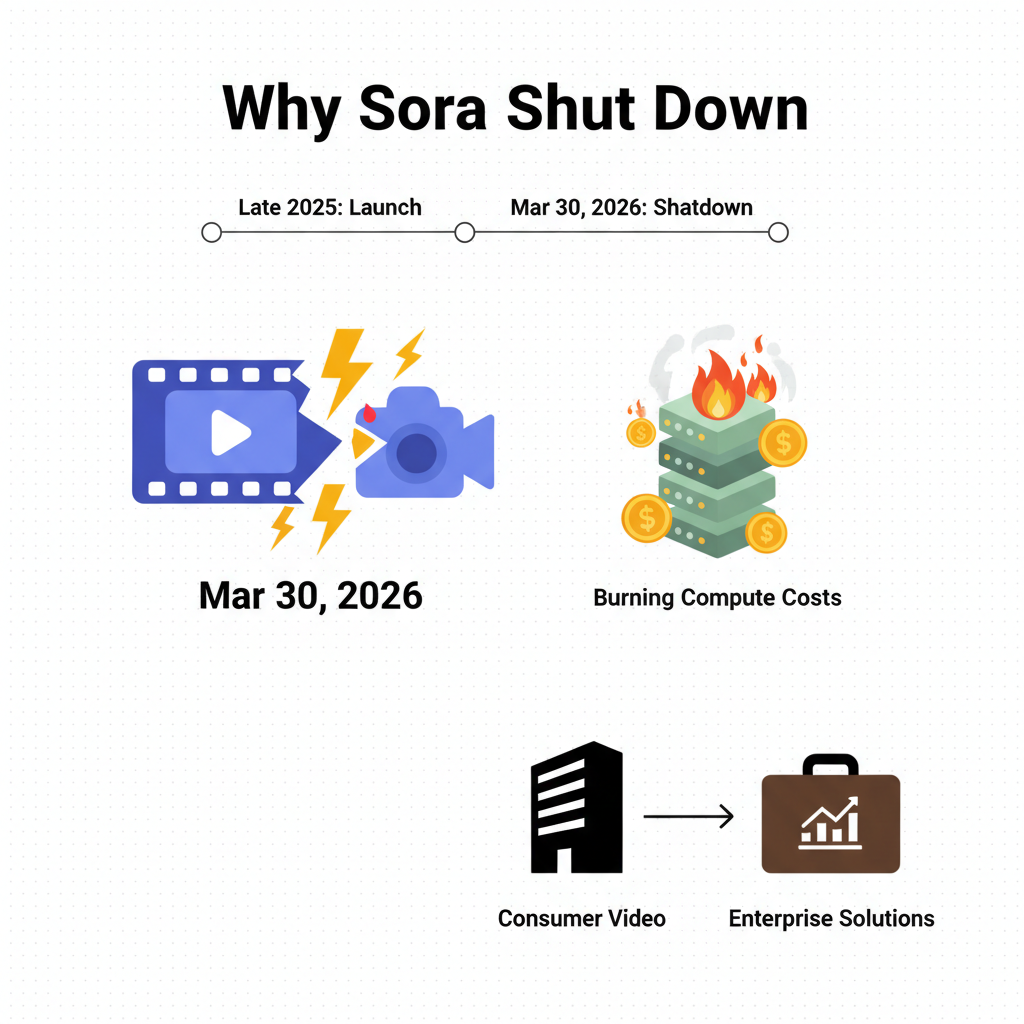
I’ll be honest — when I first heard about OpenAI shutting down Sora, I had to double-check the date. March 30, 2026. Just six months after launch. Six months.
Here’s the thing: this wasn’t some quiet sunset announcement buried in a press release. This was OpenAI pulling the plug on what many considered the future of AI video generation, leaving partners like Disney scrambling and the entire tech industry asking the same question: what the hell happened?
Look, I’ve been following AI developments for years, and this one caught everyone off guard. But after digging into the details, the story behind Sora’s shutdown is actually more revealing than the tool itself ever was.
The Timeline of Sora’s Short-Lived Journey
Let’s rewind to the beginning. OpenAI launched Sora with the kind of fanfare you’d expect from a company that brought us ChatGPT. The promise? AI-generated video that could rival professional production quality. And honestly, the early demos were mind-blowing.
The initial rollout happened in late 2025, and for a few months, everything looked golden. Tech reviewers were calling it revolutionary. Content creators were experimenting with possibilities they’d never imagined. Enterprise partners — including Disney — were signing deals left and right.
But somewhere between the launch hype and March 2026, the cracks started showing. The operational demands were massive. The costs? Even more massive. And the market reception, while enthusiastic, wasn’t translating into the kind of sustainable business model OpenAI needed.
Then came March 30, 2026. The announcement hit like a thunderbolt. No gradual phase-out. No “we’re pivoting” language. Just a straightforward shutdown notice that left everyone — especially Disney — blindsided.
Financial Realities Behind the Decision
You know what nobody talks about enough? The unglamorous financial reality of running cutting-edge AI tools.
According to insights from industry analysts (including Binance’s deep dive into the situation), Sora was burning through computational resources at an alarming rate. We’re not talking about hosting a website here — we’re talking about rendering high-quality video using AI models that require enormous processing power for every single frame.
Think about it this way: generating a 60-second video clip could cost OpenAI more in compute resources than running thousands of ChatGPT conversations. The math just didn’t work. Even with premium pricing tiers, the revenue couldn’t keep pace with the operational costs.
And here’s where it gets interesting. The AI video dream that everyone was chasing — including OpenAI — ran headfirst into market realities. Consumer willingness to pay for AI video generation? Lower than expected. Enterprise adoption? Slower than projected. The gap between hype and actual market demand was wider than anyone wanted to admit.
I’ve noticed this pattern before with bleeding-edge tech. The early adopters love it. The demos are spectacular. But when it comes to building a sustainable business? That’s where things get complicated.
The financial pressure wasn’t just about current losses — it was about projected burn rate. OpenAI had to make a choice: continue pouring resources into Sora while bleeding money, or cut losses and redirect those resources to more profitable ventures. They chose the latter.
Impact on Strategic Partnerships
Now, let’s talk about Disney. Because this is where the shutdown gets really messy.
Disney and OpenAI had inked a collaboration deal that was supposed to revolutionize content creation. Imagine AI-assisted storyboarding, rapid prototyping of animated sequences, maybe even full AI-generated supplementary content for Disney’s streaming platforms. The potential was enormous.
But when OpenAI pulled the plug on Sora, Disney was left holding the bag. Sources close to the situation (though officially, everyone’s being diplomatic) suggest that Disney executives were caught completely off-guard. They’d invested time, resources, and strategic planning into integrating Sora into their workflow.
And it wasn’t just Disney. Other enterprise partners who’d built their roadmaps around Sora’s capabilities suddenly had to scramble. Some had already begun pilot programs. Others had committed budget allocations for the next fiscal year.
Here’s what I’ve found interesting about this situation — it highlights a fundamental tension in AI partnerships. When you’re building on someone else’s platform, you’re vulnerable to their strategic pivots. It doesn’t matter how promising the technology is if the company decides it’s not financially viable.
The ripple effects extended beyond immediate partnerships too. Smaller studios and content creators who’d begun experimenting with Sora for commercial projects found themselves back at square one. The trust factor took a hit — not just for OpenAI, but for AI video generation tools in general.
Shift Towards Enterprise AI Solutions
So if OpenAI wasn’t making money with Sora, what are they doing instead?
The answer reveals a lot about where the AI industry is actually heading (versus where we thought it was heading). OpenAI is pivoting hard toward enterprise AI solutions — but not the flashy, consumer-facing kind. We’re talking about backend infrastructure, business process automation, and specialized AI tools for specific industries.
Think less “make cool videos for Instagram” and more “optimize supply chain logistics using predictive AI models.” Not as sexy, but infinitely more profitable.
This strategic realignment makes sense when you look at the numbers. Enterprise contracts provide predictable revenue streams. They’re less sensitive to compute costs because businesses are willing to pay premium prices for tools that directly impact their bottom line. And the customer acquisition costs are lower — you’re selling to procurement departments, not trying to convert individual consumers one by one.
In my experience watching tech companies evolve, this kind of pivot is often inevitable. The consumer market gets you headlines and buzz, but the enterprise market gets you profitability and sustainability. OpenAI is basically following the playbook that companies like Slack and Zoom used — start with a vision that captures imagination, then focus on the business model that actually works.
The business model transformation here is significant. Instead of a usage-based pricing model with unpredictable costs, OpenAI can negotiate enterprise licenses with fixed terms and guaranteed margins. Instead of supporting millions of small users with varying needs, they can focus on dozens or hundreds of large clients with specific, well-defined requirements.
Industry Implications and Future Outlook
Okay, so what does Sora’s shutdown mean for the broader AI video generation market?
First off, it’s not a death knell for the technology itself. But it is a reality check. The market responded to the news with a mix of concern and recalibration. Competitors like Runway, Pika, and others saw this as both an opportunity and a warning.
The opportunity? OpenAI just vacated a significant chunk of market space. The warning? If OpenAI — with all their resources and expertise — couldn’t make the economics work, what makes anyone else think they can?
What I’m seeing now is a shift in how companies approach AI video generation. Instead of trying to build general-purpose tools that do everything, there’s more focus on specialized applications with clearer ROI. Medical imaging visualization. Architectural rendering. Specific industrial applications where the value proposition is obvious and quantifiable.
The technology sector as a whole is taking notes too. This isn’t just about video generation — it’s about the sustainability of compute-intensive AI applications in general. How do you balance innovation with profitability? How do you manage customer expectations when the underlying technology is still evolving rapidly?
Looking ahead, I think we’ll see AI video generation continue to develop, but along different paths. Consumer tools will probably remain limited in scope — think filters and short-form content rather than full production capabilities. Enterprise tools will focus on specific use cases where the economics make sense.
And honestly? That’s probably healthier for the industry in the long run. The Sora shutdown is teaching everyone — from startups to established players — that you can’t just ride the hype wave forever. Eventually, you need a business model that works.
What This Really Means for the Future
Here’s my take after watching this whole saga unfold: Sora’s shutdown is less about failure and more about maturation.
The AI industry is growing up. We’re moving past the phase where “cool technology” is enough to sustain a product. We’re entering an era where financial viability, sustainable operations, and clear value propositions matter more than flashy demos.
Does this mean AI video generation is dead? Absolutely not. But it does mean the path forward is going to be more nuanced, more strategic, and probably less democratized than many of us hoped.
The companies that succeed in this space will be the ones that figure out the economics first and the features second. They’ll target specific markets where customers are willing to pay premium prices. They’ll build sustainable business models before they scale.
And you know what? That’s okay. Not every technology needs to be immediately accessible to everyone. Sometimes the most transformative innovations take time to become economically viable at scale.
Frequently Asked Questions
Why did OpenAI shut down Sora so quickly?
The shutdown came down to economics, plain and simple. Sora’s operational costs — particularly the computational resources required for AI video generation — were unsustainable relative to revenue. Even with premium pricing, OpenAI couldn’t bridge the gap between what it cost to run the service and what customers were willing to pay. Combined with slower-than-expected enterprise adoption, the financial reality forced OpenAI to make a hard decision: continue bleeding resources or pivot to more profitable AI solutions.
What happens to existing OpenAI-Disney partnerships?
The Disney partnership has been significantly disrupted, though both companies are being diplomatic publicly. Disney had invested in integrating Sora into their content creation workflow, and the sudden shutdown left them scrambling for alternatives. While the broader OpenAI-Disney relationship may continue in other areas (OpenAI has multiple enterprise offerings), the specific Sora-related initiatives are effectively dead. Disney is likely exploring other AI video generation tools or developing in-house solutions.
Will OpenAI return to consumer AI video generation?
It’s complicated. OpenAI’s current strategic focus is firmly on enterprise AI solutions that offer better profit margins and more predictable revenue streams. That said, never say never in tech. If the economics of AI video generation improve significantly — through more efficient models, cheaper compute, or different pricing strategies — OpenAI could revisit the space. But don’t hold your breath. Their enterprise pivot suggests they’re done chasing the consumer AI video dream, at least for the foreseeable future.
How does this affect the AI video generation market?
Sora’s shutdown is both an opportunity and a warning for competitors. On one hand, OpenAI just vacated significant market space that companies like Runway, Pika, and others can capture. On the other hand, it’s a stark reminder that the economics of AI video generation are challenging even for well-funded players. The market is likely to see more specialization — companies focusing on specific niches where the value proposition is clear — rather than general-purpose tools. Expect more cautious approaches, more focus on sustainable business models, and probably higher prices as companies try to make the math work.
The bottom line? Sora’s shutdown isn’t the end of AI video generation. It’s the end of naive optimism about how quickly and easily the technology can become a mass-market product. And that’s probably a good thing for everyone involved.
Ready to stay ahead of the latest AI industry developments and understand what they mean for your business? Contact our experts for personalized guidance on navigating the rapidly evolving AI landscape.