AI Agents vs Automation: Understanding the Key Differences and When to Use Each
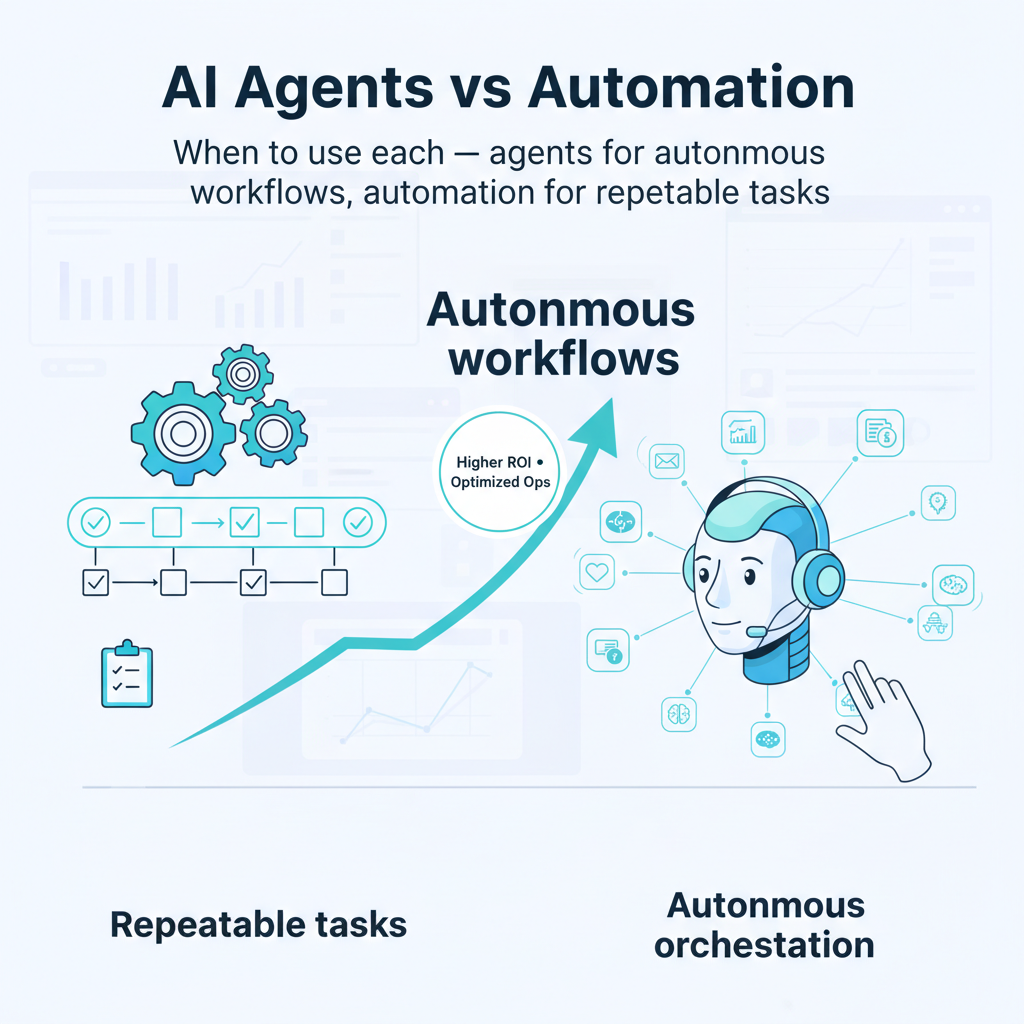
AI Agents vs Automation: Understanding the Key Differences and When to Use Each
Estimated reading time: 12 minutes
Key Takeaways
- AI agents are autonomous systems capable of decision-making, adaptation, and goal pursuit; use them when judgment and variability matter.
- Automation excels at rule-based, repetitive tasks requiring precision and minimal learning.
- Hybrid approaches combining AI agents and automation often yield the best business outcomes.
Table of contents
- Understanding AI Agents: The Digital Decision-Makers
- What are Autonomous Workflows?
- Exploring AI Automation Agents: The Best of Both Worlds
- AI Agents vs Automation: A Comparative Analysis
- Benefits of Integrating AI Agents into Business Workflows
- Considerations for Implementation
- Conclusion
- Let’s Continue the Conversation
What really distinguishes AI agents from traditional automation, and why does understanding this difference matter for modern businesses?
It’s a question I hear constantly from colleagues and clients who are trying to navigate the increasingly complex landscape of business technology. And honestly? The confusion is completely understandable. Both technologies promise to make our work lives easier, both involve computers doing tasks humans used to handle, and both get lumped together under the vague umbrella of “digital transformation.”
Read more about business process automation
But here’s the thing—they’re fundamentally different beasts.
AI agents are autonomous systems capable of decision-making, adaptation, and goal pursuit. They can reason through problems, learn from outcomes, and adjust their approach on the fly. Automation, on the other hand, excels at rule-based execution of repetitive tasks without learning or adaptation. It follows the script you give it, every single time, with impressive precision.
The stakes for getting this distinction right are enormous. According to recent research, AI agents combined with automation could add a staggering $15.7 trillion to the global economy by 2030. That’s not a typo—trillion with a T.
https://www.enkryptai.com/blog/ai-automation-vs-ai-agents
So when we talk about AI agents vs automation, we’re not splitting hairs over technical definitions. We’re talking about strategic decisions that could fundamentally reshape how your business operates and competes.
Throughout this post, I’ll walk you through what AI agents actually are, how autonomous workflows function in the real world, the emerging concept of AI automation agents that blend both approaches, and a practical side-by-side comparison to help you make informed decisions for your organization.
Understanding AI Agents: The Digital Decision-Makers
What exactly are AI agents and how do they differ from the software tools we’ve used before?
Think of AI agents as intelligent systems that autonomously reason, act, and adapt based on data, context, and goals. They’re not just executing commands—they’re continually improving through machine learning, getting smarter with every interaction.
The key word here is “autonomous.” These systems don’t sit around waiting for you to tell them exactly what to do next. They assess situations, make decisions, and take action toward specific objectives.
Let me break down the main types you’ll encounter:
Reactive agents respond only to immediate stimuli without planning ahead. Your home thermostat is a simple example—it senses the temperature and adjusts accordingly, but it’s not thinking about next week’s weather forecast or your vacation schedule. It reacts to what’s happening right now.
Proactive or goal-oriented agents are where things get interesting. These systems plan and adapt their actions toward specific objectives. Imagine a customer support AI that doesn’t just follow a decision tree. Instead, it analyzes the query, considers the customer’s history, evaluates multiple potential solutions, and decides on the best approach—all without a rigid script telling it what to do next.
https://www.enkryptai.com/blog/ai-automation-vs-ai-agents
https://www.crossfuze.com/post/ai-agents-vs-traditional-automation
The real-world applications are already transforming industries. In customer service, AI agents resolve complex queries by understanding context and tailoring responses to individual situations. They’re not just matching keywords—they’re actually comprehending what the customer needs.
In manufacturing, these agents predict equipment failures by analyzing sensor data patterns that humans might miss. They’re essentially doing preventive maintenance by thinking ahead, catching problems before they cascade into expensive downtime.
Sales teams are using AI agents that analyze buyer signals across multiple touchpoints and recommend next steps. Should you send that follow-up email now or wait two days? Should you offer a demo or share a case study first? The agent evaluates the data and suggests the optimal path forward.
The critical difference from older software? These AI agents improve over time. They learn what works and what doesn’t. They adapt to new patterns. They make decisions based on goals, not just rules.
And that capability is what powers the next evolution in business processes: autonomous workflows.
What are Autonomous Workflows?
Imagine workflows that operate independently, making smart decisions without needing human oversight—this is the promise of autonomous workflows.
Autonomous workflows are sequences of business processes that run independently, coordinated by AI agents making decisions and adapting steps to meet goals. They’re not just automated in the traditional sense; they’re intelligent and self-directing.
Here’s how AI agents enable this transformation. They interpret context from multiple sources, automate decision points that previously required human judgment, and connect tools dynamically based on what the situation demands.
Consider an AI email support agent as a concrete example. It reads incoming customer queries, understands the intent and urgency, gathers relevant data from your CRM and knowledge base, determines the appropriate response or action, and executes multiple steps—all without human input. If it encounters something truly novel or high-stakes, it knows to escalate to a human. But for the vast majority of cases? It handles everything end-to-end.
The business impact is substantial. In customer service, autonomous workflows resolve repetitive queries instantly while intelligently escalating complex tickets that require human expertise. The system isn’t just faster—it’s smarter about resource allocation.
In data management, AI agents autonomously gather information from multiple sources, analyze large volumes of data, and summarize findings in actionable formats. Companies are reporting research time cuts of up to 70% compared to manual processes or traditional automation alone.
https://www.enkryptai.com/blog/ai-automation-vs-ai-agents
What makes a workflow truly “autonomous”? It’s the ability to handle variability and make judgment calls. Traditional automated workflows break when they encounter exceptions or scenarios their rules didn’t anticipate. Autonomous workflows powered by AI agents adapt and figure out what to do.
The coordination happens through what’s increasingly called “agentic automation”—networks of AI agents working together, each handling specific aspects of a larger process while communicating and coordinating with each other. One agent might handle data gathering, another analysis, and a third execution, all working in concert toward a shared goal.
This brings us to an important hybrid category that’s emerging: AI automation agents.
Exploring AI Automation Agents: The Best of Both Worlds
AI automation agents are intelligent automation tools that couple traditional automation’s consistency with AI’s ability to learn, adapt, and make complex, context-aware decisions. They’re not purely one or the other—they’re a deliberate fusion designed to capture advantages from both approaches.
The key differentiator from traditional automation is this: AI automation agents can evaluate scenarios, weigh multiple options, and self-improve through feedback loops or machine learning. They’re not merely following scripts or rigid rules.
Let’s say you’re routing support tickets. Traditional automation might use keyword matching—if the ticket contains “password reset,” route it to the identity management team. Simple enough, but what happens when a customer describes their password problem using different language? Or when the real issue is more complex than the keywords suggest?
An AI automation agent, by contrast, understands the actual issue without relying on exact keyword matches. It evaluates the content, considers context, and makes nuanced routing decisions. And crucially, it learns from outcomes. If tickets it routed to Team A consistently got reassigned to Team B, it adjusts its future routing logic.
The performance differences are striking. Companies implementing AI automation agents are seeing efficiency gains of 70-90% compared to 40-60% for traditional automation. That’s not a marginal improvement—it’s a fundamental leap.
ROI improvements tell a similar story, averaging 171% across implementations, with some use cases achieving up to 410% returns. Those aren’t projections or promises—they’re actual results from organizations that have deployed these systems.
https://www.mindstudio.ai/blog/automation-vs-ai-agents/
Read more about AI automation ROI and measuring value
Perhaps most dramatically, we’re seeing up to 90% reductions in manual work for processes that require nuanced understanding. Tasks that previously demanded human judgment can now be handled by AI automation agents that bring both speed and intelligence to the table.
Real companies are already reaping these benefits. Organizations implementing AI automation agents for customer support, data processing, and workflow orchestration are reporting not just cost savings, but quality improvements—fewer errors, faster resolution times, and better customer satisfaction scores.
The learning capability is what sets these agents apart. Traditional automation is static until you manually update it. AI automation agents continuously refine their performance based on results, essentially getting better at their jobs over time without requiring constant reprogramming.
So how do you decide between AI agents, traditional automation, and these hybrid AI automation agents? That’s where a direct comparison becomes essential.
AI Agents vs Automation: A Comparative Analysis
To decide which technology fits your business goals, it’s essential to compare AI agents and traditional automation across key factors.
Let’s start with performance. AI agents handle complex, variable tasks with adaptability and learning capabilities. They excel when you need judgment, personalization, or the ability to deal with uncertainty. Traditional automation, on the other hand, delivers precise, fast execution of repetitive tasks. When you have a clearly defined process that doesn’t change much, automation is incredibly efficient—we’re talking 40-60% efficiency gains for the right use cases.
But AI agents push that even further for complex scenarios, achieving 70-90% efficiency gains precisely because they can handle variability that would break traditional automation.
https://www.mindstudio.ai/blog/automation-vs-ai-agents/
Scalability presents an interesting contrast. Traditional automation scales beautifully for high-volume, structured work. You can process millions of transactions with minimal additional cost. However, it struggles when the environment changes or when you need to scale across diverse scenarios.
AI agents scale differently—they handle dynamic environments by adapting their approach. Through agentic networks, multiple AI agents can coordinate to tackle increasingly complex challenges. They scale in sophistication, not just volume.
Adaptability is where the differences become most stark. AI agents adjust their plans dynamically without requiring recoding. Encounter a new type of customer query? The AI agent figures out how to handle it. Market conditions shift? The agent adapts its recommendations accordingly.
Traditional automation needs manual updates for exceptions. Every edge case requires someone to write new rules, create new branches in the logic, and test the changes. Over time, this creates maintenance complexity that can become overwhelming. You end up with sprawling rule sets that are fragile and difficult to modify.
https://www.mindstudio.ai/blog/automation-vs-ai-agents/
Cost considerations aren’t straightforward. Traditional automation has lower per-transaction costs—we’re talking pennies per execution in many cases. For high-volume, routine work, it’s extraordinarily cost-effective.
AI agents have higher per-use costs due to computational requirements. But—and this is crucial—they deliver better ROI on complex tasks because they handle things automation simply can’t. You’re not just comparing the cost per transaction; you’re comparing what each technology can actually accomplish.
https://www.mindstudio.ai/blog/automation-vs-ai-agents/
So when should you use each? Here’s my practical guidance:
Use AI agents for:
- Processes requiring judgment or decision-making
- Personalized customer interactions
- Variable workflows that change based on context
- Situations where learning and improvement matter
- Complex problem-solving that doesn’t follow simple rules
Use traditional automation for:
- Predictable, high-volume tasks
- Low-variation processes like data entry or file transfers
- Well-defined workflows with clear rules
- Situations where speed and cost per transaction are paramount
- Processes that rarely encounter exceptions
But here’s what’s becoming increasingly clear: the optimal approach is often hybrid. Companies combining both technologies are seeing the best results—using automation for the stable, routine elements and AI agents for the dynamic, judgment-intensive parts.
One case study reported annual savings of €300,000 by strategically blending traditional automation for data processing with AI agents for exception handling and decision-making. That’s the power of using the right tool for each specific job.
https://www.mindstudio.ai/blog/automation-vs-ai-agents/
The question isn’t really “AI agents vs automation” in an either-or sense. It’s about understanding where each technology shines and architecting your workflows accordingly.
Benefits of Integrating AI Agents into Business Workflows
Integrating AI agents transforms workflows by boosting intelligence, adaptability, and efficiency.
Let’s talk about enhanced decision-making first. AI agents bring autonomous reasoning and contextual awareness to processes that previously required human judgment. They can evaluate multiple factors simultaneously, consider historical patterns, and make recommendations or take actions based on goals rather than rigid rules.
I’ve seen this play out in sales workflows where AI agents analyze buyer behavior across emails, website visits, and engagement patterns to determine the optimal next action. It’s not just following a sequence—it’s making intelligent choices about timing, messaging, and approach based on actual signals.
The efficiency gains are substantial. We’re talking about 70-90% improvements in complex processes that involve variability and decision-making. Compare that to the 40-60% gains from traditional automation, and you see why organizations are paying attention.
https://www.enkryptai.com/blog/ai-automation-vs-ai-agents
https://www.mindstudio.ai/blog/automation-vs-ai-agents/
Productivity increases stem from dramatic reductions in manual work—up to 90% in some implementations. Think about data processing workflows where humans previously spent hours gathering information from multiple sources, analyzing it, and synthesizing findings. AI agents now handle this autonomously, freeing people for higher-value work that requires creativity, strategy, or complex human judgment.
But perhaps the most strategic advantage is innovation acceleration. AI agents learn patterns over time, identifying opportunities for improvement that might not be obvious to human observers. They can spot correlations in data, recognize emerging trends, and suggest process optimizations.
The rise of agentic networks—multiple AI agents collaborating toward shared goals—enables coordination across teams and departments that was previously difficult to achieve. One agent handles customer data, another manages inventory, a third coordinates logistics, all working together seamlessly.
This capability is driving massive enterprise adoption. According to recent data, 96% of enterprises plan to expand their agentic automation capabilities. That’s not hype—that’s strategic recognition of competitive advantage.
https://www.mindstudio.ai/blog/automation-vs-ai-agents/
The compounding effect matters too. Because AI agents learn and improve, the benefits grow over time. Your first month might see 60% efficiency gains, but six months later you’re at 80% because the agents have refined their approaches based on real outcomes.
Organizations are also seeing improvements in quality and consistency. AI agents don’t have bad days, don’t forget steps, and don’t make decisions based on fatigue or mood. They apply learned best practices consistently while still adapting to contextual needs.
The strategic advantage extends to scalability. As your business grows, AI agents can handle increased complexity without proportional increases in headcount. They enable you to scale operations while maintaining or even improving quality.
Considerations for Implementation
Before investing, consider key factors that will influence your success with AI agents or automation.
Start by evaluating task complexity and variability. This is the fundamental decision point. If you’re looking at stable, rule-based processes that rarely change, traditional automation is probably your best bet. It’s cost-effective, reliable, and proven.
But if your processes involve adaptive goals, contextual decision-making, or significant variability, AI agents are worth the investment. The higher upfront cost pays off through their ability to handle complexity that would require constant manual intervention with traditional automation.
Let’s be honest about the challenges you’ll face. AI agents have higher costs per transaction due to computational requirements. Integration with legacy systems can be complex—your existing infrastructure might not have been designed with autonomous agents in mind. And there’s the critical issue of autonomy guardrails: how do you ensure AI agents operate within acceptable boundaries?
https://www.crossfuze.com/post/ai-agents-vs-traditional-automation
Mitigation strategies exist for each of these challenges. Start with pilot projects rather than enterprise-wide rollouts. Choose a specific use case where the benefits are clear and the risks are manageable. Learn from that experience before scaling.
Embrace hybrid approaches from the beginning. Use traditional automation for the stable, predictable parts of your workflows and AI agents for the dynamic, judgment-intensive elements. This reduces overall costs while capturing the benefits of both technologies.
Consider no-code AI platforms that simplify deployment and reduce technical barriers. These tools make it easier for business teams to implement and manage AI agents without requiring deep technical expertise or extensive development resources.
https://www.mindstudio.ai/blog/automation-vs-ai-agents/
https://www.make.com/en/blog/the-difference-between-ai-agents-and-agentic-automation
Here are practical steps to start implementation:
- First, map your workflows into categories. Identify which tasks are routine and predictable versus which are dynamic and require judgment. This mapping exercise alone often reveals opportunities you hadn’t considered.
- Second, pilot hybrid setups. Choose a workflow where you can use automation for speed and consistency on the routine elements, with AI agents handling the variable or complex parts. This gives you direct comparison data and builds organizational confidence.
- Third, monitor ROI carefully. Focus on both efficiency metrics (time saved, cost per transaction) and adaptability metrics (how well the system handles exceptions, improvement over time). Traditional ROI calculations might undervalue the adaptability benefits that AI agents provide.
Establish clear governance frameworks before deployment. Define what decisions AI agents can make autonomously and what requires human approval. Set up monitoring systems to track agent behavior and outcomes. Create feedback loops so agents learn from both successes and mistakes.
Don’t underestimate the change management aspect. Your team needs to understand what AI agents can and can’t do. They need to trust the technology while maintaining appropriate oversight. Involve them in the pilot phase so they experience the benefits firsthand.
Start simple and iterate. You don’t need to implement the most sophisticated AI agent system from day one. Begin with narrow, well-defined use cases where success criteria are clear. Build confidence and capability before tackling more complex scenarios.
[Read more about planning your first automation project]
The organizations seeing the best results are those that view this as a journey, not a destination. They’re continuously learning, adjusting, and expanding their use of AI agents based on real-world results.
Conclusion
Understanding AI agents vs automation reveals strengths and complementary roles for these technologies in business.
Here’s what it comes down to: Automation excels in precision and cost-effectiveness for structured, repetitive tasks. It’s the workhorse that handles high-volume, predictable processes with impressive efficiency and minimal cost. When you have clear rules and stable workflows, automation is hard to beat.
AI agents bring autonomy, learning, and adaptability for complex problems that require judgment, personalization, or the ability to handle variability. They’re the intelligent layer that can reason through scenarios, make contextual decisions, and improve over time. When you need flexibility and intelligence, AI agents deliver value that traditional automation simply can’t match.
But the real insight? Hybrid solutions offer the best of both worlds. By strategically combining traditional automation for routine elements with AI agents for dynamic, judgment-intensive parts, organizations are achieving results that neither technology could deliver alone.
https://www.enkryptai.com/blog/ai-automation-vs-ai-agents
The economic impact is real and growing. That $15.7 trillion potential contribution to the global economy by 2030 will come from organizations that understand these distinctions and deploy each technology where it makes the most sense.
I encourage you to reflect on your current workflows. Where are you using manual processes that could be automated? Where is your existing automation breaking down due to exceptions or variability? Where do you need judgment and adaptation rather than just speed and consistency?
The answers to those questions will guide your strategy for integrating AI agents, automation, or—most likely—a thoughtful combination of both.
Let’s Continue the Conversation
I’d love to hear about your experiences with AI agents or automation. Are you currently using either technology? What challenges have you encountered? What results have you seen?
Drop your thoughts, questions, or experiences in the comments below. This is a rapidly evolving field, and we all learn from each other’s real-world implementations.
And if you found this deep dive valuable, subscribe to our newsletter for ongoing insights on AI technology, autonomous workflows, and automation trends. We’re tracking the latest developments and sharing practical guidance to help you navigate these decisions with confidence.
The future of work is being shaped by how we combine human intelligence with AI agents and automation. Understanding the distinctions and applications of each technology isn’t just technical knowledge—it’s strategic advantage.
Frequently Asked Questions
What is the difference between AI agents and automation?
AI agents are autonomous systems capable of decision-making, adaptation, and goal pursuit. They can reason through problems, learn from outcomes, and adjust their approach on the fly. Automation excels at rule-based execution of repetitive tasks without learning or adaptation. It follows the script you give it, every single time.
When should I use AI agents vs automation?
Use AI agents for processes requiring judgment or decision-making, personalization, variable workflows, and situations where learning and improvement matter. Use traditional automation for predictable, high-volume tasks and well-defined workflows with clear rules. Hybrid approaches are often the best path.
What are autonomous workflows?
Autonomous workflows are sequences of business processes that run independently, coordinated by AI agents making decisions and adapting steps to meet goals. They’re intelligent and self-directing, not just automated.
What is AI automation at the best of both worlds?
AI automation agents couple traditional automation’s consistency with AI’s ability to learn, adapt, and make complex, context-aware decisions. They evaluate scenarios, weigh options, and self-improve through feedback loops or machine learning.
}