Memory in the Age of AI Agents: A Deep Dive into How Machines Remember
Memory in the Age of AI Agents: A Deep Dive into How Machines Remember
Estimated reading time: 8 minutes
Key Takeaways
- AI memory mirrors human cognition by storing, retrieving, and evolving information to improve long-term decision making and personalized responses.
- Three-layer framework covers memory forms, functions, and dynamics, shaping how AI remembers and uses knowledge.
- Memory challenges are tackled with strategies like extraction, consolidation, retrieval, and strategic forgetting to balance accuracy and relevance.
- Practical implementations include industry efforts from Salesforce and Amazon Bedrock AgentCore to manage memory at scale.
Table of contents
In an era where artificial intelligence is becoming increasingly sophisticated, one of the most fascinating developments is how AI agents handle memory. Just like humans, AI systems need to remember, learn, and evolve from past experiences. This comprehensive exploration delves into the intricate world of memory in AI agents, revealing how these systems are becoming more human-like in their ability to retain and utilize information.
The Foundation of AI Memory Systems
At its core, memory in AI agents encompasses complex systems that enable machines to store, retrieve, consolidate, and evolve information. These systems are designed to mirror human cognitive processes, ultimately enhancing the AI’s ability to make long-term decisions, provide personalized responses, and adapt to new situations.
Understanding the Memory Framework
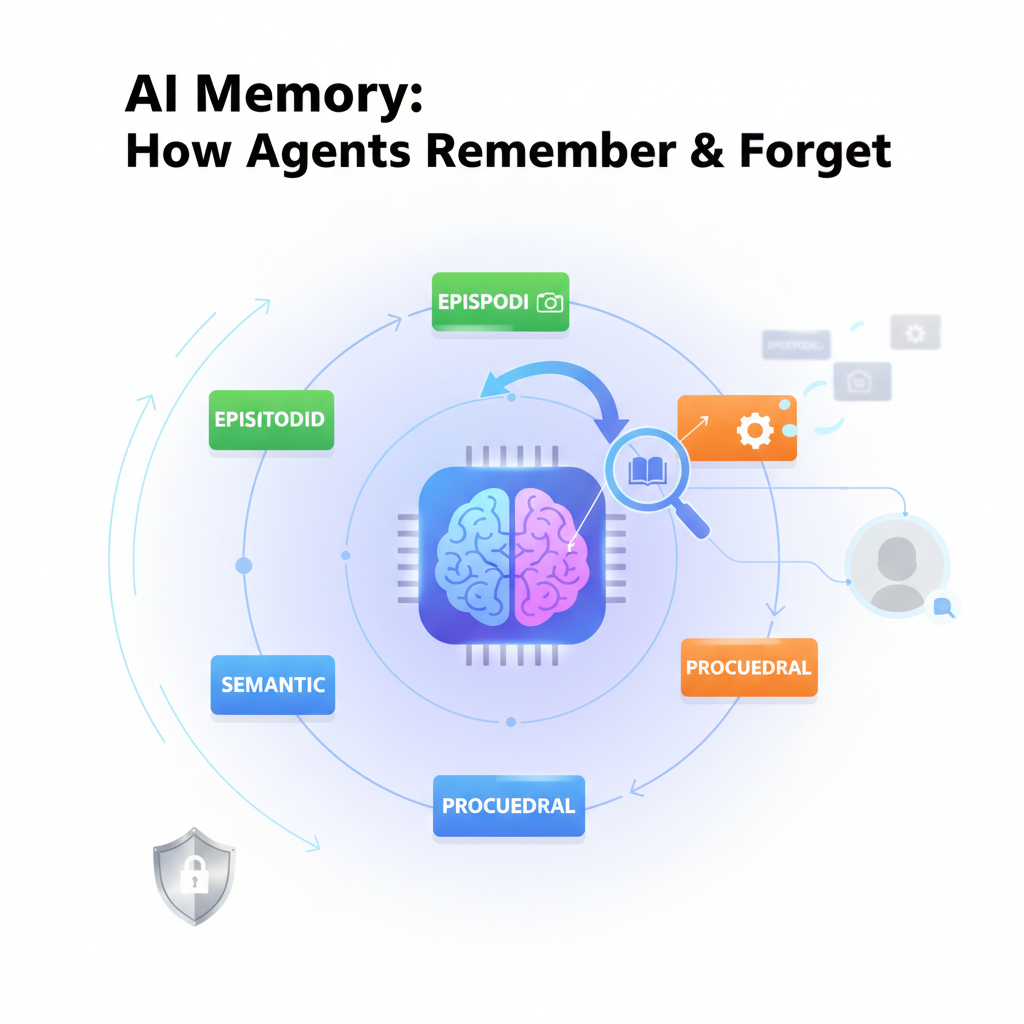
Recent research has identified three primary categories in how AI agents process and store memory:
- Forms of Memory
- Token-level memory: Direct storage of text information
- Parametric memory: Information encoded within model weights
- Latent memory: Compressed representations of data
- Memory Functions
- Factual memory: Storage of concrete facts and information
- Experiential memory: Recording and recall of specific events
- Working memory: Handling short-term task-related information
- Memory Dynamics
- Initial formation of memories
- Evolution of stored information over time
- Contextual retrieval of relevant data
The Human Connection: Episodic Memory
One of the most intriguing aspects of AI memory systems is their inspiration from human biology. Specifically, these systems often mimic the function of the human hippocampus through episodic memory. This approach helps AI agents in:
- Improved planning capabilities
- Fast learning in environments with limited feedback
- Overcoming the challenge of catastrophic forgetting, where new information overwrites existing knowledge
Tackling Major Challenges in AI Memory
As AI systems become more complex, they face several critical challenges in memory management. Here’s how the industry is addressing these issues:
- Extraction and Filtering
Modern AI systems must differentiate between meaningful insights and irrelevant information. For instance, they need to recognize the difference between important personal preferences (“I’m vegetarian”) and casual utterances (“hmm”). This is achieved through sophisticated filtering strategies focusing on:
- Semantic facts
- User preferences
- Narrative summarization
- Memory Consolidation
Amazon’s Bedrock AgentCore demonstrates how AI systems can effectively:
- Merge related information across different time periods
- Resolve conflicting data points
- Balance recent information with historical context https://anilbohra.me/virtual-lab-ai-agents-nanobodies
- Efficient Retrieval
Advanced systems now use retrieval-augmented approaches that function similar to a library catalog, allowing AI to:
- Access specific memories without scanning entire historical databases
- Maintain context-appropriate recall
- Optimize memory usage within context windows https://anilbohra.me/effective-context-engineering-ai-agents
- Strategic Memory Management
Modern AI systems incorporate:
- Intelligent forgetting mechanisms for irrelevant data
- Dynamic allocation for complex queries
- Temporal weighting systems favoring either recent or long-term patterns https://anilbohra.me/understanding-temporal-origins-and-modern-science
Practical Solutions in Action
Leading tech companies are making significant strides in AI memory management:
Salesforce’s Innovative Approach:
- Implements parallel extraction from conversation segments
- Uses smart aggregation techniques
- Achieves 13x reduction in token usage (from 27,000 to 2,000 tokens for 300 interactions)
- Maintains 70-75% accuracy while reducing system latency https://anilbohra.me/https-anilbohra-me-crm-automation-tools-guide/
Amazon’s Bedrock AgentCore:
- Offers fully managed long-term memory solutions
- Provides customizable prompts for specific domains
- Excels in inference tasks and preference detection https://anilbohra.me/virtual-lab-ai-agents-nanobodies
The Future of AI Memory
As we look ahead, several exciting developments are on the horizon:
- Memory Automation
- – Self-managing update systems
- – Autonomous memory optimization https://anilbohra.me/agentic-ai-foundation-standardization
- Multimodal Memory Integration
- – Combination of text, image, and video data
- – Unified memory systems across different data types https://anilbohra.me/llamaindex-guide-to-custom-data
- Multi-Agent Memory Systems
- – Shared memory networks between multiple AI agents
- – Collaborative learning and information sharing https://anilbohra.me/best-ai-agents-2025-guide
- Enhanced Trustworthiness
- – Improved privacy protection
- – Reduced bias in memory systems
- – Enhanced data security https://anilbohra.me/agentic-ai-foundation-standardization
The evolution of memory in AI agents represents a fundamental shift in how machines interact with information. As these systems continue to develop, we’re moving from simple reactive tools to sophisticated, learning entities that can truly benefit from past experiences.
This advancement in AI memory systems isn’t just a technical achievement; it’s a stepping stone toward more intuitive, responsive, and human-like artificial intelligence. As these technologies continue to evolve, they promise to revolutionize everything from personal digital assistants to enterprise-level AI solutions, bringing us closer to truly intelligent machines that can learn, remember, and grow from their experiences.
Frequently Asked Questions
Q: How do AI agents remember information?
A: AI memory comprises storing, retrieving, and evolving information to aid long-term decisions and personalized responses.
Q: What is episodic memory in AI?
A: It mirrors human hippocampus function to support planning, fast learning, and mitigating forgetting.
}