Notion Developer Platform AI Agents: Revolutionizing the Future of Workspaces
Notion Developer Platform AI Agents: Revolutionizing the Future of Workspaces
Estimated reading time: 8 minutes
Key Takeaways
- Notion’s Developer Platform enables AI agents to act as natural collaborators within workspaces, transforming how teams collaborate, automate tasks, and integrate AI into workflows.
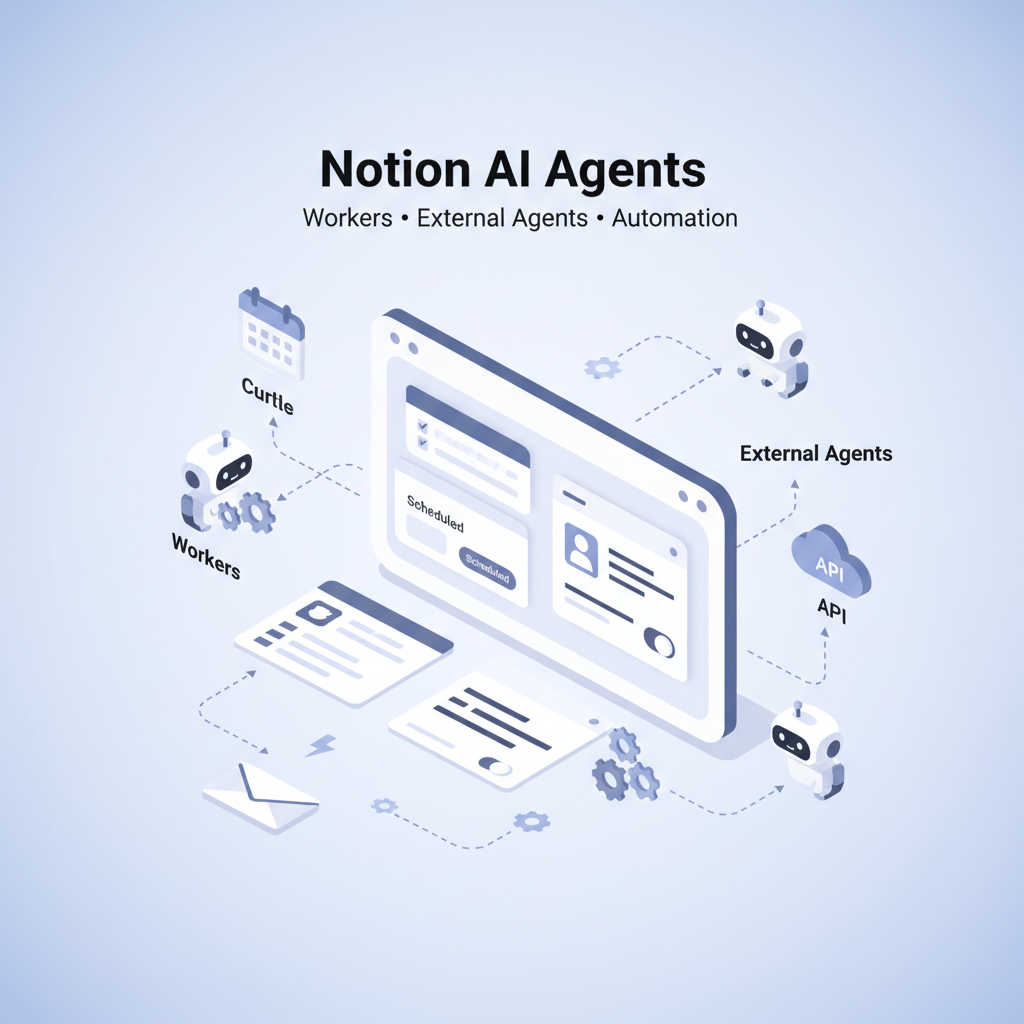
- Agents run in Notion’s runtime via Workers and can interact with external data sources to automate tasks.
- External Agents and the External Agent API are designed to bring third-party AI tools into Notion as native workspace participants.
- The platform emphasizes agent orchestration and a human-AI collaboration model to boost productivity and reduce context switching.
Table of contents
- From Static Notes to Living Workspaces
- Core Features of the Notion Developer Platform AI Agents
- External Agent API & External Agents
- Related Notion AI Features
- Strategic Context: AI & Productivity Landscape
- Why This Matters for Developers & Businesses
- Competitive Landscape
- What’s Next
- Additional Resources
- Conclusion
Notion has long been recognized as a powerful note-taking and organizational tool. But with the introduction of its new Developer Platform, Notion is shifting gears from static note-taking to building an integrated infrastructure for AI-enhanced work. The platform transforms Notion into what’s described as an “agent orchestration layer” where human teams co-exist and cooperate seamlessly with AI agents.
What does this mean in practice? Instead of just having AI-powered suggestions or passive helpers, teams can now embed a variety of AI agents directly into their Notion pages. These agents are capable of chatting, taking actions, and interacting with external data sources and custom logic—all without users ever leaving their workspace.
This is a bold step that very clearly positions Notion as a central hub in a hot and emerging area: agentic AI and workspace automation. Notion has adopted an “app store model” for AI agents, allowing for a thriving ecosystem of third-party developers and AI providers to contribute agents that enhance workflows. For more on agentic AI and its impact on productivity, see agentic AI.
From Static Notes to Living Workspaces: The Notion Developer Platform AI Agents
Notion has long been recognized as a powerful note-taking and organizational tool. But with the introduction of its new Developer Platform, Notion is shifting gears from static note-taking to building an integrated infrastructure for AI-enhanced work. The platform transforms Notion into what’s described as an “agent orchestration layer” where human teams co-exist and cooperate seamlessly with AI agents.
What does this mean in practice? Instead of just having AI-powered suggestions or passive helpers, teams can now embed a variety of AI agents directly into their Notion pages. These agents are capable of chatting, taking actions, and interacting with external data sources and custom logic—all without users ever leaving their workspace.
This is a bold step that very clearly positions Notion as a central hub in a hot and emerging area: agentic AI and workspace automation. Notion has adopted an “app store model” for AI agents, allowing for a thriving ecosystem of third-party developers and AI providers to contribute agents that enhance workflows. For more on agentic AI and its impact on productivity, see agentic AI.
Core Features of the Notion Developer Platform AI Agents
The platform is still in an early rollout phase, but already some powerful tools are available or in private beta. Here’s an in-depth look at the core components.
1. Workers — Running Custom Code in Notion (Public Beta, Available Now)
One of the biggest innovations is Workers, which lets developers deploy custom backend logic directly within Notion’s hosted runtime. This removes the need for any external server infrastructure.
Why is this important?
For the first time, developers can create custom tools that sync external data—say, sales figures from a CRM or engineering commits from GitHub—directly into Notion. These Workers can run deterministic, token-efficient code, optimizing performance for AI interactions.
How can workers be used?
– Pulling real-time customer data into deal tracking databases
– Validating workflow states to prevent errors in project tracking
– Automatically updating project timelines or drafting proposals based on internal knowledge bases
Developers write their tool logic once, deploy it as a Worker, and these Workers become callable by Notion’s Custom Agents to perform complex or predictable tasks with ease.
This capability relates well to broader workflow automation principles, which are extensively covered in the blog at automate small business processes.
2. External Agents — Bringing Third-Party AI Into Your Workspace (Waitlist / Private Beta)
Notion’s External Agents are set to become the backbone of its AI ecosystem. These agents are third-party or custom-built AI tools that act as “native workspace participants”, appearing alongside human collaborators in Notion’s UI.
This means they can:
– Chat in the same experience as humans
– Be assigned to projects or tasks
– Participate in workflows seamlessly
Some early partners and examples include:
| Agent/Provider | Specialization |
|---|---|
| Claude, Codex, Christer | Coding AI agents that help with software development tasks |
| Decagon | Customer support automation |
| Amplitude | Product analytics insights |
Initially, coding agents are being introduced, followed by specialized partners, with a full External Agent API launching soon to broaden the scope.
You can learn more about the role of AI agents and autonomous digital assistants in modern workflows here: best ai agents 2025 guide.
3. External Agent API — Unifying AI Agents through an Open Interface
Notion is also developing an External Agent API which enables any agent—whether built on popular AI frameworks or custom solutions—to be wrapped with a minimal API layer. This dramatically lowers the barrier for businesses with internal AI bots (customer support, operations, security) to integrate smoothly into the Notion workspace.
The power here lies in orchestration: the ability to share a single workspace context across documents, tasks, and notes, allowing human and AI agents to collaborate harmoniously in a unified environment.
Effective context engineering for AI agents is key to making this work well. For strategies and practices on this topic, check out effective context engineering ai agents.
4. Related Notion AI Features — Powerful AI Tools Already in Motion
Before the Developer Platform launch, Notion’s AI capabilities included:
– Custom Agents: Over 1 million created by teams, used to automate repetitive tasks such as triaging support tickets in Slack, resolving security alerts, and compiling weekly reports.
– Notion Agent: An AI that can autonomously build or edit pages and databases drawing on internal and connected app data including Slack and Google Drive.
– Enterprise Search & Connectors: Allowing users to perform cross-app search and pull relevant context into Notion workflows effortlessly.
This suite combined closely with the new Developer Platform forms a powerful, flexible AI workspace.
For further insights on AI automation strategy and consulting to support implementations like this, see https://anilbohra.me/https-anilbohra-me-ai-automation-roi-guide/.
Strategic Context: What Does This Mean for the AI and Productivity Landscape?
This move by Notion follows a clear, strategic vision and taps into broader market trends.
The Ecosystem Play: Notion Avoids Building AI In-House
Instead of developing all AI features internally, Notion cleverly empowers developers and partners to build and distribute agents on its platform. This creates a win-win ecosystem: developers get instant access to millions of daily users, and Notion solves the tough problem of distribution that often stymies productivity tools.
Becoming the “Agent Orchestration Layer”
Notion is positioning itself not as a monolithic app trying to do everything, but as the central hub where specialized AI agents collaborate. This mirrors shifts seen in broader software industries moving towards platforms and distributed ecosystems.
Key Success Factors
According to analysis from TechBuzz.ai, Notion’s success with this strategy depends on:
| Factor | Detail |
|——–|——–|
| Developer Adoption | Attracting and retaining developers to build useful, reliable agents |
| Reliability | Ensuring AI agents perform dependably in real-world workflows |
| Outcome | Becoming essential infrastructure for teams that deploy AI at work |
The Human-AI Collaboration Demo
A video demo titled “How to Orchestrate Any Agent” showcases agents working in Notion’s UI like actual team members. They share workspace context and activate tasks just like human collaborators do, illustrating how fluid this future environment will feel.
For more on the evolving future of work with AI agents, see https://anilbohra.me/future-of-work-ai-agents.
Why Is This Important for Developers and Businesses?
The arrival of this platform opens doors for multiple exciting possibilities.
Enhanced Workflow Automation
Businesses can automate formerly manual or siloed processes. For example, a sales team can have an AI agent pull in deal metrics, validate proposal workflows, and notify team members inside the same app used for planning and communication.
Building Specialized AI Collaborators
Developers can build or deploy AI agents that specialize in narrow tasks—coding assistance, customer support answers, or product analytics—creating highly focused helpers embedded right where work happens.
Simplifying Integration Without Heavy Infrastructure
Because Workers run inside Notion’s runtime, developers can bypass the complexity and costs of managing external servers, speeding up development cycles and deployments.
Empowering Knowledge Work at Scale
By merging human insight with AI agents that can search, draft, update, and analyze in real-time, teams achieve higher productivity and avoid context switching between apps.
For practical guides on building AI agents with modern workflows, you may refer to building ai agents guide.
Competitive Landscape: How Does Notion’s Platform Compare?
While there are third-party platforms that offer multi-agent systems and may integrate with Notion, the native Developer Platform’s tight, seamless integration provides superior depth and feel. For example, AI Agent Platform on dev.to offers 400+ templates and compliance certifications like SOC 2 and GDPR but lacks the embedded, collaborative interface that Notion now delivers.
What’s Next? Looking Ahead in the AI-Workspace Revolution
Currently, Notion’s Workers feature is publicly available in beta, with other components like External Agents and External Agent API in private beta or waitlist phases. This staged rollout indicates steady progress towards a fully open, extensible platform.
As more specialized agents become available and adoption grows among enterprise clients, Notion’s Developer Platform could become the go-to AI workspace, analogous to how app stores revolutionized mobile devices a decade ago.
Additional Resources
For those interested in exploring further, here are some key official links:
– Official announcement and feature deep-dive: Notion Blog: Introducing Developer Platform
– Strategic market analysis by TechBuzz.ai: Notion Just Turned Its Workspace Into a Hub for AI Agents
– Demonstration video showcasing agent orchestration: YouTube – How to Orchestrate Any Agent
– Overview of Notion’s AI offerings: Notion AI Product Page
– Developer resources: Notion Dev
– Live examples of Custom Agents in action: Notion Homepage
Conclusion: A New Era for AI and Productivity
The Notion Developer Platform AI Agents marks a thrilling step toward AI-augmented teamwork and productivity. It is much more than incremental AI features; it is a fundamental platform shift that empowers developers and teams to build AI collaborators, automations, and insights into the very fabric of their workspaces.
As this platform evolves and matures, we stand on the precipice of a future where AI agents do not just support work—they become part of the team. If you’re a developer, manager, or knowledge worker eager to unlock smarter work processes, the Notion Developer Platform is unquestionably one to watch.
The world of AI agents within your workspace is arriving fast. Are you ready to build with Notion?
Internal Links Added:
– https://anilbohra.me/future-of-work-ai-agents
– https://anilbohra.me/automate-small-business-processes/
– https://anilbohra.me/best-ai-agents-2025-guide
– https://anilbohra.me/effective-context-engineering-ai-agents
– https://anilbohra.me/https-anilbohra-me-ai-automation-roi-guide/
– https://anilbohra.me/building-ai-agents-guide
– https://anilbohra.me/https-anilbohra-me-ai-automation-roi-guide/
FAQ
What is the Notion Developer Platform AI Agents?
It is Notion’s Developer Platform that enables AI agents to act as natural collaborators within workspaces, transforming how teams collaborate, automate tasks, and integrate AI into workflows.
What are Workers?
Workers are built-in Notion capability that lets developers deploy custom backend logic directly within Notion’s hosted runtime to sync external data and automate tasks.
What are External Agents?
External Agents are third-party or custom-built AI tools that appear as native workspace participants in Notion, capable of chatting, being assigned to projects, and participating in workflows.
}