google ai agents capabilities: Unlocking the Future of Autonomous Intelligence
Google AI Agents Capabilities: Unlocking the Future of Autonomous Intelligence
Estimated reading time: 12 minutes
Key Takeaways
- Autonomy & multi-step planning: AI agents plan, reason, and execute complex workflows with minimal human input.
- Rich tool use & integration: They leverage toolkits and APIs to browse the web, run code, and interact with Google apps like Gmail, Calendar, and Docs.
- Memory & context over time: Agents maintain state across interactions while following governance and privacy rules.
- Security-first governance: Enterprise-grade security, governance, and compliance frameworks underpin safe operation.
Table of contents
Introduction to Google AI agents emphasizes a shift from passive responses to autonomous planning, reasoning, and execution across personal, enterprise, and customer service contexts. The post surveys architecture, platforms, security practices, and what these agents mean for the future of AI-driven interactions.
What Are Google AI Agents?
Before we unpack the details, it’s important to understand what Google means by “AI agents.” At their core, these are autonomous or semi-autonomous systems that leverage advanced large language models (LLMs) and tool integrations to carry out complex workflows without constant human input. Unlike traditional chatbots or simple automation scripts, these agents:
- Can plan and reason over multi-step workflows.
- Use toolkits and APIs to browse the web, execute code, and interact with Google apps like Gmail, Calendar, and Docs.
- Maintain state and context over time, remembering past interactions.
- Operate within strict security, governance, and compliance frameworks to protect data and ensure safe operation.
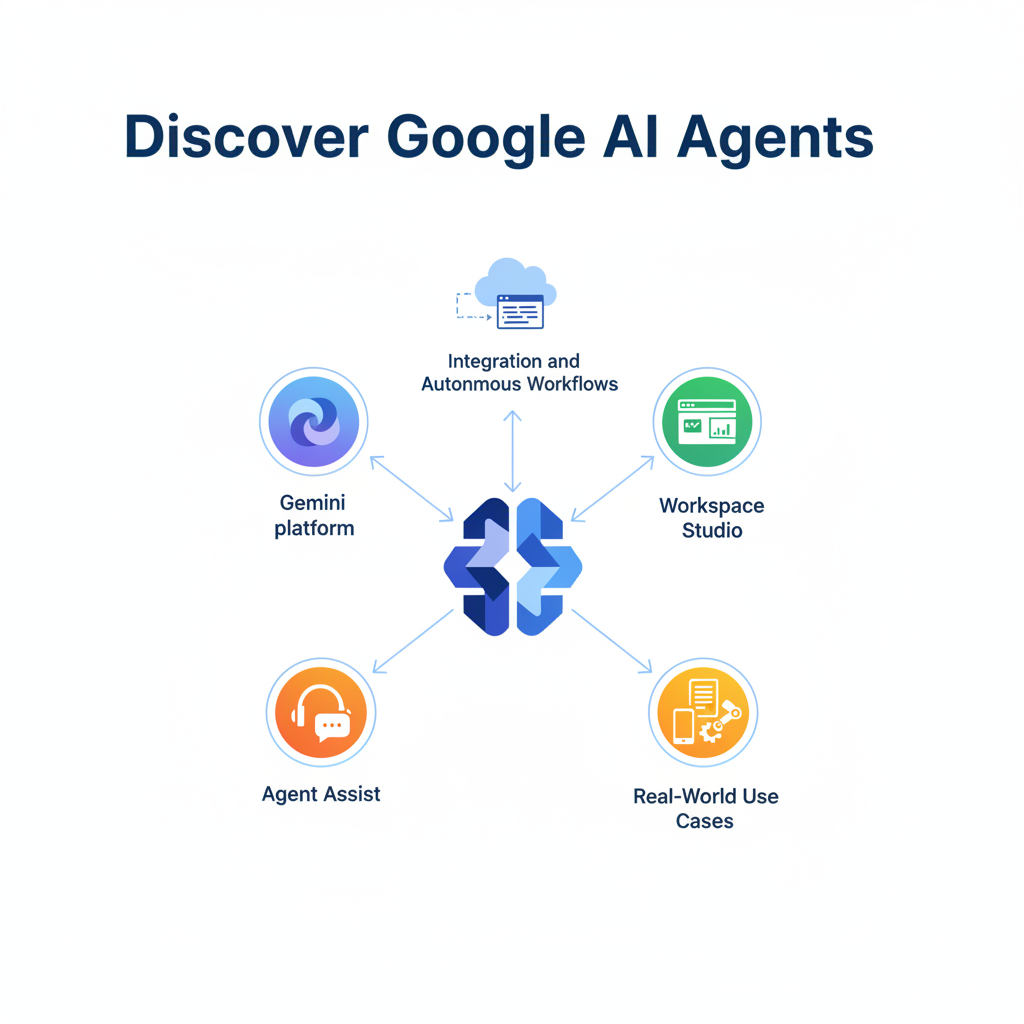
This agent paradigm appears across various Google products and platforms, including:
- The Gemini Enterprise Agent Platform for businesses.
- The consumer-focused Gemini Agent (or Gemini Spark) for personal productivity.
- Google Workspace Studio agents that automate knowledge worker tasks.
- The Customer Experience Agent (CX) Studio for support teams.
- Developer-centric tools like Vertex AI Agent Builder.
- Agent Assist tools for customer service support.
Let’s explore each of these facets in detail.
Source: Google Cloud Gemini Enterprise Agent Platform Overview
Gemini Enterprise Agent Platform: The Backbone of Corporate AI Agents
Within Google Cloud lies the Gemini Enterprise Agent Platform, a unified infrastructure for creating, deploying, governing, and optimizing AI agents tailored for enterprise needs.
Four Pillars of the Gemini Enterprise Platform
- Build: Design, prototype, and develop agents using modular tools and frameworks.
- Scale: Deploy agents on a high-performance, scalable runtime capable of handling enterprise workloads.
- Govern: Secure and control each agent’s identity, access permissions, and data usage.
- Optimize: Continuously monitor, evaluate, and improve agent behavior using advanced analytics.
Intelligence: Access to 200+ Foundation Models
Agility and flexibility power this platform through access to over 200 foundational models, including:
- The Gemini model family, which supports text and multimodal inputs.
- Google’s proprietary models and open-source alternatives accessible via Vertex AI.
A specially designed Agent Development Kit allows creators to build agents that can reason through complex, multi-step workflows and utilize various tools, from APIs to integrated browsers.
Runtime: Fast, Scalable, and Memory-Enabled
One standout feature is the Agent Runtime, a high-performance environment engineered for sub-second cold starts to minimize latency. This enables agents to spin up quickly and handles long-running or background workflows asynchronously.
Agents maintain context through Agent Platform Sessions, managing state within a single interaction, while the Agent Platform Memory Bank provides persistent recall across sessions — meaning agents “remember” your preferences or prior interactions while adhering to strict governance rules.
Tool Use & Execution Capabilities
Google AI agents are powerful tool users:
- They can generate and safely execute Python code in sandboxed environments to carry out calculations, data analysis, or custom logic.
- They can query enterprise databases, search through knowledge stores, and interact with APIs — both Google Cloud-native and third-party services like CRM or ERP.
- They control a Chromium-based browser for real web interactions.
- They even integrate with image generation and visualization tools, enabling the creation of charts, graphs, or images on demand.
Enterprise-Grade Security and Governance
Security is baked into every layer of the Gemini Enterprise Agent Platform:
- Agent Identity and Access Controls assign precise permissions to each agent, regulating data and API access.
- The Agent Gateway is the centralized traffic controller, authenticating and routing requests.
- Google Cloud’s renowned Model Armor offers multi-layered defense mechanisms to detect and block prompt injections, jailbreak attempts, and data exfiltration.
- Advanced semantic governance policies monitor and prevent sensitive content leaks or policy violations.
- Real-time AI threat and vulnerability scanning protects agentic systems.
- The AI Content Detection API supports trust and safety by identifying AI-generated content requiring labeling or compliance checks.
Monitoring and Optimization
Ongoing evaluation ensures agent quality and safety:
- Automated tools like Multi-Turn AutoRaters assess real-world interactions.
- Synthetic user simulations stress-test agents under diverse scenarios.
- The Unified Trace Viewer provides in-depth insight into agent decision-making, including tool calls and reasoning steps.
- Analytics drive prompt optimization and refine agent workflows.
Source: Google Cloud Gemini Enterprise Agent Platform Overview
Gemini Agent / Gemini Spark: Your Autonomous Personal AI Companion
On the consumer front, Google’s Gemini Agent, also marketed as Gemini Spark, represents a new generation of personal AI assistants designed to run continuously in the background, managing complex, multi-step tasks on your behalf.
Always-On, Proactive Task Management
Unlike traditional assistants triggered by user prompts, Gemini Spark operates 24/7, even while your devices are off. Whether monitoring your inbox, managing subscriptions, or researching a multi-leg trip, the agent autonomously advances tasks while keeping you in the loop.
Robust Multi-Step Workflows
This agent can:
- Conduct live web research, comparing products or travel deals.
- Manage your Gmail inbox, drafting replies, highlighting priorities, and extracting key info like invoices or deadlines.
- Convert long email chains into actionable plans and checklists.
- Schedule reminders, maintain lists in Google Keep, and log expense data into Sheets.
- Provide weekly digests of news or subscription updates.
Deep Integration With Google Apps
Gemini Spark ties into your Google ecosystem, including Gmail, Calendar, Drive, Docs, Sheets, YouTube, and Maps — with data access strictly opt-in.
This enables what Google calls Personal Intelligence, connecting the dots across apps to help with tasks like auto-drafting calendar events from emails or scheduling meetings based on project documents.
Privacy and Control
Privacy is paramount. Your agent only accesses data you explicitly allow. It checks with you before performing significant actions such as sending emails or bookings.
Source: Gemini Agent Overview
Future of Work AI Agents, Best AI Agents 2025 Guide, 5-day AI Agents Course – Google
Google Workspace Studio Agents: Automating Work, No Coding Needed
Google Workspace brings AI agents to knowledge workers with Workspace Studio — a no-code/low-code platform that lets anyone build custom AI agents in minutes.
Democratizing AI Agent Creation
No technical expertise is necessary. Using Google’s Gemini 3 models for reasoning and multimodal understanding, employees across every department can create agents to automate everyday tasks.
Sophisticated Workflow Automation
Workspace agents can:
- Perform sentiment analysis on customer feedback.
- Generate content such as emails, document summaries, or meeting notes.
- Prioritize messages and tasks intelligently.
- Send smart alerts based on document or sheet conditions.
- Manage end-to-end processes across apps, like processing customer inquiries by extracting data, updating Sheets, drafting responses, and notifying teams via Google Chat.
Personalized Contextual Understanding
Agents comprehend your working context, including documents, emails, and calendar data, and adhere to your organization’s policies for content and workflow. Outputs are personalized in tone and style, maintaining brand voice and compliance.
Source: Google Workspace Blog — Introducing Workspace Studio
Customer Experience Agent Studio (CX Agent Studio): Elevating Customer Support
For businesses delivering customer service, Customer Experience (CX) Agent Studio equips teams with advanced AI agents that provide multilingual, multimodal virtual assistants.
Rapid Deployment and Multimodal Interaction
CX Agent Studio supports:
- Text, voice, and image inputs.
- Human-like voices in over 40 languages.
- Integration with CRM, ticketing systems, FAQs, and knowledge bases.
- Seamless handoff to human agents and AI co-pilot features.
Personalized, AI-Powered Customer Interaction
Powered by Gemini’s deep reasoning, agents tailor responses based on customer history and preferences, drastically improving response quality. Deployment time shrinks from weeks to days thanks to guided tools and templates.
Source: Google Cloud — Customer Experience Agent Studio
Developer Tools: Vertex AI & Agent Builder
Google’s developer community is empowered by Vertex AI Agent Builder and associated tools, which underpin many Google AI agent capabilities.
Key Functions and Architecture
From official Google I/O talks and codelabs, we know these agents:
- Orchestrate complex tasks by decomposing them into subtasks.
- Maintain long-term memory and access varied contextual sources.
- Use code execution for precise math or data handling.
- Have access to browsing, image generation, APIs, and databases.
- Operate over multiple streamed interactions, maintaining context throughout.
Data Store Agents
These specialized agents excel at retrieving and synthesizing knowledge from documents, websites, and structured data to answer complex queries, ideal for replacing static FAQs or internal knowledge assistants.
Developer Support
The included Google Skills course guides developers through building, configuring, and optimizing agents for diverse applications.
Source: Google I/O 2024 — Building AI Agents on Google Cloud
principles-building-ai-agents-pdf, building-ai-agents-guide
Agent Assist: AI-Powered Customer Service Enhancement
In customer support workflows, Agent Assist leverages generative AI to provide:
- Instant answers sourced from FAQs and knowledge bases.
- Real-time summarization and suggestion tools for human agents.
- Data-store-powered retrieval agents delivering source-verified responses.
This enhances agent productivity and improves customer experience while integrating seamlessly into existing tools.
Source: Google Skills — Agent Assist and Gen AI
anthropic-ai-agents-financial-services
Securing AI Agents: Model Armor and the Advent of Agents Initiative
As autonomous AI agents wield increasing power, Google implements a multi-layered defense strategy under the Model Armor framework:
- Filters input and output to block malicious prompt injections.
- Classifies risks and enforces runtime policies.
- Provides real-time monitoring and vulnerability scanning.
The Advent of Agents project offers best practices and infrastructure to build secure, compliant agents aligned with enterprise governance standards.
Source: Advent of Agents — Google Cloud Security
Cross-Cutting Features Across Google AI Agents
Several unifying themes emerge in Google’s AI agent strategy:
- Advanced Reasoning and Multi-Step Planning — Agents break down complicated problems into manageable steps, adapting dynamically as new data emerges.
- Extensive Tool Integration — From web browsing to APIs, code execution to image generation, agents harness a wide toolset.
- Multimodal Understanding — Handling text, images, voice, and data seamlessly to support diverse applications.
- Statefulness and Memory — Maintaining conversation context and persistent memory across interactions for more human-like engagement.
- Autonomy and Proactivity — Going beyond simple response bots, agents can autonomously initiate tasks and workflows under user-approved controls.
- Rigorous Governance and Privacy — Role-based permissions, content controls, risk management, and user data opt-in mechanisms ensure safety and compliance.
- Continuous Evaluation and Observability — Automated monitoring, synthetic stress tests, and tracing tools help maintain quality and performance.
Related references: memory-in-ai-agents-age, effective-context-engineering-ai-agents
Real-World Use Cases: What Can Google AI Agents Do Today?
- For Consumers: Automatically scan emails for invoices, log expenses, create calendar reminders, research and compare travel plans, or summarize newsletters and news stories.
- For Knowledge Workers: Categorize and route customer emails, generate document summaries, monitor shared drives for project updates, perform sentiment analysis on support tickets, or schedule team notifications.
- For Enterprises and Developers: Build secure, auditable internal agents that query business data warehouses and CRM systems; deploy multilingual support chatbots and voicebots; orchestrate API-driven workflows while enforcing security policies.
The Future is Here: Google AI Agents Capabilities Redefine Intelligence
Google’s AI agents capabilities paint an exciting picture of the future — where AI systems aren’t just question-answering machines but autonomous collaborators deeply embedded across personal, business, and customer service domains. From the developer tools enabling tailored solutions to personal productivity agents quietly working behind the scenes, Google’s ecosystem is setting new standards for intelligence, security, and user empowerment.
As these agents continue to evolve, their ability to wield tools, manage complex workflows, and respect governance boundaries will unlock unprecedented efficiency and creativity, shaping the next frontier of human-AI interaction.
Explore more about Google’s AI agents and how they can empower you or your organization through the official resources linked throughout this post. The age of autonomous AI agents is here — and it’s powered by Google.
Frequently Asked Questions
What are Google AI agents?
They are autonomous or semi-autonomous systems that leverage advanced large language models (LLMs) and tool integrations to carry out complex workflows without constant human input. They can plan and reason over multi-step workflows, use tools and APIs to browse the web, execute code, and interact with Google apps, maintain state across interactions, and operate under strict governance and security frameworks.
What platforms do they power?
They appear across the Gemini Enterprise Agent Platform, the consumer-facing Gemini Agent (Gemini Spark), Workspace Studio agents, CX Agent Studio, Vertex AI tools like Agent Builder, and Agent Assist.
How is security handled for Google AI Agents?
Security is addressed through Model Armor, which blocks malicious prompts, enforces policies, and monitors for threats; and through governance, risk management, and privacy controls to protect data and ensure compliant operation.
Where can I learn more about these platforms?
Key sources include the Google Cloud Gemini Enterprise Agent Platform Overview, Gemini Agent Overview, Workspace Studio, CX Agent Studio, Vertex AI, and Agent Assist pages linked throughout this post.
Source references provided in the sections above lay out the official resources and overviews for each platform and capability.
}