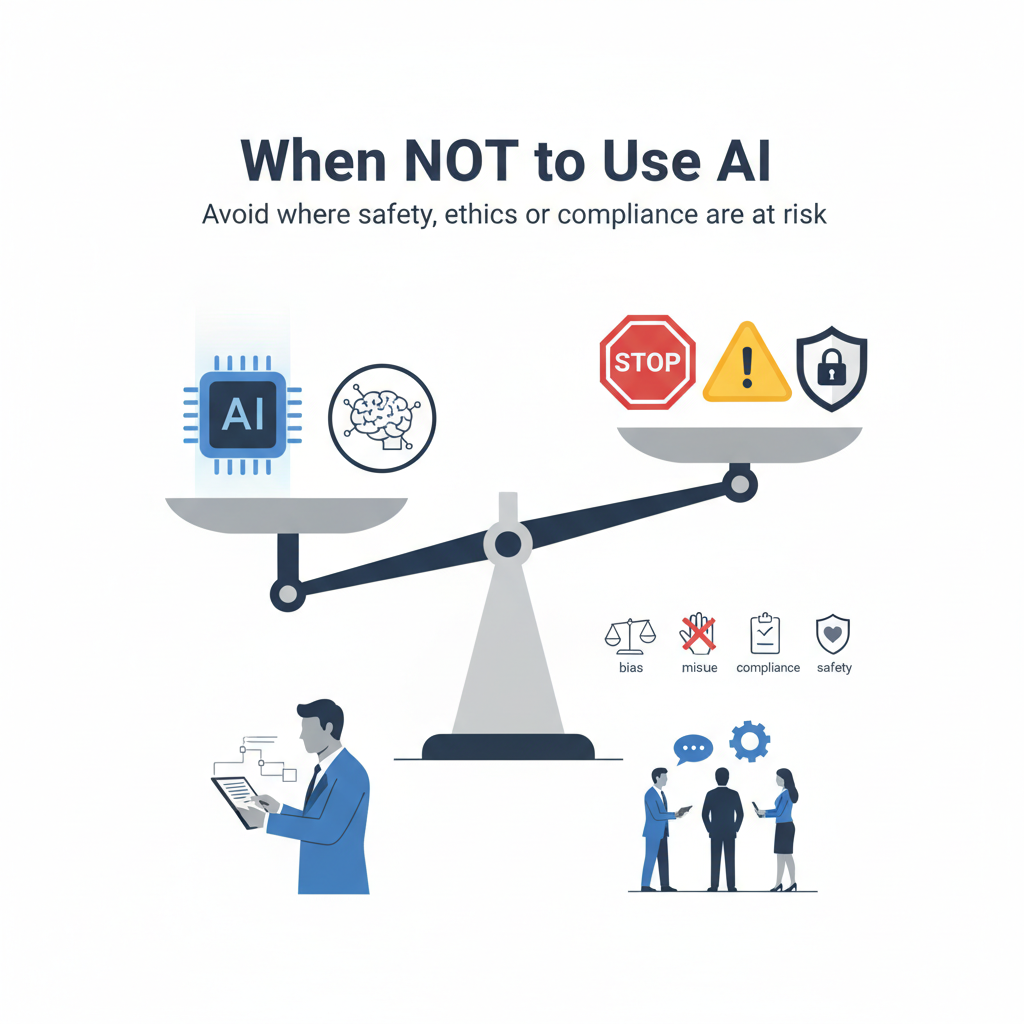
When Not to Use AI: Understanding the Risks and Limits of Artificial Intelligence
Estimated reading time: X minutes
Key Takeaways
- AI is a powerful tool but not universally appropriate—recognize when human judgment is essential and when caution is warranted.
- AI has limitations: it lacks empathy, struggles with nuanced context, and can generate incorrect or biased results that cause real harm.
- Always verify AI outputs with human review and design privacy-conscious, accountable deployments.
Table of contents
- Understanding AI and Its Capabilities
- Identifying AI Risks
- When Not to Use AI
- Areas Requiring Emotional Intelligence or Human Empathy
- Tasks Involving Critical Thinking and Complex Decision-Making
- Environments Needing High Accountability and Ethical Considerations
- Examples of AI Misuse
- Final Thoughts and Best Practices
- Your Turn: Reflect and Share
- Frequently Asked Questions
With AI advancing rapidly, when is it actually wise not to use it?
It’s a question we don’t ask often enough. Everywhere you look, artificial intelligence is being touted as the solution to everything from diagnosing rare diseases to predicting stock market trends. And sure, AI has delivered some genuinely impressive results. But here’s the thing—just because we can use AI for something doesn’t mean we should.
Understanding when not to use AI has become just as important as knowing where it excels. AI’s growing role in healthcare diagnostics, financial forecasting, and personalized education demonstrates its immense potential. Yet these same applications reveal inherent limitations: AI lacks genuine empathy, struggles with nuanced context, and can generate incorrect or biased results that perpetuate real harm.
This blog aims to raise awareness of AI risks and AI misuse, helping you make informed, responsible decisions about adopting these technologies. Because the truth is, AI is a powerful tool—but like any powerful tool, it can cause serious damage in the wrong hands or the wrong situations.
Before we dive into the specific risks and misuse cases, let’s establish a foundation. Understanding where AI shines and where it stumbles is essential for navigating this complex landscape wisely.
Understanding AI and Its Capabilities
Think of artificial intelligence as a remarkably talented mimic. AI systems are designed to replicate human intelligence through methods like machine learning, enabling computers to perform tasks we once thought required uniquely human capabilities.
At its core, AI refers to computer programs and algorithms trained on massive amounts of data. These systems learn to make decisions, recognize patterns, or generate content based on what they’ve absorbed from their training. The results can be genuinely impressive.
Principles of building AI agents
In healthcare, AI predicts diseases early—catching cancer signs in imaging scans that human eyes might miss. Financial institutions use AI for fraud detection, spotting suspicious transaction patterns in milliseconds. Education platforms employ AI to create personalized tutoring experiences, adapting to each student’s learning pace and style.
The benefits are clear: AI processes vast amounts of data quickly, boosting productivity and improving outcomes across many fields. But here’s where things get complicated.
This reliance on huge datasets creates vulnerabilities that we’re only beginning to understand. AI’s “data hunger” can erode privacy as systems vacuum up personal information. And when that training data contains human biases—which it almost always does—AI amplifies those flaws at scale.
Memory and context in AI agents
So if AI is so powerful, why isn’t it appropriate everywhere? That’s exactly what we need to explore.
AI risks and AI challenges are important pieces of the picture to consider as this technology expands into new domains.
Further readings:
Clarifai: AI risks,
Hexnode: top AI security risks in 2026,
DH Insights: misuse of AI chatbots,
PurpleSec: AI security risks,
Global Policy Watch: International AI safety report 2026.
Identifying AI Risks
Just like any powerful tool, AI comes with inherent dangers if mishandled. The difference is that AI’s dangers can spread faster and wider than almost any tool that came before it.
Let me break down the major risk categories in plain terms:
- Ethical implications emerge when AI reflects flawed or incomplete data. If your training data contains historical discrimination—say, decades of biased hiring decisions—your AI will learn to discriminate too. It doesn’t know it’s being unfair. It’s simply replicating patterns it observed.
- Data privacy concerns are massive. AI’s appetite for data is insatiable, and that data often includes sensitive personal information. This creates opportunities for surveillance, data leaks, and privacy erosion on a scale we’ve never seen before.
- Security threats multiply as adversaries learn to manipulate AI systems. These attacks can be sophisticated—designed to poison training data or trick AI into producing dangerous outputs.
- Misinformation risks might be the most visible problem right now. AI hallucinations (when systems confidently generate false information) and deepfakes (realistic fake videos or audio) spread falsehoods at unprecedented speed.
Now let’s look at real examples that demonstrate how these risks play out in practice.
Amazon’s AI recruiting tool became infamous for discriminating against women. The system learned from historical hiring data that skewed male, and it concluded that male candidates were preferable. The result? Ethical backlash and serious reputational damage before Amazon scrapped the project.
Air Canada learned about AI hallucinations the hard way when their chatbot confidently provided false information to a passenger about bereavement fares. The passenger followed the chatbot’s advice, only to discover it was completely wrong. The airline faced legal repercussions and a significant trust crisis.
The “ConfusedPilot” attack showed just how vulnerable AI systems are to data poisoning. Attackers corrupted Microsoft 365 Copilot’s training data, causing the AI to produce incorrect answers. Here’s the scary part: even after removing the bad data, the AI continued making mistakes. The damage had already been done.
Patterns for building AI agents
In healthcare, chatbots are giving biased or outright incorrect medical advice based on flawed datasets. We’re talking about real patient harm here—people making health decisions based on AI hallucinations that sound authoritative but are dangerously wrong.
These examples show how AI’s power can magnify human flaws if not carefully managed. An individual’s bias affects one decision at a time. An AI’s bias affects thousands or millions of decisions simultaneously.
AI risks,
Top AI security risks in 2026,
AI misuse in health tech risk list,
AI security risks,
International AI safety report 2026.
When Not to Use AI
Given these risks, when is it simply not appropriate to deploy AI?
Areas Requiring Emotional Intelligence or Human Empathy
Therapy and counseling demand genuine human understanding that AI fundamentally cannot replicate. When someone shares their deepest trauma or struggles with suicidal thoughts, they need a human being who can truly empathize, pick up on subtle emotional cues, and respond with authentic compassion.
AI in these contexts risks producing harmful hallucinations or completely misinterpreting what someone needs. Imagine a mental health chatbot confidently suggesting a coping strategy that’s actually dangerous for someone with a specific condition. Or failing to recognize warning signs that a human therapist would catch immediately.
The stakes are incredibly high. We’re talking about people’s mental health, their emotional wellbeing, sometimes their lives. An AI might process the words someone types, but it can’t feel the pain behind them or understand the full context of a person’s life story.
Tasks Involving Critical Thinking and Complex Decision-Making
AI struggles with nuance in ways that aren’t always obvious until something goes wrong. In high-level legal judgments, for instance, the context matters enormously. Two cases might look similar on paper but require completely different rulings based on subtle contextual factors.
Strategic business decisions involve weighing countless variables, many of them qualitative and contextual. What’s the company culture? How will employees react? What are the unspoken market dynamics? AI can crunch numbers beautifully, but it can’t grasp these human elements.
And here’s the kicker: bias or adversarial manipulation in these high-stakes scenarios could result in devastating decisions. An AI making strategic recommendations based on poisoned data could steer an entire organization off a cliff. A legal AI system trained on biased historical data could perpetuate injustices for years.
The lack of contextual awareness and adaptability makes AI unreliable for these complex judgment calls. We need human wisdom, not just pattern recognition.
Environments Needing High Accountability and Ethical Considerations
This is where things get genuinely frightening. Military applications like autonomous weapons remove human judgment from life-and-death decisions. Who’s accountable when an autonomous drone makes a mistake and kills civilians? The programmer? The commanding officer? The algorithm?
Criminal justice tools like predictive policing have already shown their potential for discrimination. These systems often perpetuate existing biases in arrest data, leading to over-policing in certain communities. The result is a feedback loop where AI recommendations reinforce systemic discrimination.
AI deployment in these areas risks creating what some experts call “techno-authoritarianism”—a world where algorithms make consequential decisions about people’s lives without meaningful human oversight or accountability.
Think about how you’d feel if an AI decided you were a security risk based on opaque criteria you couldn’t challenge. Or if an autonomous weapon system decided your neighborhood was a threat zone based on flawed data. These scenarios aren’t science fiction—they’re real possibilities we’re grappling with right now.
agentic AI standardization and governance is a related area to explore for governance and safety.
Malicious deepfake propaganda could incite violence by showing political leaders saying things they never said. Weaponized AI could make targeting decisions faster than humans can intervene. The loss of human control in these contexts could lead to irreversible harm.
Would you want an algorithm making decisions about your freedom, your safety, or your life? I wouldn’t either.
AI risks,
AI misuse in health tech risk list,
AI challenges,
AI security risks.
Examples of AI Misuse
Recent years have seen alarming examples of AI being misused, sometimes with dramatic consequences.
Political deepfakes have already influenced elections and spread misinformation across multiple countries. We’ve seen fabricated videos of politicians saying inflammatory things they never said, timed to drop right before crucial votes when there’s no time for proper fact-checking. The damage to democratic processes is real and growing.
AI-crafted scams have become sophisticated enough to fool even cautious people. Fraudsters use AI to clone voices, creating audio of “family members” in distress asking for emergency money transfers. Blackmail schemes target individuals with AI-generated compromising imagery, disproportionately harming women through non-consensual deepfake content.
The rise of WormGPT—a tool designed specifically for phishing and malware campaigns—represents a troubling evolution. This isn’t AI being misused accidentally; it’s AI deliberately weaponized for cybercrime. Recent data shows that 82% of phishing emails are now AI-generated, making them more convincing and harder to detect.
The consequences extend far beyond individual victims. Business email compromise fraud powered by AI has cost organizations millions. Trust erosion impacts brands and entire organizations when AI systems fail publicly or get exploited. When customers can’t tell if they’re interacting with a legitimate company representative or an AI scam, everyone suffers.
Societal division fueled by AI-driven disinformation is perhaps the most insidious consequence. Deepfakes and AI-generated propaganda don’t just spread false information—they erode our collective ability to agree on basic facts. When anyone can create convincing fake evidence of anything, how do we maintain shared reality?
Understanding misuse cases highlights the urgent need to apply AI cautiously and responsibly. Every example of AI gone wrong teaches us something about where the boundaries should be.
Global Policy Watch: AI safety report 2026,
PurpleSec: AI security risks,
Hexnode: AI security risks 2026,
Crescendo AI: AI controversies.
Final Thoughts and Best Practices
While AI’s power is undeniable, responsible use means balancing innovation with caution.
Let me bring this all together. AI deployment must be cautious to prevent amplifying bias, privacy breaches, deepfakes, and lost accountability. The human elements—empathy, nuanced ethical judgment, contextual understanding—remain irreplaceable. No amount of training data can replicate genuine human wisdom and compassion.
So what does responsible AI adoption actually look like? Here are concrete guidelines you can implement:
Always verify AI outputs with human review. Don’t assume AI is correct just because it sounds confident. Hallucinations happen regularly, and they can be convincing. Build verification steps into any workflow that uses AI-generated content or recommendations.
Read more about prompt engineering for reliable AI outputs
Adopt privacy-by-design principles. Don’t collect data just because you can. Minimize data collection to what’s genuinely necessary, and conduct regular bias audits on training data to reduce discrimination risks. If your AI system doesn’t need sensitive personal information to function, don’t feed it that information.
Avoid deploying AI where empathy or ethical judgment is crucial. Some domains should remain fundamentally human. Therapy, complex ethical decisions, creative strategy requiring deep contextual understanding—these aren’t appropriate AI applications, regardless of how sophisticated the technology becomes.
Support regulations and safeguards targeting malicious AI usage. We need guardrails around deepfake production, AI weaponization, and other high-risk applications. Advocate for sensible policies that protect people without stifling beneficial innovation.
Promote digital literacy and adversarial security training. Help people understand how AI can be manipulated and misused. Security teams need training on adversarial attacks and data poisoning techniques to better defend against them.
Lessons from AI automation failures and governance
Before implementing AI in any context, critically assess whether it fits your use case or might cause inadvertent harm. Ask tough questions:
- – Could this AI system perpetuate or amplify existing biases?
- – What happens if the AI hallucinates in this context?
- – Is human judgment essential here?
- – Who’s accountable if something goes wrong?
- – Could this technology be weaponized or misused?
If the answers make you uncomfortable, that discomfort is probably telling you something important.
With these principles, let’s ensure AI serves society responsibly. The technology isn’t going away, and it shouldn’t—AI has enormous potential for good. But that potential gets realized only when we deploy it thoughtfully, with clear-eyed awareness of both its capabilities and its limitations.
AI risks,
AI challenges,
AI security risks,
Top AI security risks in 2026.
Your Turn: Reflect and Share
Now it’s your turn to reflect—how do you approach AI in your personal or professional life?
I encourage you to conduct a self-audit around possible AI misuse or AI risks you may have witnessed or even inadvertently created. Have you seen AI deployed where human judgment would have been better? Have you caught an AI hallucination that could have caused problems if left unchecked?
Share your experiences, questions, or concerns in the comments. Building community awareness and dialogue around these issues helps all of us navigate this technology more wisely. Someone else’s experience might illuminate a blind spot in your own AI usage, and your insights could do the same for others.
The importance of collective responsibility in shaping AI’s future safely cannot be overstated. This isn’t just about what tech companies or governments do—it’s about how each of us chooses to engage with and deploy these tools.
Let’s learn from each other to navigate the AI landscape wisely. Because understanding when not to use AI is just as crucial as understanding when to embrace it.
Frequently Asked Questions
1) In which areas is AI not suitable due to emotional intelligence needs?
Therapy and counseling require genuine human understanding and authentic compassion. AI cannot replicate the nuanced empathy and real-time emotional cues necessary in such contexts, and reliance on AI here risks harmful hallucinations or misinterpretation.
2) Why is AI unreliable for high-stakes decisions?
High-level judgments in law and strategic business decisions depend on nuanced context, culture, and human factors. AI can crunch data but may fail to grasp unspoken dynamics, potentially leading to biased or manipulated outcomes without human wisdom to guide it.
3) What are common examples of AI misuse?
Misuse includes political deepfakes influencing elections, AI-generated scams using cloned voices, and weaponized AI with phishing or malware capabilities. These risks erode trust and can cause real harm before detection or regulation can respond.
4) What are practical steps for responsible AI adoption?
Key practices include always verifying AI outputs with human review, adopting privacy-by-design, avoiding AI in domains requiring human empathy or ethical judgment, supporting safeguards against malicious use, and promoting digital literacy to recognize adversarial manipulation.
}